How Far Away Is Pluto?
Pluto remains one of the most intriguing bodies in our solar system, not only due to its distant location but also because of its unique orbital characteristics and captivating mysteries. Once hailed as the ninth planet, Pluto’s legacy persists as both a scientific curiosity and a symbol of our rapidly evolving understanding of planetary science. This article will walk through the precise distance from Earth to Pluto, continue with Pluto’s orbit and the fascinating variations therein, unravel its size and composition, and answer popular questions about this icy world at the edge of our solar system.
Pluto’s Changing Distance: Measuring the Edge
The solar system’s planets, including Pluto, travel in elliptical orbits rather than perfect circles. This means the distance between Earth and Pluto constantly shifts as both move through their respective orbits around the Sun. At its closest approach (opposition), Earth and Pluto draw together to within 2.66 billion miles (4.28 billion kilometers). At its most distant point, when the two are on opposite sides of the Sun, the distance swells to about 4.67 billion miles (7.5 billion kilometers).
- Closest distance: 2.66 billion miles (4.28 billion km)
- Farthest distance: 4.67 billion miles (7.5 billion km)
- Average distance: Roughly 3.7 billion miles (5.9 billion km)
To put this in perspective, light from the Sun takes about 5.5 hours to reach Pluto at an average orbital distance of 39.5 AU (astronomical units).
The Eccentric Orbit of Pluto
Pluto’s orbit is far from ordinary. While most planets in our solar system travel on relatively flat, circular paths, Pluto’s is both highly inclined and eccentric. At times, Pluto’s tilted elliptical path even brings it closer to the Sun than Neptune—a feat possible due to a stable orbital resonance that keeps the two from colliding.
- Orbital range: 30–49 astronomical units (AU) from the Sun (4.5–7.3 billion km or 2.8–4.6 billion miles)
- Orbital Period: About 248 Earth years to complete one full trip around the Sun
- Inclination: Pluto’s orbit is tilted by 17° compared to Earth’s orbital plane
This combination of distance, eccentricity, and inclination accounts for the remarkable variability in Pluto’s position and interactions with other celestial bodies.
Pluto’s Status: From Planet to Dwarf Planet
For over 75 years, Pluto held the title of the solar system’s most distant planet. However, in 2006, the International Astronomical Union (IAU) redefined what constitutes a planet and Pluto was reclassified as a dwarf planet. Though small compared to its planetary neighbors, Pluto has held onto its spot as a prominent object in the Kuiper Belt—a region of icy bodies beyond Neptune.
- Pluto’s designation: Dwarf planet, Kuiper Belt object
- Kuiper Belt: A ring of icy bodies that extends far beyond Neptune
- Pluto’s minor-planet designation: 134340 Pluto
Size and Mass: Pluto’s Physical Characteristics
Despite its aura of cosmic mystery, Pluto is modest in size. Measurements from the New Horizons spacecraft have provided the most accurate values to date, settling long-standing debates regarding its diameter and volume.
| Aspect | Pluto | Earth’s Moon | Earth |
|---|---|---|---|
| Diameter | 2,376.6 km (1,473 miles) | 3,474 km | 12,742 km |
| Mass | 1.303 × 10²² kg | 7.35 × 10²² kg | 5.97 × 1024 kg |
| Surface Area | 17,744,430 km2 | 37,940,000 km2 | 510,072,000 km2 |
| Surface Gravity | 0.063 g | 0.17 g | 1 g |
| Escape Velocity | 4,363.2 km/h (2,711.2 mph) | 8,568 km/h (5,322 mph) | 40,270 km/h (25,020 mph) |
Pluto’s circumference at the equator is about 4,627 miles (7,445 km)—just slightly less than the distance from Denver to London. Scientific evidence also suggests that Pluto has a rocky core overlain by ice, causing noticeable changes in its surface features as sunlight-driven temperature variations occur.
Comparing Dwarf Planets: Pluto vs. Eris
Pluto and Eris are the largest known objects in the solar system beyond Neptune. For years, the debate raged regarding which was bigger. New Horizons settled this, demonstrating Pluto’s diameter is slightly larger than Eris’s 2,326 km (1,445 miles). Despite its larger size, Pluto is less massive due to its lower density.
Atmosphere and Climate: Pluto’s Fragile Envelope
Pluto possesses a tenuous, dynamic atmosphere, primarily composed of nitrogen with traces of methane and carbon monoxide. Its atmospheric behaviors are dramatic, influenced heavily by Pluto’s elongated orbit and variable proximity to the Sun.
- Atmospheric composition: Mostly nitrogen, with methane and carbon monoxide
- Atmospheric extension: Can reach as far as 6,456 miles (10,390 km) into space—about 4.5 times Pluto’s diameter
- Interaction with moons: Escaping molecules may deposit on Charon, Pluto’s largest moon
Scientific models estimate the escape rate and structure form a delicate balance. Seasonal changes cause Pluto’s icy surface to evaporate, expanding the atmosphere outward, which can even extend more than halfway to Charon. When further from the Sun, low temperatures may cause the atmosphere to freeze out onto the surface.
Pluto’s Family: Moons and Their Dynamic Relationship
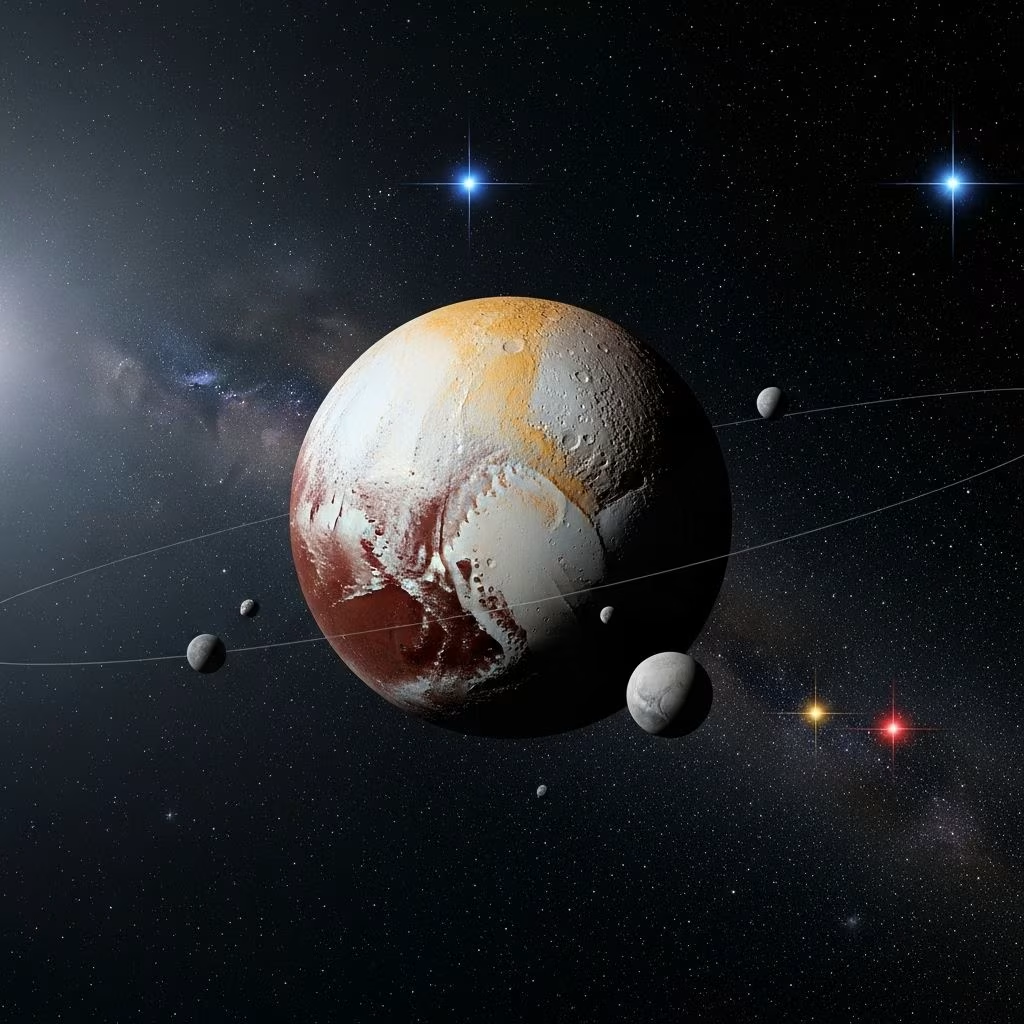
Pluto’s gravitational influence has allowed it to retain five known moons, all discovered in the last forty years. The largest, Charon, is remarkable for its size—over half Pluto’s own diameter—creating a binary system in which both bodies are tidally locked and orbit a barycenter outside either world. The four smaller moons are Styx, Nix, Kerberos, and Hydra.
- Charon: Largest moon; tidal locking with Pluto forms a binary system
- Styx, Nix, Kerberos, Hydra: Much smaller, irregularly shaped moons
- Interactions: Shared atmospheric molecules, orbital resonance, and stable patterns due to tidal forces
New Horizons and the Study of Pluto
NASA’s New Horizons spacecraft revolutionized our understanding of Pluto after its historic flyby in July 2015. The mission provided high-resolution images, precise size measurements, and detailed data about Pluto’s atmosphere and surface.
- Major milestones: First close-up images of Pluto and Charon
- Confirmed Pluto’s diameter: 2,376.6 km
- Unraveled surface features: Demonstrated active geology, such as glacial and cryovolcanic processes
- Atmospheric insights: Traced seasonal changes and escape rates
New Horizons’ observations continue to inform models of Pluto’s atmosphere and its interaction with Charon, as well as refine our knowledge of the wider Kuiper Belt.
Pluto’s Orbit: Stability and Chaos in the Kuiper Belt
Pluto’s orbit may seem precarious, but computer models show it skirts a chaotic path while remaining stable over millions of years. This stability arises due to resonant relationships with Neptune, which ensure Pluto never collides with its neighbor, despite their paths crossing in projection.
- Orbital resonance: 2:3 ratio with Neptune (for every two Pluto orbits, Neptune completes three)
- Period of close approach: Pluto occasionally crosses Neptune’s orbit, but never comes dangerously close due to gravitational locks
This delicate gravitational balancing act highlights the dynamism of celestial mechanics in the outer solar system.
Frequently Asked Questions About Pluto
Q: Why does Pluto’s distance from Earth change so much?
A: Both Earth and Pluto move in elliptical orbits, causing their mutual distance to vary from about 2.66 billion miles at their closest to 4.67 billion miles at their farthest.
Q: How long does it take to travel to Pluto?
A: The New Horizons spacecraft, launched by NASA, traveled approximately 3 billion miles in 9.5 years, arriving near Pluto in July 2015.
Q: Can Pluto’s atmosphere reach its moons?
A: Yes. Scientific modeling suggests Pluto’s atmosphere can extend so far that some molecules escape and may land on Charon, its largest moon.
Q: How does sunlight affect Pluto?
A: Sunlight at Pluto takes about 5.5 hours to arrive and is very faint, which influences atmospheric freeze-out and the dynamics of Pluto’s surface ice.
Q: Why was Pluto reclassified as a dwarf planet?
A: Pluto was downgraded due to the 2006 IAU definition, which requires a planet to clear its neighborhood of other objects. Pluto shares its region with many other Kuiper Belt objects, unlike the main planets.
Summary Table: Pluto’s Quick Facts
| Pluto Fact | Details |
|---|---|
| Closest Distance to Earth | 2.66 billion miles |
| Farthest Distance from Earth | 4.67 billion miles |
| Orbital Period | 248 Earth years |
| Average Sunlight Travel Time | About 5.5 hours |
| Diameter | 2,376.6 km |
| Atmosphere | Nitrogen, methane, carbon monoxide |
| Number of Moons | 5 (Charon, Styx, Nix, Kerberos, Hydra) |
| Classification | Dwarf Planet, Kuiper Belt Object |
Conclusion: Pluto’s Enduring Fascination
Despite being demoted from its planetary status, Pluto remains a beacon of discovery at the frontier of our solar system. Its shifting distance, unusual orbit, fascinating binary relationship with Charon, and intricate atmospheric processes make it an object of continuous scientific investigation. As technology advances, our knowledge of Pluto and the Kuiper Belt will only deepen, further illuminating the complexities of our cosmic neighborhood.
References
- https://www.space.com/18628-pluto-atomosphere-larger.html
- https://www.space.com/18566-pluto-distance.html
- https://en.wikipedia.org/wiki/Pluto
- https://www.space.com/18568-how-big-is-pluto.html
- https://www.space.com/pluto-orbit-influences-from-giant-planets
- https://www.space.com/43-pluto-the-ninth-planet-that-was-a-dwarf.html
- https://www.space.com/why-pluto-is-not-a-planet.html
- https://www.space.com/31100-most-distant-dwarf-planet-found.html
- https://www.space.com/pluto-problem-time-to-rethink-definition-of-a-planet
- https://www.space.com/9594-fighting-pluto-planet-title-planetary-scientist-alan-stern.html