The Star of Bethlehem: A Celestial Mystery
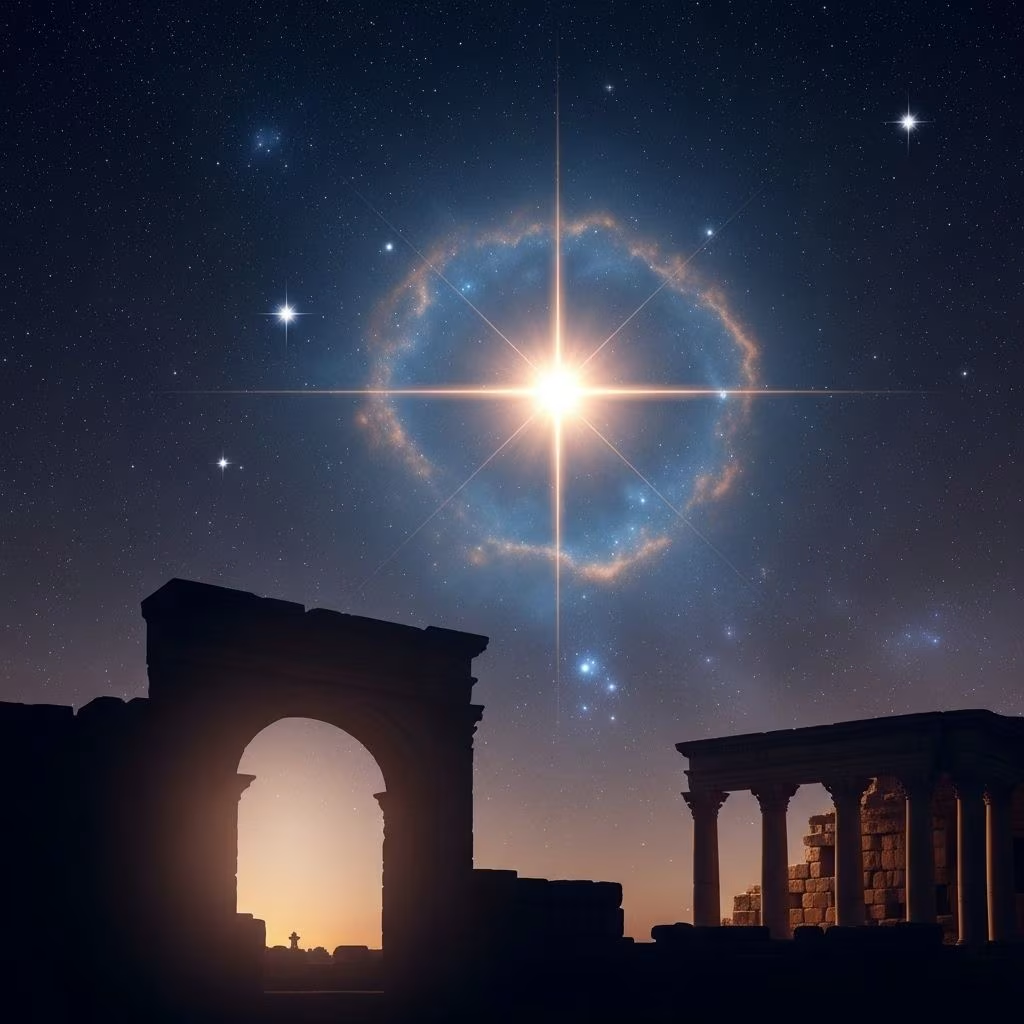
For centuries, the Star of Bethlehem—also known as the Christmas Star—has fascinated astronomers, historians, and theologians alike. Described in the Gospel of Matthew, the appearance of this radiant star led the Wise Men, or Magi, on a journey to locate the newborn Jesus. Was the Star of Bethlehem a real astronomical event, a miraculous sign, or simply a symbolic narrative? This article explores ancient records, modern scientific proposals, and the lasting religious impact of this enigmatic star.
Biblical Accounts of the Star of Bethlehem
The primary source for the Star of Bethlehem is the Gospel of Matthew (Matthew 2:1-12). According to the narrative, “wise men from the East” (often called the Magi) observed ‘his star’ rising and followed it to Jerusalem in search of the newborn “King of the Jews.” Their inquiry prompted King Herod to consult Jewish priests and scribes, leading to the prophecy that the Messiah would be born in Bethlehem. As the Magi set out, the star “went ahead of them and stopped over the place where the child was,” prompting their adoration and the presentation of gifts: gold, frankincense, and myrrh.
Key features from the biblical description include:
- The star signified a birth and was associated with kingship and the Jewish nation.
- It appeared in the East and had not been previously noticed by locals, including King Herod.
- The star appeared at an exact time and persisted over time, eventually “stopping” over Bethlehem.
- The Magi’s journey and gifts are central to Christian tradition and the celebration of Epiphany (January 6).
Historical and Cultural Context
Ancient sources and church traditions generally indicate the Magi’s visit occurred some time after Jesus’ birth, not at the exact moment of nativity. The Gospel uses the Greek word paidíon (meaning “child” or “infant”), suggesting the event may have taken place when Jesus was no longer a newborn.
Early theologians often saw the Star as a miraculous sign from God, possibly fulfilling ancient prophecies such as the “Star Prophecy” from the Book of Numbers 24:17: “A star shall come out of Jacob, and a scepter shall rise out of Israel.” For centuries, the story has been retold in art, music, and the liturgy, reinforcing its spiritual significance regardless of its literal historicity.
Science and the Star: Theories and Evidence
Astronomers and historians have sought explanations for the Star of Bethlehem using the tools of science and analysis of ancient records. These investigations often address three main questions:
- Could the Star have been an identifiable astronomical phenomenon?
- What celestial events would have been visible from the Middle East around 7–2 BCE, the commonly proposed time for Jesus’ birth?
- Does the biblical account align with any historical records or observable astronomical events?
Some phenomena ruled out by scientific scrutiny include:
- Meteors: Too fleeting to be tracked over weeks.
- Supernovae: No recorded supernova or corresponding remnants match the timing or visibility described in ancient records.
Major Astronomical Theories
Below are the leading scientific proposals, each with their own strengths and shortcomings.
1. Planetary Conjunctions
- Jupiter and Saturn Conjunction (7 BC): A triple conjunction occurred when Jupiter and Saturn appeared close together in the sky three times over several months. Although they never merged into a single point of light, such an event could have held great astrological significance for ancient viewers.
- Jupiter, Regulus, and Venus (3–2 BC): Attorney Frederick Larson, using historical and astronomical analysis, proposes that a sequence of rare alignments—including a triple conjunction of Jupiter (“king planet”) and Regulus (“king star”), followed by a close alignment of Jupiter and Venus—may have created a dramatic, meaningful display.
- Jupiter’s Stationary Point: Jupiter’s apparent halting (stationary point) in the sky—a result of its retrograde motion—might have been perceived as “standing over” Bethlehem. However, this type of phenomenon is not rare, occurring annually.
Table: Major Proposed Conjunctions
| Year | Planets/Stars Involved | Description |
|---|---|---|
| 7 BC | Jupiter & Saturn | Triple conjunction in Pisces, potentially significant to astrologers. |
| 3 BC | Jupiter & Regulus | Jupiter repeatedly passed Regulus, the “king star.” |
| 2 BC | Jupiter & Venus | Very close conjunction, appearing as a bright, single beacon. |
2. Comet Hypothesis
- Some scholars suggest a comet as the Star. Chinese astronomical records document a bright comet visible for more than 70 days in 5 BC. This could correlate with the biblical description of an enduring, notable star.
- Comets were often viewed as portents of significant change or the birth of a great ruler in ancient cultures, supporting the symbolic weight of Matthew’s narrative. However, comets were just as often seen as omens of doom.
3. Nova or Supernova
- The idea that the Magi saw an exploding star (nova or supernova) is centuries old. Yet there is no direct historical record or remnant that aligns with the likely time frame of Jesus’ birth.
- Chinese sources reported a nova in 4 BC, but its brightness and location are uncertain, and it is not widely accepted as the Star.
4. Astrological Interpretations
- Some interpretations view the Star as an astrological rather than an astronomical event—signs interpreted by adept astrologers (such as the Magi) as signaling a royal birth in Judea.
- Ancient astrologers attached great significance to planetary configurations, especially those involving Jupiter, Venus, and major constellations.
Religious Interpretations and Cultural Legacy
To many Christians, the Star of Bethlehem is primarily a miraculous sign. Its theological value often outweighs the need for historical or scientific validation. The event is considered by many to fulfill ancient prophecies and to demonstrate divine intervention in the birth of Jesus.
Others, including some modern scholars, suggest the story may be a later literary addition meant to reinforce the messianic credentials of Jesus, linking his birth with notable cosmic phenomena in the eyes of contemporary readers.
Despite debate, the journey of the Magi, guided by a mysterious star, remains central to the Christian celebration of Epiphany and is a frequent subject in Christmas art, pageants, and planetarium shows worldwide.
Modern Fascination and the Star’s Legacy
The Star of Bethlehem captivates not only the faithful, but also scientists, historians, and skywatchers of all backgrounds. Each Christmas season, planetariums revisit the astronomical possibilities, and new theories periodically arise as our understanding of ancient records—and of celestial mechanics—improves.
Its enduring appeal lies in its intersection of faith, history, and cosmic wonder, inviting ongoing exploration and interpretation.
Frequently Asked Questions (FAQs)
Q: Was the Star of Bethlehem a real astronomical event?
Many scholars and astronomers have proposed real celestial events, such as planetary conjunctions or a comet, as explanations. However, there is no consensus, and some maintain that the Star was a miraculous or symbolic element of the nativity story.
Q: What were the possible astronomical events at the time of Jesus’ birth?
Candidates include a series of conjunctions between Jupiter and Saturn in 7 BC, conjunctions of Jupiter, Venus, and Regulus in 3–2 BC, and a notable comet recorded by Chinese astronomers in 5 BC.
Q: Did the Star of Bethlehem fulfill any biblical prophecies?
Some theologians connect it to the “Star Prophecy” in Numbers 24:17, and see the star as divinely ordained evidence confirming Jesus’ messianic role.
Q: How do planetariums explain the Star of Bethlehem?
During the Christmas season, planetariums often explore historical sky simulations, showing conjunctions and comets as plausible candidates, while also explaining the biblical narrative and its significance.
Q: Why does the story remain so popular?
The enduring fascination comes from the combination of spiritual significance, cosmic mystery, and the opportunity for scientific investigation—making the Star of Bethlehem one of the world’s most intriguing and beloved astronomical puzzles.
References
- https://www.astronomy.com/science/the-star-of-bethlehem-can-science-explain-what-it-was/
- https://en.wikipedia.org/wiki/Star_of_Bethlehem
- https://www.asa3.org/ASA/topics/Astronomy-Cosmology/S&CB%2010-93Humphreys.html
- https://www.rmg.co.uk/stories/space-astronomy/what-was-christmas-star
- https://www.space.com/star-of-bethlehem
- https://www.biblicalarchaeology.org/daily/what-was-the-star-of-bethlehem/
- https://www.youtube.com/watch?v=ozxqp0B1npU