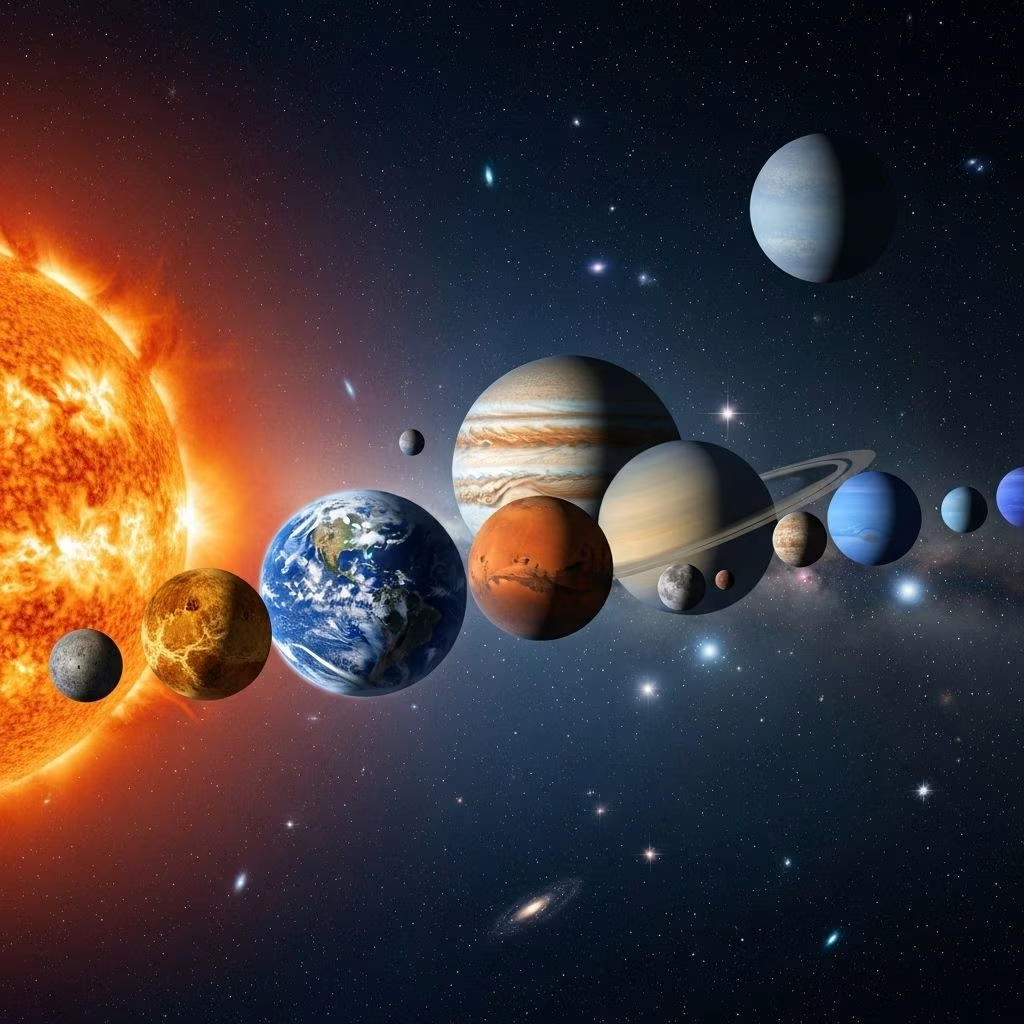
Join us for a sweeping journey through the solar system, venturing from the blazing heart of the Sun out past mysterious dwarf planets. Meet each planet and notable moon, learn about their environments, and uncover surprising discoveries that reveal the complexity, beauty, and ongoing mysteries of our cosmic neighborhood.
The Sun: Lifegiver and Engine of the Solar System
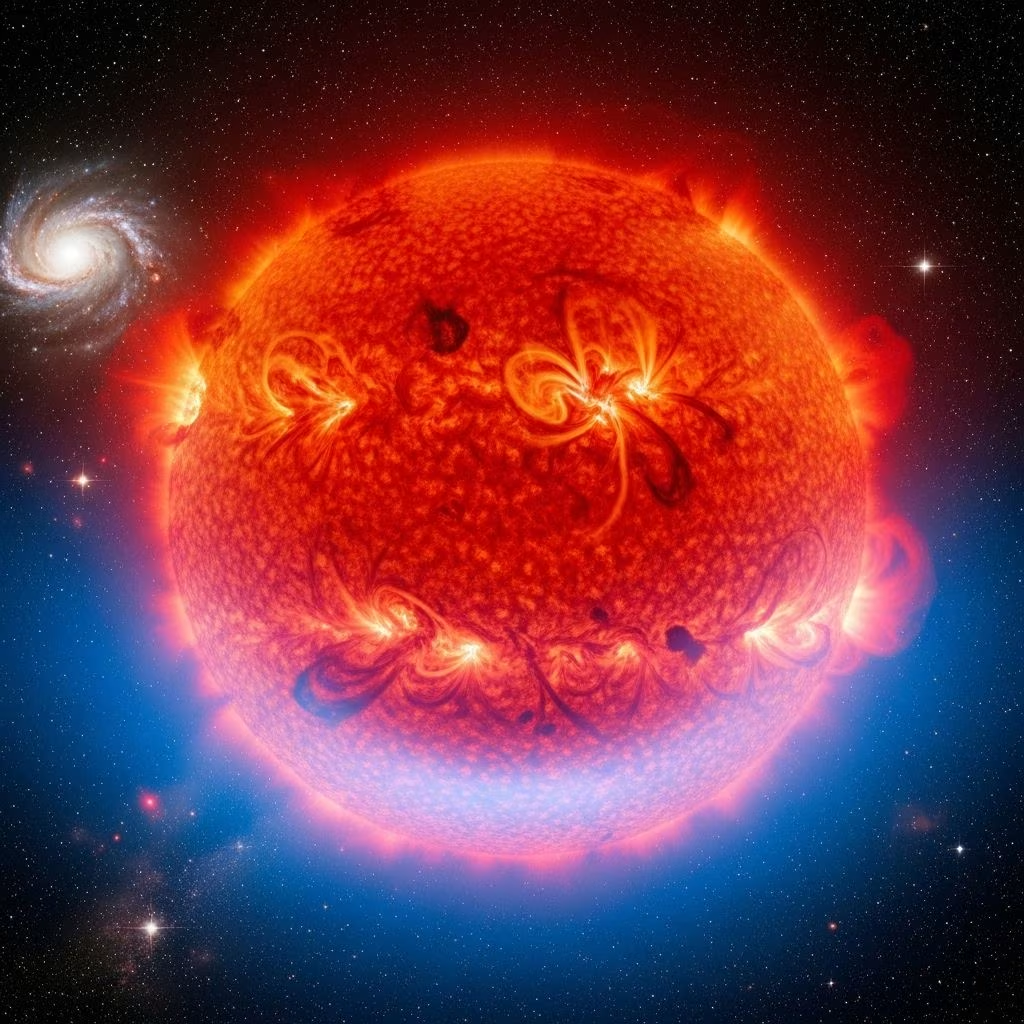
The solar system’s story begins with the Sun, a colossal sphere of plasma over 100 times wider than Earth. Containing more than 99% of the solar system’s mass, the Sun’s gravity keeps the planets locked in their orbits while its energy sustains life on our planet.
- Composition: 72% hydrogen, 26% helium, with traces of heavier elements.
- Surface temperature: Approximately 5,500°C (9,932°F); core temperatures reach about 15 million°C (27 million°F).
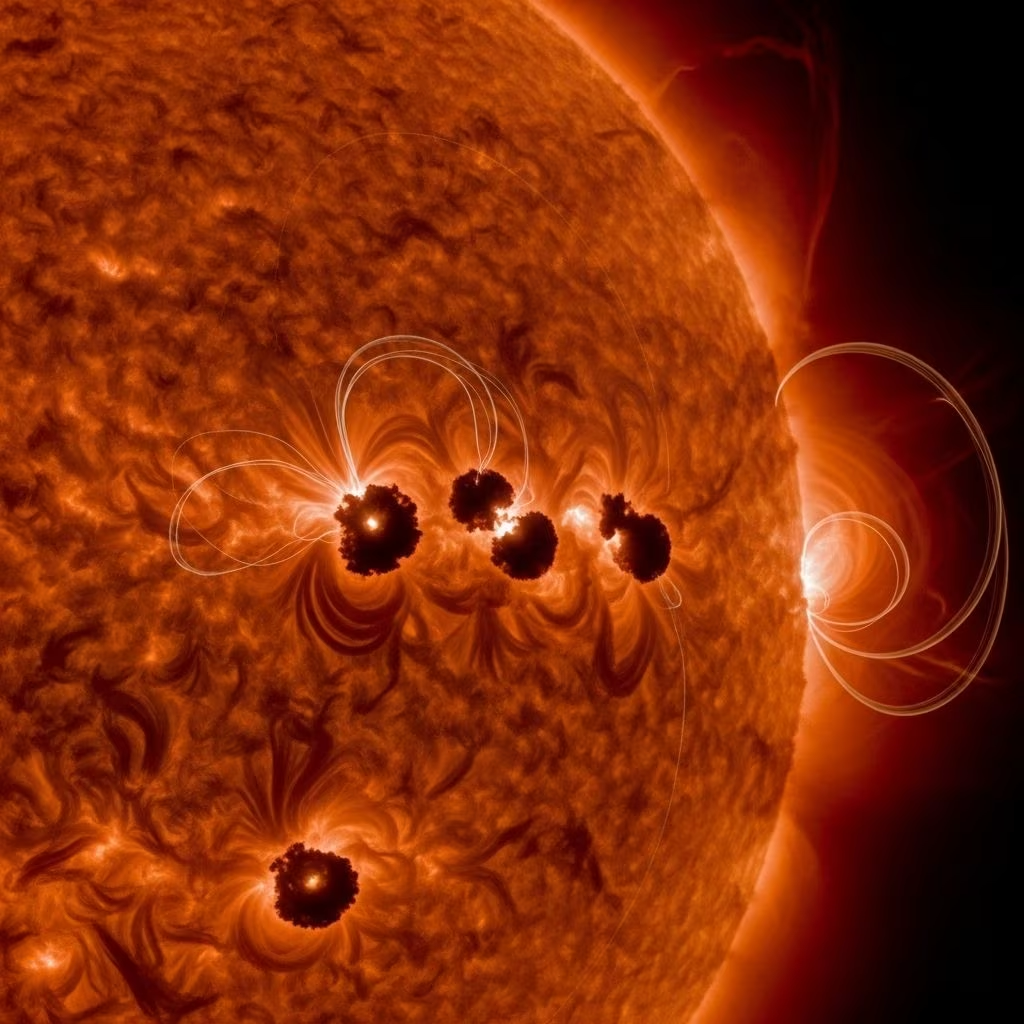
- Solar phenomena: Solar flares, sunspots, and the solar wind shape space weather and affect planetary atmospheres throughout the solar system.
- Fun fact: Light from the Sun takes about 8 minutes and 20 seconds to reach Earth.
Mercury: The Sun’s Scorched Messenger
Closest to the Sun, Mercury is a small, rocky world only slightly larger than Earth’s Moon. With barely any atmosphere to moderate temperatures, Mercury’s surface bakes under the Sun’s glare by day and freezes at night.
- Surface features: Heavily cratered, with ancient impact basins and long ridges called “lobate scarps.”
- Day length: A single day on Mercury (sunrise to sunrise) lasts about 176 Earth days.
- Temperatures: Swings between 430°C (800°F) in sunlight and -180°C (-290°F) at night.
- Number of moons: Zero. Mercury’s proximity to the Sun makes it nearly impossible to retain satellites.
Venus: Earth’s Toxic Twin
Venus appears as Earth’s sister in size, but that’s where the similarities end. Shrouded in thick clouds of toxic sulfuric acid, Venus has a crushing atmosphere—over 90 times Earth’s pressure.
- Surface temperature: Over 460°C (860°F)—hot enough to melt lead.
- Atmosphere: 96% carbon dioxide, with perpetually cloudy, corrosive skies.
- Striking features: Vast volcanic plains, giant mountains, and pancake-shaped volcanic domes.
- Moons: None. Like Mercury, Venus is moonless—the reasons for this puzzle scientists.
Earth: Our Unique Oasis
Earth stands out as the only known planet to harbor life. Its balanced atmosphere, liquid water, and protective magnetic field create conditions for a bewildering diversity of organisms.
- Atmosphere: 78% nitrogen, 21% oxygen, trace gases.
- Surface: 70% covered by oceans of water; varied continents and climates.
- Life: Only planet in the universe known to support abundant, complex life forms.
- The Moon: Earth’s sole natural satellite, formed from a colossal ancient impact. It stabilizes Earth’s tilt and tides and is unusually large relative to its planet.
- Fun fact: The Moon is slowly drifting away from Earth, by around 3.8 centimeters each year.
Mars: The Red Planet
Mars, the famed Red Planet, gets its color from rust-like iron oxide dust. Frequent dust storms sweep over towering volcanoes, deep canyons, and polar ice caps. Mars’ thin atmosphere and colder temperatures make it a target for future human exploration.
- Notable features: Olympus Mons (largest volcano in the solar system), Valles Marineris (giant canyon system), and polar caps composed of water and carbon dioxide ice.
- Moons: Two small, irregularly shaped moons—Phobos and Deimos. They may be captured asteroids.
- Atmosphere: Very thin, mostly carbon dioxide.
The Asteroid Belt: A Rocky Frontier
Between Mars and Jupiter lies the asteroid belt, a region filled with countless rocky fragments—ranging from tiny pebbles to dwarf planets. The belt contains Ceres, the largest object in the region and the first dwarf planet discovered.
- Composition: Silicate rock, metal, and carbon-rich materials.
- Dwarf planet: Ceres, which exhibits evidence of water-ice beneath its surface.
- Other bodies: Includes notable asteroids such as Vesta and Pallas.
Jupiter: King of the Planets
Jupiter is a colossal gas giant, more massive than all other planets combined. Famous for its colorful cloud bands, the Great Red Spot, and powerful storms, Jupiter guards the gateway to the outer solar system.
- Atmosphere: Mostly hydrogen and helium, with bands created by high-speed winds.
- The Great Red Spot: A persistent, planet-sized storm estimated to be over 350 years old.
- Number of moons: Over 95 confirmed; four major Galilean moons stand out as worlds in their own right.
- Magnetic field: The strongest of any planet, generating intense auroras at its poles.
The Galilean Moons of Jupiter
- Io: The most volcanically active world in the solar system; surface coated in sulfur, reshaped by powerful volcanoes every year.
- Europa: Icy surface likely hiding a subsurface saltwater ocean; a key target in the search for extraterrestrial life.
- Ganymede: The largest moon in the solar system and the only moon with its own magnetic field; may also possess an internal ocean.
- Callisto: Heavily cratered, ancient surface, and possibly a less active ocean world.
Saturn: The Ringed Wonder
Saturn is instantly recognizable by its brilliant rings—the most extensive and complex in the solar system. Like Jupiter, Saturn is a giant ball of hydrogen and helium, but is less dense (it would float in water!) and spins rapidly, causing its shape to bulge at the equator.
- Rings: Composed of countless icy particles; extend up to 282,000 km from the planet.
- Moons: The most of any planet, with 274 confirmed as of March 2025. Saturn’s major moons include Titan, Rhea, Iapetus, Dione, Tethys, Enceladus, and Mimas.
- Atmospheric features: Giant hexagonal storm at the north pole, rapid winds, and ammonia clouds.
Saturn’s Marvelous Moons
- Titan: Larger than Mercury, with a thick orange hazy atmosphere; rivers and lakes of liquid methane and ethane. Titan is a world with weather and possibly even prebiotic chemistry.
- Enceladus: Icy, with geysers erupting from a subsurface ocean, hinting at potential habitability.
- Other notable moons: Rhea (heavily cratered), Mimas (the “Death Star” moon), Iapetus (two-toned appearance), Dione, and Tethys.
Uranus: The Tilted Ice Giant
Uranus is an icy giant, pale blue-green in color due to methane in its upper atmosphere. What makes Uranus unique is its extreme tilt—rotating on its side, possibly the result of a major collision long ago. This causes dramatic seasonal changes, with each pole experiencing 42 years of sunlight followed by 42 years of darkness.
- Atmosphere: Hydrogen, helium, and methane.
- Rings: Faint, narrow, and dark, discovered in 1977.
- Moons: 28 confirmed as of 2025, with Miranda, Ariel, Umbriel, Titania, and Oberon being the largest.
Neptune: The Windy Blue World
Neptune, the farthest known planet, is a deep blue ice giant with the most rapid winds in the solar system—up to 2,000 km/h (1,243 mph). Neptune was the first planet discovered via mathematical prediction, due to its effect on Uranus’ orbit.
- Atmosphere: Hydrogen, helium, and methane.
- Great Dark Spot: A giant storm system similar to Jupiter’s, visible during Voyager 2’s flyby in 1989.
- Moons: 16 confirmed as of 2025. The largest, Triton, is unique in orbiting Neptune backwards (retrograde motion), suggesting it was captured from the Kuiper Belt.
Neptune’s Notable Moons
- Triton: Geologically active, with nitrogen geysers spurting into space. The only large moon in the solar system to orbit in the opposite direction of its planet’s rotation. Triton is considered a captured dwarf planet from the outer reaches of the solar system.
- Other moons: Smaller and irregularly shaped; Proteus and Nereid are the largest after Triton.
The Realm of Dwarf Planets: Pluto and Beyond
Beyond Neptune lies a region packed with icy remnants from the solar system’s formation, including Pluto and other dwarf planets like Eris, Haumea, and Makemake. These distant worlds are rich in mystery and variety.
- Pluto: Once considered the ninth planet, now classified as a dwarf planet. Features a heart-shaped basin called Tombaugh Regio and large mountains of water-ice. Its thin atmosphere occasionally thickens when closest to the Sun.
- Pluto’s moons: Five confirmed. Charon is the largest, more than half Pluto’s diameter, and the two bodies are tidally locked, always showing the same face to each other. The others are Styx, Nix, Kerberos, and Hydra.
- Haumea: Notable for its elongated, spinning shape and faint rings. Moons: Hi’iaka and Namaka.
- Makemake: Has one known moon (MK2).
- Eris: Larger than Pluto but more distant. Has one known moon, Dysnomia.
Natural Satellites: A Solar System Teeming with Moons
Moons come in all shapes and sizes, ranging from giant planet-like bodies to tiny captured asteroids.
- Total moons: As of March 2025, over 400 confirmed in the outer solar system alone.
- Spherical (major) moons: 17 in the outer system; include Ganymede, Titan, Triton, Callisto, and the Galilean moons. Most formed from primordial disks around their planets.
- Irregular moons: Small, distant, and captured objects—including many associated with Jupiter, Saturn, Uranus, and Neptune.
- Evidence of subsurface oceans: Moons like Europa, Ganymede, and Enceladus are prime candidates for hidden liquid water oceans.
Frequently Asked Questions (FAQs)
How many planets are in our solar system?
There are eight recognized planets: Mercury, Venus, Earth, Mars, Jupiter, Saturn, Uranus, and Neptune. Dwarf planets, including Pluto, are not counted among the major eight.
Why are Mercury and Venus moonless?
Mercury, being closest to the Sun, would have difficulty holding onto a moon due to intense solar gravity. Venus’s lack of moons is still debated and not fully understood by astronomers.
What makes Earth unique in the solar system?
Earth uniquely supports life, has abundant liquid water, and consists of a stable atmosphere and magnetic field. Earth’s single large moon also helps stabilize its tilt and climate.
Which planet has the most moons?
Saturn currently holds the record for confirmed moons, with 274 as of 2025. Jupiter comes next, with over 95 confirmed moons.
Do any moons have atmospheres or oceans?
Titan (Saturn) has a dense nitrogen-rich atmosphere. Europa (Jupiter), Enceladus (Saturn), and possibly Ganymede (Jupiter) are believed to harbor subsurface liquid water oceans, evidenced by plumes and magnetic data.
Are there planets or dwarf planets beyond Pluto?
Beyond Pluto lies the Kuiper Belt with other dwarf planets, such as Eris, Haumea, and Makemake, as well as countless smaller icy bodies. The solar system’s edge stretches out into the Oort Cloud, a distant reservoir of comets.
Key Fast Facts (Table)
| Planet | Order from Sun | Number of Moons (2025) | Largest Moon |
|---|---|---|---|
| Mercury | 1 | 0 | – |
| Venus | 2 | 0 | – |
| Earth | 3 | 1 | Moon |
| Mars | 4 | 2 | Phobos |
| Jupiter | 5 | 95+ | Ganymede |
| Saturn | 6 | 274 | Titan |
| Uranus | 7 | 28 | Titania |
| Neptune | 8 | 16 | Triton |
| Pluto* | 9 | 5 | Charon |
| Haumea* | – | 2 | Hi’iaka |
| Makemake* | – | 1 | MK2 |
| Eris* | – | 1 | Dysnomia |
* Not a major planet (considered a dwarf planet).
Conclusion: A Living Solar System
From the powerful force of the Sun to the swirling gas giants and the icy dwarfs beyond, our solar system is an ever-changing, dynamic place. Advances in space telescopes, probes, and robotic explorers continue to reveal new moons, probe underground oceans, and raise fresh questions about how planetary systems form and evolve. As we venture deeper into this grand cosmic neighborhood, each discovery brings us closer to understanding our place in the universe.
References
- https://www.fas37.org/wp/moons-of-the-solar-system/
- https://en.wikipedia.org/wiki/List_of_natural_satellites
- https://spaceplace.nasa.gov/how-many-moons/
- https://www.britannica.com/science/solar-system/Planets-and-their-moons
- https://www.go-astronomy.com/planets/planet-moons.htm
- https://www.space.com/16080-solar-system-planets.html
- https://www.youtube.com/watch?v=e8YzKyot4Pc
- https://en.wikipedia.org/wiki/Solar_System