The Best Sci-Fi TV Shows of the 1950s: A Golden Age Retrospective
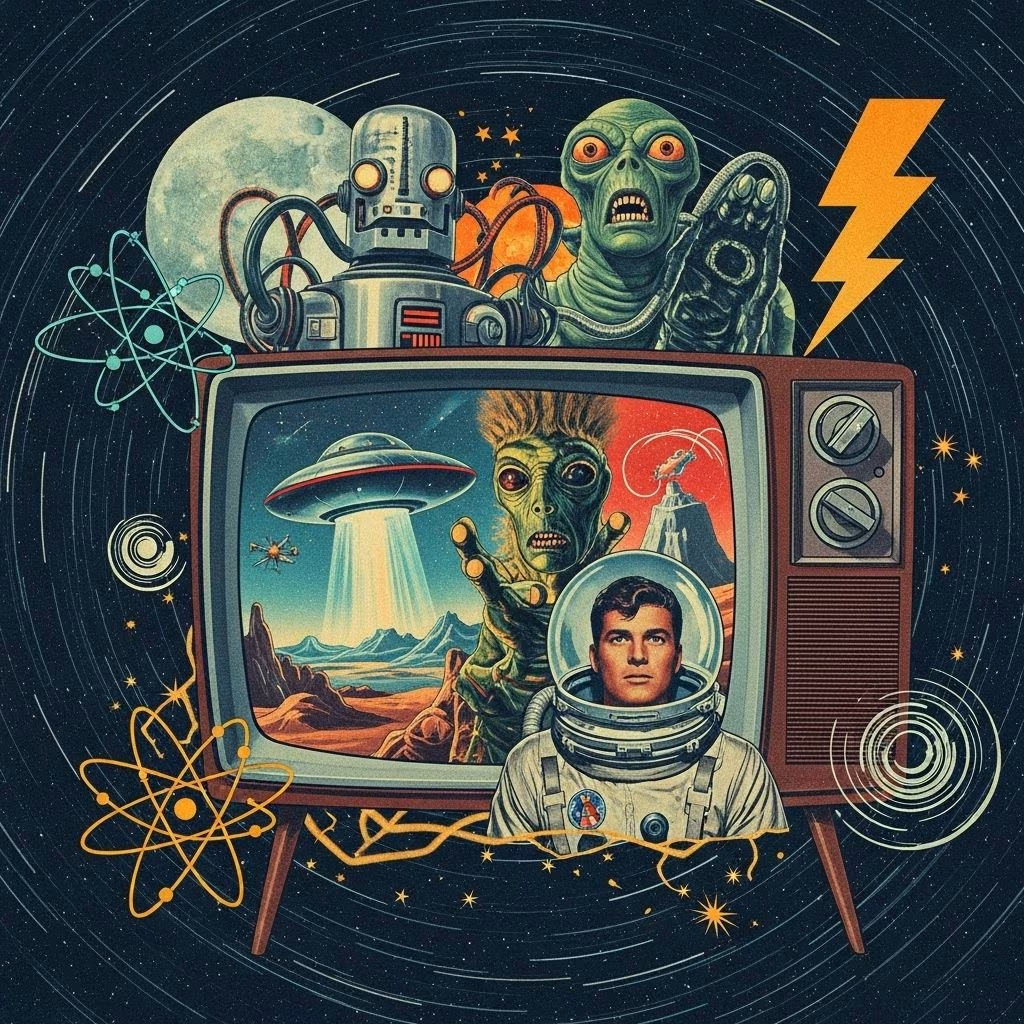
The 1950s stand as a monumental era in the history of science fiction television. This decade laid the foundation for space operas, imaginative anthologies, and time-travel adventures that continue to inspire TV to this day. With limited technology and modest budgets, creators in the ’50s relied on inventive storytelling and boundless imagination, introducing viewers to cosmic explorations, futuristic gadgets, and philosophical parables about humanity’s place in the universe.
Introduction: Science Fiction Comes to Television
In the wake of World War II and amid the burgeoning space race, 1950s America witnessed an explosion of public interest in technology, outer space, and what the future might hold. Television, still a novel medium, became the perfect platform for these stories. Audiences gathered around their sets, captivated by rocket ships, ray guns, time machines, and bold heroes who protected Earth from intergalactic threats. Despite primitive special effects by modern standards, these shows pioneered genres, themes, and storytelling forms that anticipated everything from “Star Trek” to “Doctor Who.” Let’s revisit the most influential science fiction TV shows of the 1950s and the reasons they endure as cult favorites.
Captain Video: Master of Time and Space
Year: 1949–1955
Network: DuMont Television Network
As the first-ever science fiction and space adventure program on television, Captain Video was a trailblazer that debuted on June 27, 1949. Starring Richard Coogan, the live-broadcast series centered on Captain Video and his Video Rangers, a justice-fighting posse operating from a mountaintop headquarters on a futuristic Earth in the year 2254.
- The show used inventive, low-budget tricks such as miniature models and stock Western footage to evoke distant worlds and far-flung adventures.
- At its peak, “Captain Video” aired nightly (except Sundays) on 24 stations and boasted 3.5 million viewers by 1951.
- Its enormous popularity sparked a wave of imitators, making it the model for many TV space operas that followed.
Space Patrol: Adventures in the Thirtieth Century
Years: 1950–1955
Network: ABC
Arriving quickly on the heels of Captain Video, Space Patrol aired on Saturday mornings and featured Commander Buzz Corry and Cadet Happy venturing across the 30th-century cosmos aboard their ship, the Terra. The show set itself apart with a stronger emphasis on interplanetary policing and storytelling depth.
- Villains included the nefarious Mr. Proteus and Prince Baccarratti, whose defeat often involved futuristic devices like the Brainograph that could “reprogram” wrongdoers.
- “Space Patrol” also existed as a companion radio series from 1952 to 1955, with 129 episodes produced.
- The show’s blend of earnest heroics and imaginative gadgetry resonated with young viewers and propelled its popularity nationwide.
Tom Corbett, Space Cadet: Earning the Right to Explore
Years: 1950–1955
Network: CBS/NBC/ABC/DuMont (syndicated)
Tom Corbett, Space Cadet chronicled the trials of Academy Cadets Tom Corbett, Roger Manning, and Astro as they trained to join the Solar Guards of the 24th century. A fresh-faced cast and action-packed stories set the tone for later ensemble-based space shows.
- The cadets’ ship, the Polaris, whisked viewers through disasters, cosmic phenomena, and the occasional alien menace.
- Notably, the show’s rotation among major networks speaks to its widespread appeal and adaptability.
- Emphasizing teamwork, morality, and scientific curiosity, “Tom Corbett, Space Cadet” became essential Saturday morning viewing.
Flash Gordon: The Hero Returns to the Screen
Years: 1954–1955
Network: DuMont Network and syndication
Based on the famous Alex Raymond comic strip, Flash Gordon starred Steve Holland as the titular hero, joined by Dale Arden and Dr. Zarkov of the Galaxy Bureau of Investigation. Although Universal Studios owned the character rights, a lapse in TV licensing allowed this adaptation to be produced independently.
- The 39-episode run depicted classic outer space adventures, with Flash and his crew battling monstrous aliens, ruthless overlords, and cosmic catastrophe.
- The Galaxy Bureau concept presaged later team-driven science fiction such as “Star Trek’s” Starfleet.
- Despite its shoestring budget, the show fueled the ongoing pulp fascination with space travel and adventure.
Commando Cody: Sky Marshal of the Universe
Year: 1955
Network: NBC (syndicated after theatrical release)
In a shift toward science and environmental themes, Commando Cody: Sky Marshal of the Universe followed the masked, rocket-suited super scientist Cody as he investigated climate disasters engineered by Venusian aliens led by a villain called The Ruler.
- Originally produced for theaters, the 12-episode series aired on television in 1955, exploring early science fiction anxieties about planetary climate and extraterrestrial invasion.
- The show’s mix of special effects, rocket ships, and secret government agencies echoed throughout later sci-fi television and film.
Captain Z-Ro: Guardians of the Timeline
Years: 1955–1956
Origin: KRON-TV, San Francisco (syndicated)
Captain Z-Ro charted new territory with its focus on time travel and historical intervention. With the aid of his young assistant Jet and a robot named Roger, Captain Z-Ro used his Time Screen to highlight anomalies in the timeline, then traveled back in time to correct them aboard their starship ZX-99.
- The show’s central premise anticipated time-travel classics like “Doctor Who” and “Quantum Leap.”
- By emphasizing the responsible use of technology and the lessons of history, “Captain Z-Ro” encouraged both education and adventure.
Science Fiction Theatre: Anthology and Imagination
Years: 1955–1957
Host: Truman Bradley
Eschewing space opera tropes, Science Fiction Theatre delivered intelligent, self-contained stories inspired by actual scientific debates and emerging theories. Each of its 78 episodes, many based on articles from Scientific American, wove plots around spaceflight, UFOs, time travel, psychic phenomena, and more.
- Its semi-documentary style and focus on plausible science set the stage for future anthology series like “The Twilight Zone” and “The Outer Limits.”
- Episodes featured guest stars, including future “Star Trek” highlight DeForest Kelley.
- The series remains acclaimed for its mix of speculative fiction and credible scientific context.
Other Notable 1950s Sci-Fi TV Shows
- Buck Rogers (1950-1951): The legendary hero awakens in the 25th century to fight tyrants and save the galaxy, continuing a tradition of serialized futuristic pulp fiction.
- Tales of Tomorrow (1951-1953): Hosted anthology series adapting works by foundational authors like Ray Bradbury and Robert Heinlein. Its 85-episode run presented adult-oriented science fiction, paving the way for later, more sophisticated genre fare.
- Atom Squad (1953-1954): Focused on a secret government team meeting threats from evildoers and malfunctioning machines, mirroring Cold War anxieties.
- Johnny Jupiter (1953–1954): Blending puppetry with live action, this unusual show followed a TV repairman who communicated with a puppet alien, Johnny Jupiter. Its offbeat style made it a memorable oddity in 1950s television.
- Operation Neptune (1953): A short-lived but adventurous series that centered on mysteries beneath the sea, often involving extraterrestrial threats — expanding the sci-fi landscape beyond space.
- Out There (1951-1952): An early anthology that adapted stories from legends like Bradbury and Heinlein, aiming squarely at an adult audience and featuring dark or speculative scenarios.
Defining Traits of 1950s Sci-Fi TV
Despite budget and technological constraints, 1950s science fiction TV shows share several defining qualities:
- Resourceful Production: Sets were simple, effects inventive, and storytelling prioritized over spectacle.
- Optimism & Anxiety: Shows reflected postwar optimism about science as well as Cold War fears of invasion, mutation, or global catastrophe.
- Educational Values: Many series, like “Captain Z-Ro” and “Science Fiction Theatre,” encouraged curiosity about science, history, and the future.
- Moral Clarity: Heroic figures who embodied American and humanistic values were central; villains were often clear stand-ins for existential dangers of the age.
- Familial Appeal: Stories were accessible to young and old, supporting the rise of TV as a family-friendly medium.
The Enduring Legacy: Influence on Modern Sci-Fi
The influence of 1950s television science fiction is impossible to overstate. Its signature motifs — conquering unknown worlds, encountering strange life forms, wrestling with the unintended consequences of new technology, and questioning humanity’s path — underpin nearly every major franchise that followed, from “Star Trek” and “Doctor Who” to “The X-Files” and “Stranger Things.”
Modern science fiction TV frequently tips its hat to this era, whether through homages, reboots, or simply in the optimism that the future can be shaped for the better. The moral dilemmas, technological wonders, and imaginative spirit of these early shows endure in the DNA of the genre.
Frequently Asked Questions (FAQs)
Q: What was the very first science fiction TV show?
A: The first science fiction TV show is widely recognized as “Captain Video: Master of Time and Space,” which debuted in 1949 and ran until 1955, setting the template for countless space adventure series.
Q: Why do 1950s sci-fi TV shows look so different from today’s shows?
A: 1950s shows were created with far less advanced technology and lower budgets compared to modern productions. As a result, they made creative use of simple sets, practical effects, and resourceful storytelling to compensate for technical limitations.
Q: Are any of these classic shows available to watch today?
A: Many episodes of these series, such as “Flash Gordon,” “Space Patrol,” and “Tales of Tomorrow,” have been preserved and are available through streaming services, DVD, or online platforms specializing in classic TV.
Q: Which 1950s sci-fi show most influenced future genre TV?
A: All these shows contributed to the evolution of science fiction television, but “Captain Video,” “Flash Gordon,” and “Science Fiction Theatre” are often cited as especially influential for their imaginative world-building and narrative innovations.
Q: Did any famous actors start out in 1950s sci-fi shows?
A: Yes. For example, DeForest Kelley, who later became Dr. McCoy in “Star Trek,” appeared in several episodes of “Science Fiction Theatre.” These early roles often provided launching pads for young talent in Hollywood.
Conclusion
The 1950s represent a golden age where science fiction television took its first tentative steps toward the stars. Through innovation, courage, and endless curiosity, these shows enchanted millions and proved that the universe — both real and imagined — was within reach.
References
- https://www.imdb.com/list/ls000097346/
- https://www.space.com/entertainment/the-best-sci-fi-tv-shows-of-the-1950s
- https://www.youtube.com/watch?v=ABljOhik0uk
- https://en.wikipedia.org/wiki/Category:1950s_American_science_fiction_television_series
- https://www.youtube.com/watch?v=q6jeS-OwXqE
- https://www.wcbu.org/local-news/2023-04-25/exploring-the-lost-world-of-tv-sci-fi-in-the-50s
- https://www.youtube.com/playlist?list=PLP9BvyXK9FAGdZdjBxcrnzwiRWw-QArdL