


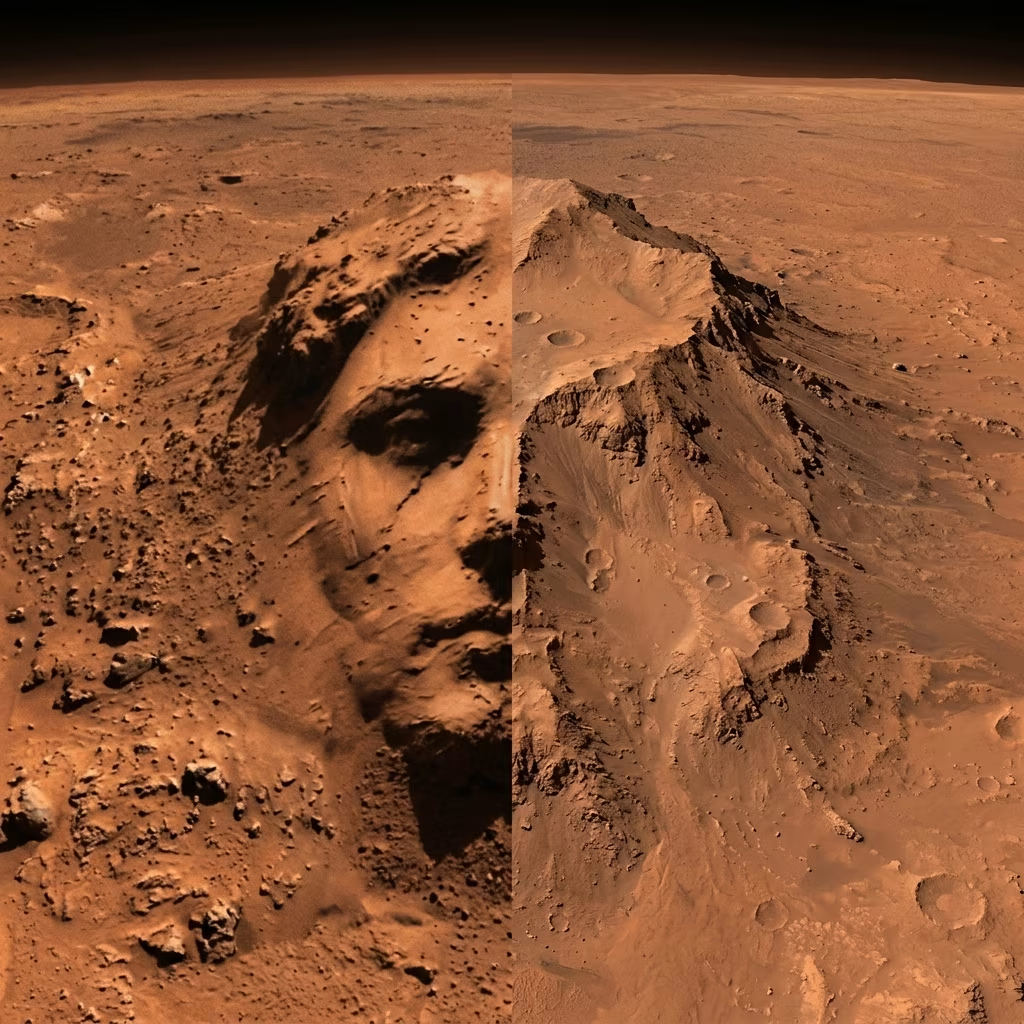
The Face on Mars: Fact, Fiction, and Science
Few planetary images have sparked the public imagination and controversy quite like the ‘Face on Mars.’ This iconic photo, captured by NASA’s Viking 1 Orbiter in 1976, showed a segment of the Martian landscape in the Cydonia region that eerily resembled a human face. Was this an archaeological remnant, an alien artifact, or a natural landform caught at the perfect moment? For decades, this question occupied scientists, conspiracy theorists, and the wider public alike.
Discovery and Initial Public Reaction
On July 25, 1976, NASA’s Viking 1 Orbiter was conducting a photographic survey of Mars as it searched for a landing site for its twin spacecraft, Viking 2. In its sweep of the Martian surface, the craft sent back hundreds of images to NASA engineers. Among these was a photograph of a region called Cydonia, captivating scientists and the public when released almost a week after capture.
The official NASA caption noted a “huge rock formation in the center [of the photo] which resembled a human head”. Despite the scientific tone, the uncanny resemblance ignited the imagination of the public and media, who started pondering whether this could be a megastructure or monument created by intelligent beings.
The Cydonia Region: Setting the Scene
The Cydonia region lies in Mars’ northern hemisphere, characterized by a mix of mesas, hills, and complex terrain. This area was a frequent subject of study for early Mars missions because its varied landscape promised to reveal much about the planet’s history and geology. The “face” is located at approximately 40.8° N latitude and 9.6° W longitude. The formation appeared as a hill casting long shadows, giving an impression of eye sockets, a nose, and a mouth.
Key facts about Cydonia:
- Geological Diversity: Contains mesas, buttes, and erosional features.
- Scientific Interest: Studied closely for potential ancient water outflows and complex terrain.
- Setting for ‘Face’: The now-famous mesa is one of many unique landforms found there.
Debate: Alien Artifact or Optical Illusion?
What started as a curious geological feature quickly became the centerpiece of decades-long debates about the possibility of intelligent life or even ancient civilizations on Mars. Books, documentaries, and television shows explored—and often sensationalized—the idea that an intelligent species had constructed a huge monument visible from space.
| Theory/Claim | Supporters | Basis |
|---|---|---|
| Artificial Megastructure | Some scientists, authors, fringe theorists | Resemblance to a human face; pattern-seeking instinct |
| Natural Formation | Mainstream planetary scientists, NASA | Understanding of Martian geology; shadow and light effects |
In the decades that followed, the “Face on Mars” became synonymous with Martian mysteries and possible proof of extraterrestrial intelligence. However, scientists advocated caution, warning of the risks inherent in drawing conclusions from single, low-resolution images.
Follow-Up Missions and Revealing New Evidence
A crucial turning point came when NASA and other space agencies sent new missions to Mars with advanced imaging technology. These missions included:
- Mars Global Surveyor (MGS): Equipped with a high-resolution Mars Orbiter Camera (MOC), the MGS conducted a detailed survey of the Cydonia region in April 1998.
- Mars Express: ESA’s orbiter also captured high-quality images at additional angles and lighting conditions.
The 1998 MGS flyover was conducted at an altitude of approximately 275 miles (444 km), acquiring images with a stunning 14.1 feet (4.3 meters) per pixel resolution—ten times better than the original Viking images.
Key findings from these follow-up missions:
- Under different lighting conditions and higher resolution, the “face” lost much of its human-like appearance.
- Analysis showed the structure to be an ordinary Martian mesa, shaped by erosion, wind, and time.
- No evidence of artificial origins, precise geometric structures, or markings was found.
The images have since been made widely available, allowing the public and researchers to evaluate the feature for themselves and confirm its natural origins.
The Science Behind the Illusion
Why did so many people see a face in the Cydonia mesa? The answer lies in psychology and the limitations of early space photography.
- Pareidolia: The human brain is hardwired to recognize familiar patterns, especially faces, even where none exist—a phenomenon known as pareidolia.
- Lighting and Resolution: The original Viking image was taken in low resolution with shadows accentuated by the position of the sun. The interplay of shadow and highlighted terrain amplified the illusion.
- Selective Attention: When viewers are cued to “see” something specific, their perceptions adapt to find that shape or form.
Subsequent scientific review using higher-resolution data, 3D modeling, and comparisons to Earth analogues provided overwhelming evidence that the Cydonia “face” was no more than a natural rock formation.
The Face on Mars in Pop Culture and Public Imagination
For over four decades, the “Face on Mars” captured the imagination of artists, writers, filmmakers, and conspiracy theorists. Its iconic “stare” has appeared in:
- Science fiction films and TV shows (such as The X-Files and documentaries).
- Books examining ancient aliens or lost civilizations.
- Music videos and album art invoking cosmic mysteries.
This public fascination served as a useful entry point into discussions about planetary exploration, scientific skepticism, and the power of perception.
Lessons from the ‘Face on Mars’
- The Need for Caution: Early, low-resolution images are susceptible to misinterpretation. The development of new technology often provides clarifying data that overturns initial excitement.
- Pareidolia Is Universal: Humans naturally find significance in patterns—one reason why scientific rigor must prevail over wishful thinking or pattern recognition alone.
- Importance of Follow-Up Observations: As more sophisticated missions explore Mars, features once thought mysterious have become well-understood geological formations.
- Inspiration for Exploration: Despite being debunked as an artificial monument, the Face on Mars has inspired countless people to learn about astronomy and planetary science.
Frequently Asked Questions (FAQs)
Q: Is there really a giant face on Mars?
A: No, high-resolution imaging from Mars orbiters have shown that the ‘face’ is a natural mesa shaped by erosion, appearing facial only in low-resolution, shadowed images.
Q: Why did people believe it could be an alien artifact?
A: The resemblance to a human face in early photos, coupled with public fascination about extraterrestrial life, led to speculation and theories about its artificial origin.
Q: What is pareidolia?
A: Pareidolia is a psychological phenomenon in which the human brain perceives familiar patterns, such as faces, in unrelated shapes or objects.
Q: Are there any real signs of life on Mars?
A: No definitive evidence of life, present or past, has been found on Mars to date; the ‘face’ is one of many natural features explained by geology, not biology or culture.
Q: How did newer spacecraft improve our understanding?
A: Missions like Mars Global Surveyor supplied much higher-resolution images that resolved the structure into an ordinary mesa, debunking the myth of the ‘face.’
Quick Reference Table: Comparison of Key Mars Images
| Spacecraft | Year | Resolution | Image Impact |
|---|---|---|---|
| Viking 1 Orbiter | 1976 | Low | Face on Mars becomes global sensation |
| Mars Global Surveyor | 1998 | High (4.3 meters/pixel) | Confirms natural mesa, illusion debunked |
| Mars Express | 2006+ | Very high, multi-angle | 3D analysis, final confirmation of natural origins |
Conclusion: From Mystery to Understanding
The “Face on Mars” stands as a powerful case study in how science progresses: initial observations, public intrigue, rigorous testing, and ultimately, the advancing power of technology to reveal underlying truths. Today, the Cydonia mesa no longer holds its mysterious mask, but it continues to be an enduring symbol of both the limits and the promise of planetary exploration.
References
- https://science.nasa.gov/resource/face-on-mars/
- https://www.space.com/17191-face-on-mars.html
- https://science.nasa.gov/resource/highest-resolution-view-of-face-on-mars/
- https://www.skyatnightmagazine.com/space-science/face-on-mars
- https://www.iflscience.com/what-we-know-about-the-face-on-mars-first-seen-in-1976-77958
- https://www.planetary.org/space-images/a-face-on-mars
- https://www.thesunmagazine.org/articles/23266-the-face-on-mars
- https://www.sciencealert.com/eerie-discovery-on-mars-looks-exactly-like-a-human-face
- https://www.science.org/content/article/face-it-its-not-face
- https://universemagazine.com/en/face-with-pain-expression-perseverance-finds-a-surprising-rock/
- https://www.youtube.com/watch?v=qCF1fQyRDE0
- https://www.iflscience.com/face-on-mars-photographed-by-nasas-mars-perseverance-rover-76316
- https://web.archive.org/web/20161102014014/http:/science1.nasa.gov/science-news/science-at-nasa/2001/ast24may_1/
- https://www.youtube.com/watch?v=R6j5tNbC7mQ
- https://science.howstuffworks.com/face-on-mars.htm


