How Growing Trees and Mushrooms Together Could Feed Millions and Combat Climate Change
By integrating mushroom cultivation with tree planting, scientists and environmentalists are identifying a remarkable solution to two of humanity’s most pressing challenges: nourishing a growing global population and mitigating climate change. This emerging practice, known as mycoforestry, leverages the ancient symbiosis between trees and fungi to unlock new possibilities for food production and forest conservation.
Understanding the Global Challenge: Food Production vs. Forest Conservation
Globally, there is a significant and escalating conflict between the need for agricultural land and the imperative to preserve forests. As the demand for food increases with population growth, more forests are being cleared each year to create space for crops. According to data from 2010 to 2020, the world lost about 4.7 million hectares of forest annually, primarily driven by new agricultural activity.
This conflict creates a troubling dilemma. On one hand, forests play a critical role in absorbing atmospheric carbon dioxide, supporting biodiversity, and maintaining ecological balance. On the other, feeding humanity remains a fundamental necessity.
Introducing Mycoforestry: Trees and Mushrooms in Harmony
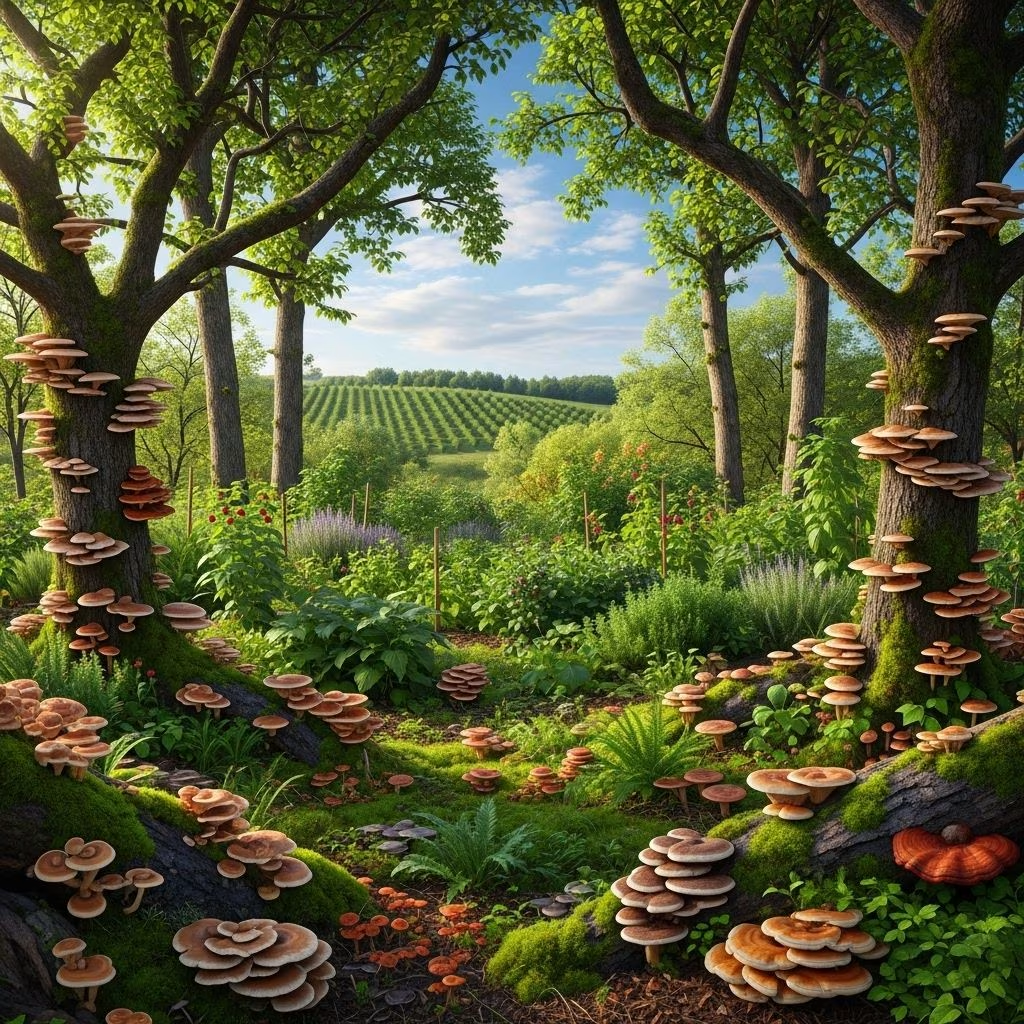
Mycoforestry is the practice of cultivating edible fungi in symbiosis with living trees, turning new tree plantings into productive ecosystems that yield nutritious food.
- Fungi—specifically, edible mushrooms known as ectomycorrhizal fungi (EMF)—grow in partnership with tree roots, establishing underground networks that benefit both organisms.
- The fungi help trees absorb water and nutrients more efficiently, while trees provide sugars and a supportive environment for the fungi.
- This mutualistic relationship forms the foundation of mycoforestry—and unlocks a host of powerful benefits for people and the planet.
The “Wood Wide Web”
Recent research has revealed that the underground connections between fungi and trees—sometimes called the “wood wide web”—are far more complex and vital than previously understood. Through vast networks of mycorrhizal fungi, trees can communicate, share nutrients, and even warn each other about pests or disease threats.
- These networks allow entire forest communities to become more resilient.
- Fungi play a critical role in decomposing organic matter, recycling nutrients, and supporting new plant growth.
The Science: How Mycoforestry Sequesters Carbon and Produces Food
Led by Professor Paul Thomas and Professor Alistair Jump at the University of Stirling, recent landmark research has quantified, for the first time, the extraordinary potential of edible mushroom cultivation alongside trees.
Major Findings of the Study
- Carbon Sequestration: Cultivating edible ectomycorrhizal fungi in forests can sequester up to 12.8 metric tons of carbon per hectare annually.
- Mass Food Production: This system could produce enough food to feed nearly 19 million people per year, using the calorific output of edible mushrooms.
- Climate Advantage: Unlike all other major food categories, which typically result in greenhouse gas emissions during production, edible fungi cultivated via mycoforestry result in net carbon capture, making them uniquely climate-positive.
Why Mushrooms?
Edible mushrooms are widely recognized for their nutritional value, serving as a source of:
- High-quality protein
- Dietary fiber
- Antioxidants
- Trace minerals like selenium, which helps protect against cellular damage and infection
As a non-meat protein option, mushrooms are already appreciated in many cuisines, but their mainstream adoption as a mass food source would require widespread cultural acceptance and adaptation.
How the Tree-Mushroom Connection Works
The marriage between trees and mushrooms is established underground, where fungus and tree roots combine to form what is known as an ectomycorrhizal association. In this arrangement:
- The fungus wraps around the tree roots and penetrates the soil, massively increasing the surface area through which the tree can absorb water and nutrients—particularly key elements like nitrogen and phosphorus.
- In exchange, the tree supplies the fungus with carbohydrates (sugars) produced via photosynthesis.
This exchange significantly boosts the health and productivity of both organisms. The enhanced abilities of trees and fungi to access resources and withstand environmental stress make ecosystems more robust while also increasing the edible yield for humans.
Comparing Mycoforestry with Traditional Food Systems
| Aspect | Traditional Agriculture | Mycoforestry (Tree-Mushroom Integration) |
|---|---|---|
| Land-Use Impact | Drives deforestation; single-crop systems often degrade soil. | Promotes forest planting and conservation; enriches soil and ecosystem health. |
| Greenhouse Gas Emissions | Typically leads to net emissions (from machinery, fertilizers, land clearing). | Results in net carbon sequestration—absorbs more carbon than it emits. |
| Food Production Output | High output, but often at environmental cost. | High potential yield of nutritious edible mushrooms, alongside trees. |
| Biodiversity | Monocultures reduce biodiversity and ecosystem resilience. | Strengthens biodiversity by supporting diverse plant and fungal communities. |
The Environmental Benefits of Mycoforestry
- Reduces Deforestation: By generating food within forest systems rather than clearing them for crops, mycoforestry helps preserve existing forests and incentivizes new tree planting.
- Enhances Carbon Capture: Forest fungi increase carbon sequestration rates, further amplifying the forest’s role in fighting climate change.
- Improves Soil Health: Fungi enhance the decomposition of organic material, recycle nutrients, and promote the fertility of the forest floor.
- Supports Biodiversity: By weaving together plant and fungal communities, mycoforestry nurtures more resilient ecosystems with richer species diversity.
Potential Scale and Real-World Impact
The University of Stirling study estimated:
- If mycoforestry had been adopted alongside global forestry initiatives over the past decade, it could have generated enough food to feed nearly 19 million people each year.
- In China alone, combining mushroom cultivation with recent tree planting efforts would have produced enough calorific output to feed approximately 4.6 million people annually.
Despite these remarkable numbers, the researchers caution that widespread implementation will require further research, investment, and careful planning to address technical, social, and cultural barriers.
Nutritional and Social Benefits
Edible mushrooms integrated into tree-planting offer a unique combination of benefits:
- Serve as a sustainable, non-meat protein option for global diets.
- Provide essential vitamins, minerals, and antioxidants.
- May be produced using low-impact, regenerative agricultural practices.
- Offer new income opportunities for forest communities, smallholder farmers, and regions seeking food sovereignty.
Challenges and Considerations
- Public Acceptance and Culinary Adaptation: While mushrooms are valued in many cultures, widespread consumption—especially as a staple—will require adaptation and education.
- Research Gaps: More studies are needed to optimize the integration of tree and fungal species for different climates and ecosystems.
- Management Complexity: Mycoforestry systems are more complex than monocultures, requiring new expertise in forestry and fungal science.
- Equitable Access: The benefits of mycoforestry should reach diverse communities and contribute to food security and economic opportunity for marginalized groups.
Frequently Asked Questions (FAQs)
Q: What is mycoforestry?
A: Mycoforestry is the cultivation of mushrooms in symbiosis with living trees, creating mutually beneficial systems that produce food and enhance forest health.
Q: How does growing mushrooms with trees help the climate?
A: The process sequesters significant amounts of carbon in the soil and trees, reducing atmospheric greenhouse gases and mitigating climate change.
Q: Can mycoforestry help solve the problem of deforestation?
A: Yes. Integrating food production with forest systems reduces pressure to clear land for crops and incentivizes tree planting.
Q: Are edible mushrooms a good source of nutrition?
A: Absolutely. Mushrooms provide high-quality protein, fiber, vitamins, antioxidants, and essential minerals.
Q: What is the symbiotic relationship between trees and fungi?
A: Fungi attach to tree roots, helping trees absorb water and nutrients, while trees supply the fungi with sugars—all forming a beneficial partnership underground.
Q: What are the main obstacles to implementing mycoforestry globally?
A: Key challenges include public acceptance, the need for more research, and the complexity of managing these integrated systems.
Conclusion: The Promise of Growing Trees and Mushrooms Together
By recognizing and harnessing the profound natural alliance between trees and fungi, mycoforestry offers an innovative blueprint for a future where food security, ecological health, and climate stability work together. As research and practice evolve, integrating mushroom cultivation with forest stewardship could become a cornerstone of sustainable development worldwide—feeding millions while restoring the planet.
References
- https://www.weforum.org/stories/2023/04/cultivating-mushrooms-by-trees-could-feed-millions-while-mitigating-climate-change-research-finds/
- https://phys.org/news/2023-03-mushrooms-trees-millions-mitigate-effects.html
- https://www.stir.ac.uk/news/2023/march-2023-news/growing-mushrooms-alongside-trees-could-feed-millions-and-mitigate-effects-of-climate-change-research-finds/
- https://treepeople.org/2023/04/14/fungi-and-trees-plants/
- https://www.nationalforests.org/blog/underground-mycorrhizal-network
- https://www.youtube.com/watch?v=iMMkEXvkMUU
- https://doorcountypulse.com/trees-and-mushrooms-how-are-they-connected/