Daylight Saving Time: Do We Still Need It?
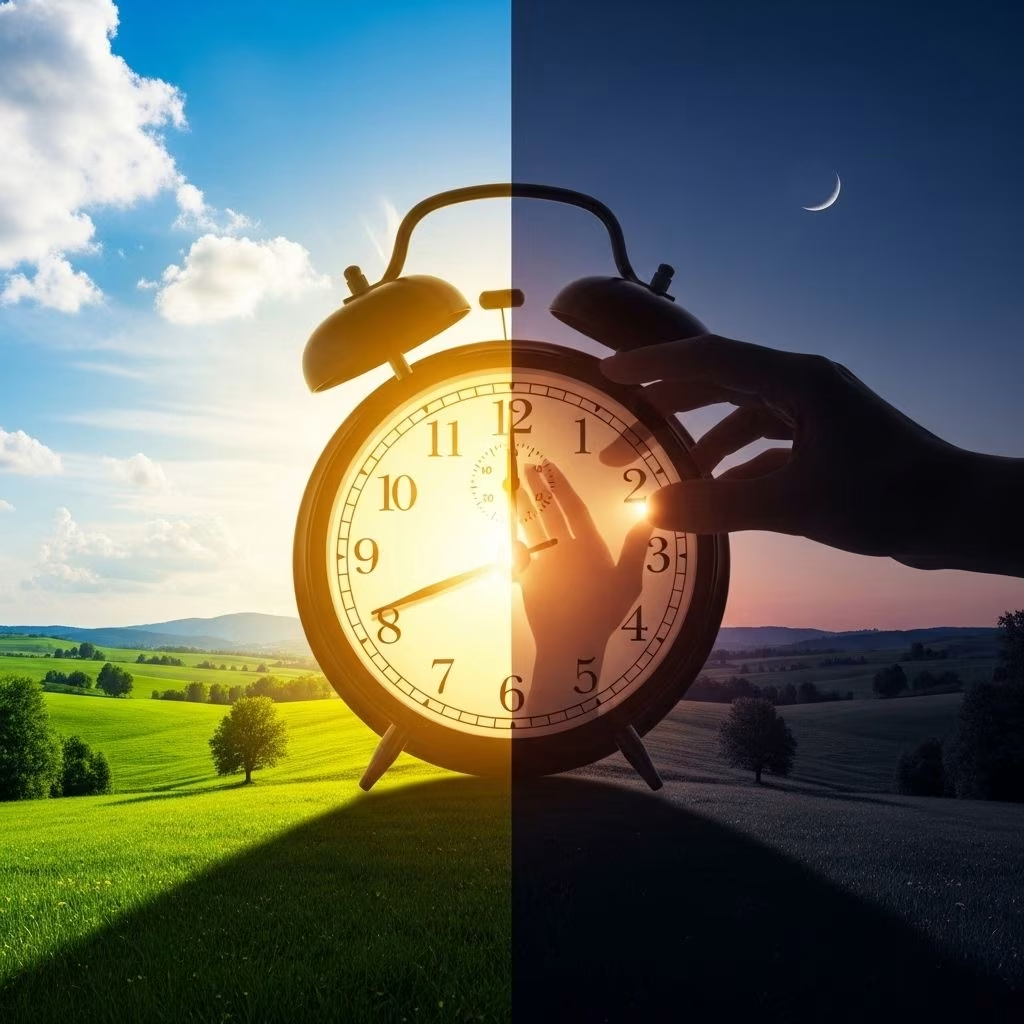
Twice every year, millions of people adjust their clocks for daylight saving time (DST), “springing forward” in March and “falling back” in November. But over a century after it began, the practice remains controversial and widely debated. Does it still make sense in our modern world? Here, we explore the history behind DST, its original intentions, its impact on energy use and public health, who supports or opposes it today, and the growing calls for reform or abolition.
What Is Daylight Saving Time?
Daylight saving time refers to the practice of setting clocks one hour ahead of standard time during the warmer months, typically to extend evening daylight and reduce morning light. In the United States, DST generally starts on the second Sunday in March and ends on the first Sunday in November. At 2:00 a.m. local time, most Americans set their clocks forward in spring and back in fall, a mnemonic known as “spring forward, fall back.”
- Purpose: To better align active hours with natural daylight, theoretically reducing energy consumption and providing brighter evenings for recreation and commerce.
- Exceptions: States such as Hawaii and most of Arizona, along with U.S. territories like Puerto Rico and Guam, do not observe daylight saving time.
How DST Works in the U.S. (Table)
| Time Zone | Standard Time (UTC Offset) | Daylight Saving Time (UTC Offset) |
|---|---|---|
| Eastern | EST (UTC−05:00) | EDT (UTC−04:00) |
| Central | CST (UTC−06:00) | CDT (UTC−05:00) |
| Mountain | MST (UTC−07:00) | MDT (UTC−06:00) |
| Pacific | PST (UTC−08:00) | PDT (UTC−07:00) |
| Alaska | AKST (UTC−09:00) | AKDT (UTC−08:00) |
Most of the country participates in DST, with varying enthusiasm and compliance, while some regions opt out entirely.
The Roots of Daylight Saving Time
Although commonly believed to benefit farmers, DST’s origins tell a more complicated story. The idea is often attributed to Benjamin Franklin, who jokingly suggested it as a way to save candles in 1784, but the first serious proposal came from George Hudson, a New Zealand entomologist, in the 1890s.
Modern daylight saving time in the U.S. began during World War I, intended as a wartime measure to conserve fuel by making better use of daylight. After the war, the policy was inconsistently applied until the Uniform Time Act of 1966 standardized the practice nationally.
Contrary to myth, farmers generally opposed DST; their schedules followed the sun, not social clocks. Adjusting time disrupted routines like milking cows, whose biological rhythms do not change with the clock.
Does DST Save Energy?
The original promise of DST was that by shifting activity into daylight hours, society could save artificial lighting and thus energy. However, research on this effect is mixed, especially given technological changes.
- Early 20th-century calculations suggested substantial savings because lighting made up a larger share of energy use in homes.
- Today, lighting is more efficient, and usage patterns have shifted. Additional daylight may lead to more air conditioning use, especially in warm climates, which can offset or even exceed any savings from lighting.
- Recent studies show energy savings from DST are now negligible or nonexistent; some states actually see a tiny increase in demand, depending on geography and weather.
How DST Affects Health and Daily Life
Clock changes, especially “springing forward,” can disrupt the body’s circadian rhythm—the natural sleep-wake cycle governed by light. This disruption has notable impacts on health, productivity, and safety:
- Short-Term Effects: The sudden loss of an hour of sleep can lead to decreased concentration, increased irritability, and greater risk of accidents, particularly traffic collisions and workplace injuries in the days after the time shift.
- Long-Term Health Risks: Chronic sleep disruption is associated with increased risk for heart attack, stroke, metabolic disorders, and mood disturbances.
- School Performance: Children and students may struggle more after the shift, with diminished alertness in class and challenges adjusting schedules.
- Benefits: Proponents argue that longer evening daylight encourages people to be outdoors, fostering physical activity and social interaction.
The Case For and Against DST
The debate over DST touches on public health, energy use, commerce, and social preferences. Here’s a look at the primary arguments from each side:
- Arguments in Favor:
- Promotes evening outdoor activity and commerce.
- May reduce crime rates due to more activity during daylight hours.
- Aligns daylight with people’s active hours, potentially improving quality of life.
- Arguments Against:
- Sleep deprivation and health risks, especially after the spring transition.
- Negligible or negative energy savings in modern contexts.
- Disruption to schedules, particularly for shift workers, schoolchildren, and pets or livestock.
- Widespread public confusion and inconvenience.
Who Observes DST? Who Does Not?
Most of the United States continues to participate in DST, but Arizona (except the Navajo Nation), Hawaii, and all U.S. territories have opted out of the practice.
Globally, DST is mainly found in North America and parts of Europe, but countries like Russia, China, and most of Africa and Asia do not observe it. Europe is also considering dropping the twice-a-year clock change.
History of Changes and Recent Developments (Table)
| Year | DST Start | DST End |
|---|---|---|
| 2022 | March 13 | November 6 |
| 2023 | March 12 | November 5 |
| 2024 | March 10 | November 3 |
| 2025 | March 9 | November 2 |
| 2026 | March 8 | November 1 |
This variation can create confusion and technical complexity for time-sensitive systems.
Calls for Reform: Keep, Abandon, or Make DST Permanent?
Given the drawbacks and diminishing benefits, a growing number of scientists, lawmakers, and citizens are calling for change. Three primary options are under consideration:
- Abolish DST Entirely: Maintain standard time year-round—favored by sleep specialists and public health advocates, as it best aligns with the natural circadian rhythm.
- Make DST Permanent: Some argue that permanent DST would maximize daylight after work or school, providing evening light all year. The U.S. Senate has even passed legislation (the Sunshine Protection Act) to this effect, but it has not become law.
- Maintain the Status Quo: Others prefer to keep the current system, arguing that it provides flexibility and is familiar to most Americans.
Recent polls reflect a widespread desire to stop changing the clocks, but opinions are divided on which kind of time should become permanent.
Frequently Asked Questions (FAQs)
Q: Why do we still have daylight saving time?
A: The original goal was to conserve energy by shifting daylight to later in the day, but today the practice persists mostly out of habit and inertia. Efforts to change the law have been hindered by conflicting interests and a lack of consensus on which time to adopt permanently.
Q: Does daylight saving time actually save energy?
A: In recent decades, modern energy use patterns have changed, and studies show that any savings are minimal or nonexistent. In some regions, DST increases electricity demand due to greater air conditioning use.
Q: Do most countries observe DST?
A: No, the majority of the world’s population does not observe DST. It is mainly observed in North America and parts of Europe, but many major economies have never adopted it or have since abandoned the practice.
Q: How does DST affect health?
A: The abrupt shift can disrupt normal sleep patterns, causing short-term increases in fatigue and a temporary spike in traffic accidents, heart attacks, and other health issues. These impacts are most acute in the days immediately following the time change.
Q: Can individual states opt out of DST?
A: Under current U.S. law, states can choose to remain on standard time year-round but cannot unilaterally adopt permanent daylight saving time without federal approval.
Conclusion: Is It Time to Reconsider Daylight Saving Time?
Daylight saving time was introduced in a different technological and social era, with promises of energy savings and coordinated routines. Today, with evidence suggesting negligible benefits—coupled with clear downsides for health and well-being—the debate has intensified. As policymakers and stakeholders weigh the costs and benefits, the future of DST remains uncertain, but pressure for reform is stronger than ever.
For now, most Americans will continue the familiar ritual—resetting clocks each spring and fall, questioning the wisdom of the practice, and wondering if soon, the “time” for change might finally arrive.
References
- https://economictimes.com/news/international/us/daylight-saving-time-2025-when-will-the-us-adjust-its-clocks-key-details-on-the-time-change/articleshow/118539727.cms
- https://www.ourmidland.com/news/police_and_courts/article/daylight-saving-time-2025-start-20197732.php
- https://en.wikipedia.org/wiki/Daylight_saving_time_in_the_United_States
- https://www.edweek.org/leadership/what-to-expect-from-students-after-the-start-of-daylight-saving-time/2025/03