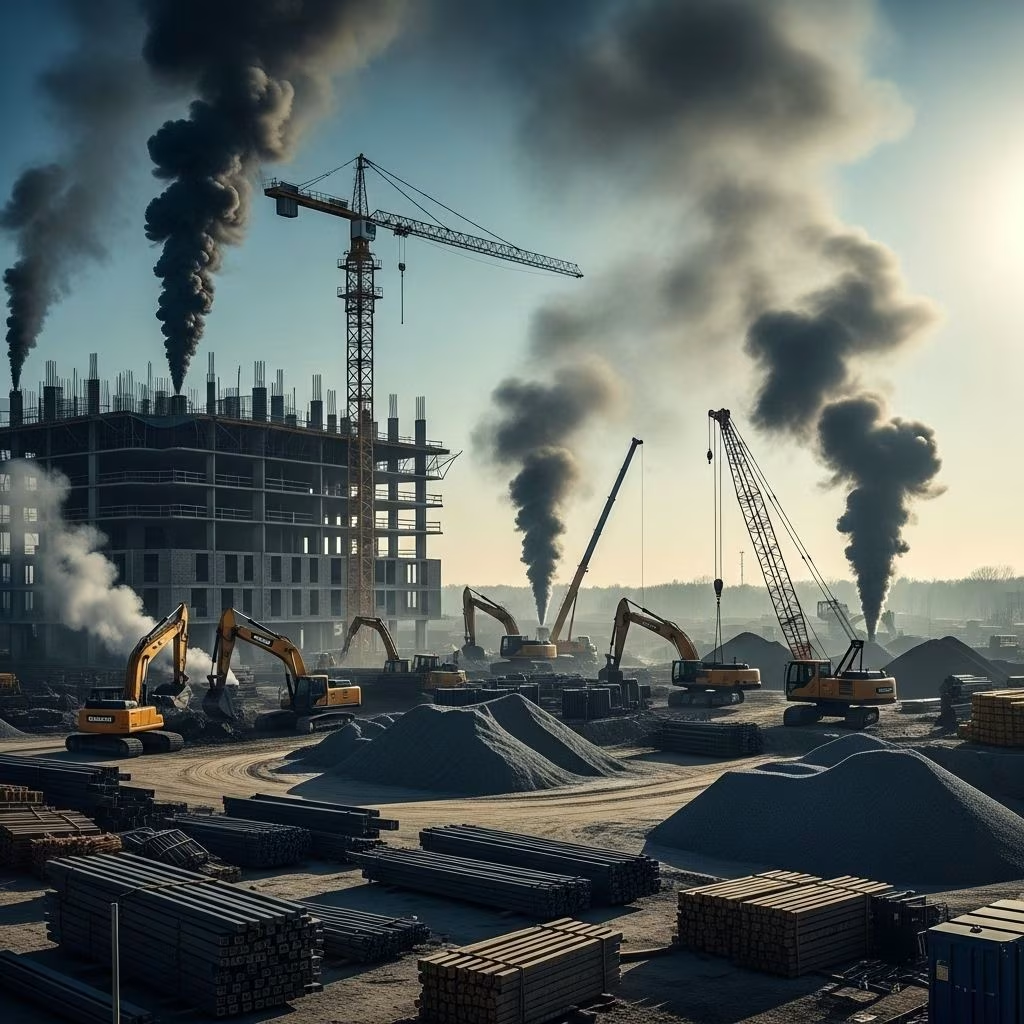
Real Estate Development’s Massive Upfront Carbon Problem
As the world races to address the climate crisis, the role of the built environment—homes, offices, and infrastructure—has come under intense scrutiny. While much attention is paid to how much energy buildings consume over their lifetime, a growing body of evidence shows that upfront carbon emissions—the greenhouse gases released during the construction of buildings—pose one of the most significant, yet underappreciated, climate threats. Understanding the sources, significance, and potential solutions to these emissions is essential for a sustainable urban future.
What Are Upfront Carbon Emissions?
Upfront carbon emissions (also called embodied or upfront embodied carbon) refer to all the greenhouse gases released during the entire process of constructing a building—from extracting raw materials, manufacturing construction products, their transportation, and the physical act of building. These emissions are released before a building is operational—long before the first light bulb is switched on or the first heater is plugged in.
- Embodied carbon: The total carbon emissions associated with a building across its entire lifecycle (upfront, operational, maintenance, and end-of-life).
- Upfront carbon: Refers specifically to emissions released before a building is occupied and in use.
- Operational carbon: The GHGs given off during the building’s lifespan as it is heated, cooled, powered, maintained, and eventually demolished.
Together, these categories provide a whole life carbon profile for buildings, but upfront emissions are unique in that they are released all at once and are essentially “locked in” once a building is completed.
The Scale of the Problem: Why Upfront Carbon Matters
The built environment is one of the world’s largest sources of carbon emissions. According to recent data:
- Buildings contribute 39% of global energy-related carbon emissions. Of this, 28% is from operational sources, while 11% comes from materials, manufacturing, and construction—i.e., embodied and upfront carbon.
However, as energy grids decarbonize and new buildings become more energy efficient, the relative share of upfront carbon is set to grow. Between today and 2050, half the carbon footprint from new buildings will come from upfront emissions. With the world’s building stock expected to double by 2050 to accommodate nearly 10 billion people, action on upfront carbon cannot be delayed.
How Upfront Carbon Is Generated
Every phase of construction, from quarry to site, involves steps that emit significant greenhouse gases. The main sources include:
- Raw material extraction: Mining, quarrying, and processing raw inputs (concrete, steel, glass, etc.) are highly energy-intensive operations that rely on fossil fuels.
- Manufacturing: Converting raw materials into building-ready products (e.g., cement to concrete, iron ore to steel) produces vast emissions—particularly from cement kilns and steel furnaces.
- Transportation: Both raw materials and finished products are transported, sometimes across continents, consuming diesel and gasoline.
- Construction activity: Onsite machinery, generators, and heavy equipment all emit greenhouse gases during the actual building assembly.
The bulk of these emissions—the so-called “upfront embodied carbon”—are released before occupancy. Once construction is finished, those emissions are impossible to reclaim or offset by efficient building operation alone.
Life Cycle Stages of Building Carbon Emissions
The life cycle assessment (LCA) of a building divides emissions into several key stages:
| Stage | Description | Examples of Emissions |
|---|---|---|
| Product Manufacture (A1-A3) | Extraction, transport, and processing of raw materials | Emissions from mining, milling, cement production, steel fabrication |
| Construction (A4-A5) | Transport to site, onsite assembly | Truck emissions, diesel equipment, generator use |
| In-Use (B1-B7) | Operational phase, maintenance, repairs, upgrades | Energy for HVAC, lighting, replacement materials, waste |
| End-of-Life (C1-C4) | Demolition, waste management, material recycling/disposal | Heavy machinery, transport, landfill methane |
Upfront carbon primarily includes emissions from stages A1 to A5.
Which Materials Contribute Most to Upfront Carbon?
Certain construction materials are much more carbon-intensive than others. Recent studies, including case analyses from the National Renewable Energy Laboratory, show:
- Concrete and its main ingredient, Portland cement, are among the top contributors to embodied carbon globally.
- Steel production is also highly carbon-intensive due to its energy requirements and reliance on fossil fuels.
- Insulation and cladding (wall and roof materials) have a significant impact, especially in colder climates where heavy use is needed.
Choice of materials can dramatically impact upfront carbon:
- High-carbon options: Standard concrete, conventional steel, non-renewable insulation.
- Lower-carbon alternatives: Supplementary cementitious materials, recycled or green steel, bio-based insulation and wood products when sourced sustainably.
Why Reducing Upfront Carbon Is Urgent
There’s an inherent urgency: once built, a new development’s upfront emissions are permanent.
- These emissions “lock in” a portion of the global carbon budget, limiting options later and accelerating warming.
- Even if a building operates efficiently, its “carbon debt” from construction may never be repaid through use.
- Net-zero operational targets cannot compensate for massive upfront emissions.
Trends and the Future of Building Stock
Projections indicate a massive increase in global building stock by 2050 due to population growth and urbanization. If current practices continue:
- Upfront emissions will account for up to half of the carbon footprint of new construction between 2020 and 2050.
- This would consume a significant share of the world’s remaining carbon budget for keeping global warming below 1.5^\u00b0C.
Approaches to Reducing Upfront and Embodied Carbon
Tackling the challenge of upfront carbon emissions requires systemic change at every level of the building sector. Initiatives and strategies include:
1. Efficient Material Use and Specification
- Optimizing structural design to minimize the quantity of high-carbon materials.
- Specifying lower-carbon alternatives such as blended cement or recycled steel.
2. Life Cycle Assessment (LCA) Requirements
- Mandating whole-life carbon assessments in building codes and planning approvals.
- Encouraging transparency through carbon disclosure in materials and construction processes.
3. Circular Economy and Reuse
- Prioritizing the reuse of existing buildings over demolition and new builds.
- Employing recycled and upcycled materials wherever possible.
4. Regulatory Standards and Voluntary Frameworks
- Incorporating embodied carbon targets into sustainability standards (e.g., LEED, BREEAM, SBTi guidance).
- Public sector leadership through procurement rules that favor low-carbon materials and construction methods.
5. Retrofitting and Adaptive Reuse
- Retrofitting existing buildings for energy efficiency avoids the upfront emissions of new construction while delivering operational carbon savings.
The Investor and Developer Perspective
For investors and developers, tackling whole-life carbon (WLC) is becoming both a regulatory necessity and a market expectation.
- A WLC approach considers both operational and embodied emissions to find optimal points of intervention.
- Investors are uniquely placed to influence design choices, material selection, and lifecycle management throughout their portfolios.
- Setting science-based targets requires addressing both upfront (embodied) and in-use (operational) emissions across assets.
Emerging Policies and Industry Initiatives
Several global organizations and governments are moving to address upfront carbon in the built environment:
- World Green Building Council: Calls for radical sector-wide shifts, including accounting for upfront embodied carbon in all new projects by 2030.
- Science Based Targets initiative (SBTi): Recommends dedicated targets for reducing both operational and upfront embodied emissions in new and existing buildings.
- GRESB and other ESG frameworks: Now require asset-level disclosure on embodied carbon to qualify for top sustainability ratings.
- National and local governments: Some cities have begun limiting or pricing embodied carbon in building codes and procurement.
Barriers and Challenges
Addressing upfront carbon is not without difficulties:
- Limited availability of robust, standardized data on the embodied carbon in common building materials.
- Lack of incentives or regulatory mandates in most jurisdictions to prioritize upfront carbon reduction over short-term cost minimization.
- Upfront carbon emissions are less visible than operational use, making them an “invisible” problem until standards change.
- Industry inertia and resistance to the adoption of alternative materials and new construction techniques.
Opportunities for Innovation and Decarbonization
- Material innovation: New low-carbon concretes, bio-based materials, improved recycling and upcycling methods are rapidly emerging.
- Digital tools: Building information modeling (BIM) and advanced LCA software allow accurate estimation and management of embodied carbon.
- Design for disassembly: Creating buildings with future reuse in mind reduces both upfront and end-of-life emissions.
- Advocacy and education: Industry leadership, client demand, and public awareness are key to changing current practices.
Frequently Asked Questions (FAQs)
Q: What is the difference between embodied carbon and operational carbon?
A: Embodied carbon refers to the emissions produced during the materials sourcing, manufacturing, transportation, and construction of a building. Operational carbon is the emissions resulting from energy consumed during the use phase of the building (heating, cooling, lighting, etc.).
Q: Why can’t we just focus on efficient buildings and ignore upfront carbon?
A: As buildings get more energy efficient and grids decarbonize, the proportion and impact of upfront carbon increases. Without reducing upfront emissions, new construction will consume a significant portion of the remaining carbon budget, making climate targets unreachable.
Q: Which building materials are the biggest contributors to upfront carbon emissions?
A: Concrete, steel, insulation, and cladding are typically the most significant contributors. Cement production, in particular, is responsible for around 8% of global CO2 emissions.
Q: How can developers or architects reduce upfront carbon?
A: By performing full lifecycle carbon assessments, selecting lower-carbon materials, prioritizing reuse and retrofitting, optimizing design for material efficiency, and adhering to robust green building standards with explicit embodied carbon criteria.
Q: Are there any regulations targeting upfront carbon?
A: Regulation is emerging in some progressive jurisdictions, and voluntary frameworks like LEED, BREEAM, and SBTi strongly recommend or require disclosure and reduction targets for embodied (upfront) carbon. More widespread regulations are expected in the coming years.
Conclusion: The Path Forward for Real Estate Decarbonization
Tackling the crisis of upfront carbon in real estate development is now as urgent as improving building energy efficiency. By reforming industry practices, innovating materials and processes, and establishing robust reporting and regulatory systems, it is possible to sharply reduce the carbon locked into every new building. The clock is ticking—without significant progress, the built environment may use up the planet’s remaining carbon budget long before net-zero operational targets can be achieved.
References
- https://worldgbc.org/climate-action/embodied-carbon/
- https://carbonaccountingfinancials.com/files/downloads/ghg_emissions_real_estate_guidance_1.0.pdf
- https://www.iigcc.org/insights/an-investor-guide-to-addressing-whole-life-carbon-in-real-estate
- https://sciencebasedtargets.org/sectors/buildings
- https://docs.nrel.gov/docs/fy23osti/83049.pdf
- https://www.gresb.com/nl-en/what-is-embodied-carbon-in-the-real-estate-sector-and-why-does-it-matter/
- https://savingplaces.org/stories/upfront-carbon-and-why-it-matters
- https://www.gbca.org.au/get/resources/2156/794DF066980741905C78C3EE5A89D0C3
- https://dusp.mit.edu/news/changing-real-estates-carbon-footprint-data-guide