Finding the Mother Tree: From Forests to Film
Suzanne Simard’s ideas about trees and their astonishing, hidden connections have changed the way scientists, conservationists, and now filmmakers see forests. Her bestselling memoir, Finding the Mother Tree: Discovering the Wisdom of the Forest, is not only a scientific revelation but also a deeply personal account—drawing a direct line from the dense woods of British Columbia to the bright lights of Hollywood, where Amy Adams is set to bring Simard’s story to an even wider audience.
The Birth of a Scientific Revolution
In the dense, misty forests of British Columbia, Canada, a quiet revolution began. Suzanne Simard, then a foresightful forestry scientist, noticed peculiar patterns in tree health and survival that existing models could not explain. Her curiosity led her to one of the most influential discoveries in ecological science: trees are not solitary; instead, they share resources and communicate through an unseen, underground network.
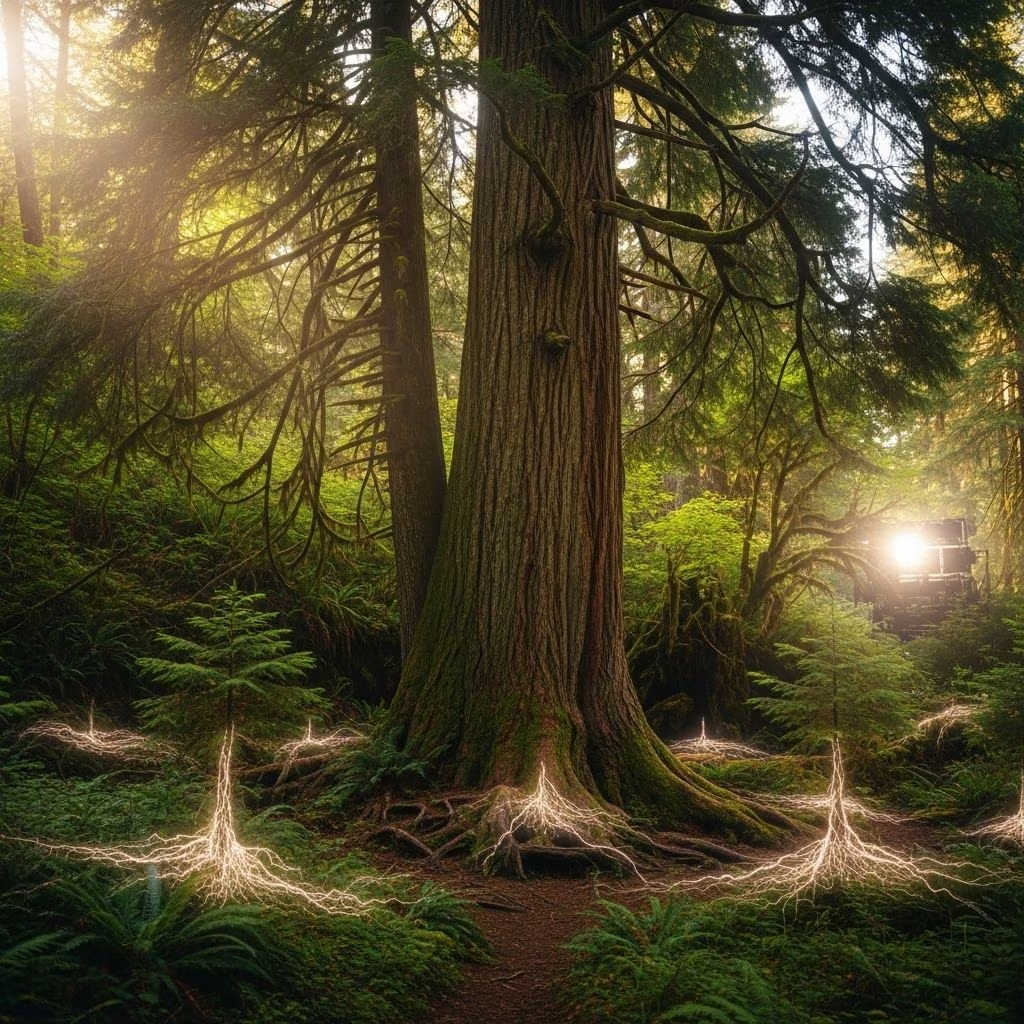
Simard’s work established that trees—once thought to compete ruthlessly for sunlight and nutrients—actually collaborate through vast, intricate webs of mycorrhizal fungi. These networks, akin to an underground internet, allow trees to exchange warnings about pests or drought, to share carbon, nitrogen, and even chemical defense signals. Most astonishingly, Simard discovered the presence of ‘Mother Trees’: old, central trees that nurture younger seedlings and maintain the health of entire forests.
- First major discovery in 1992: Simard provided evidence that Douglas fir and paper birch trees exchange carbon below ground, challenging then-dominant views of plant competition.
- Her experiments, involving the tracing of carbon isotopes, proved conscious and deliberate sharing among different tree species, mediated by mycorrhizal fungi.
These ideas upended decades of dogma and set the course for a new branch of ecology—one, as Simard describes, that reveals the forest as a “society, not a battleground.”
From Science to Storytelling: Simard’s Memoir
Despite her landmark research, Simard noticed that much of her story—and the story of the forests themselves—remained locked away in scientific papers. Craving a broader audience and a more personal mode of communication, she decided, after years of contemplation, to write a book that braided the narrative of her scientific breakthroughs with her own life journey.
Published in May 2021, Finding the Mother Tree quickly soared to the top of bestseller lists. The memoir reflects on:
- Simard’s formative experiences growing up in the forests of British Columbia in the 1960s, when old-growth woods dominated the landscape.
- Her struggle against industry norms that dismissed or derided her findings as radical or unproven.
- The multifaceted relationships between humans, trees, and the broader ecosystem.
- A plea for forest protection, as less than 3% of iconic old-growth forests remain in some of Canada’s most critical habitats.
“The events unfolded quickly—my book was released and became a number one bestseller, and just days later, the film rights were sold,” Simard reflected in interviews.
The memoir’s powerful combination of scientific insight and intimate storytelling resonated far beyond academia. Readers praised its ability to humanize the scientific process, turning data and discoveries into a moving narrative of perseverance, discovery, and hope.
Why Trees Matter: Simard’s Discoveries Explained
Simard’s most significant contribution is the demonstration that forests operate as interconnected communities. The scientific foundation of her work centers on several key concepts:
1. Mycorrhizal Networks
These are symbiotic relationships between fungi and tree roots. Fungi extend far beyond a tree’s root system, connecting with roots of other trees, forming what’s often called the ‘wood-wide web.’
- Fungi break down nutrients in the soil and share them with trees in exchange for carbon-rich sugars produced via photosynthesis.
- Through these connections, trees can send not just nutrients but also complex chemical signals.
2. Mother Trees
Older, established trees can detect and preferentially support their offspring as well as unrelated seedlings through enhanced resource transfer.
- Mother Trees bolster forest resilience in the face of disturbance, drought, and disease by redistributing critical nutrients.
- If a mother tree is cut down, the survival rate of nearby seedlings can dramatically decrease.
3. Forest as a Social Network
Simard’s research directly challenges the view of forests as arenas of pure competition. Instead, her model sees a web of cooperation, kin selection, and mutual benefit.
This scientific reframing has implications for:
- Forest management and conservation policy
- Climate change mitigation strategies
- Reforestation efforts that mimic natural social networks of old-growth woods
The Journey to Hollywood: From Page to Screen
Soon after the book’s critical and commercial success, the story began attracting attention in Hollywood. The rights were quickly acquired, catalyzed by the book’s relevance to contemporary concerns around climate change, biodiversity, and the search for meaning in a fast-changing world.
- Amy Adams signed on to both star as Simard and co-produce the adaptation through her Bond Group Entertainment company.
- Jake Gyllenhaal and his company Nine Stories also joined as co-producers, lending further star power and production expertise.
- The film is currently in advanced development stages, with scriptwriting, casting, and distribution details forthcoming. Filming is set to begin following distributor confirmation.
The momentum behind the adaptation reflects not just the appeal of Simard’s scientific journey but also the urgent environmental message at its core. As Amy Adams herself stated, “Finding The Mother Tree is not only a deeply beautiful memoir about one woman’s impactful life, it’s also a call to action to protect, understand and connect with the natural world.”
Casting Simard: Amy Adams and More
The casting of Amy Adams as Suzanne Simard has been widely celebrated. Adams is known for her ability to portray characters with complexity, emotional depth, and intellectual curiosity. She previously played a scientist in Denis Villeneuve’s Arrival and brought similar sensitivity to roles in Julie & Julia and Hillbilly Elegy. For Simard, Adams’s background as a middle child in a large family resonated with her own upbringing—a detail underscored in their mirrored personal journeys.
Jake Gyllenhaal’s role is largely as producer, but his attachment to the project further raises its profile. The production companies behind the adaptation—Bond Group Entertainment (Adams) and Nine Stories (Gyllenhaal)—promise a thoughtful, high-quality translation of complex science and immersive storytelling.
| Role | Talent | Notable Previous Work |
|---|---|---|
| Suzanne Simard | Amy Adams | Arrival, Hillbilly Elegy, Julie & Julia |
| Producer | Jake Gyllenhaal | Brokeback Mountain, Nightcrawler (as actor/producer) |
| Production Companies | Bond Group Entertainment, Nine Stories | Various acclaimed projects |
Cultural Impact and the Urgency of Conservation
Beyond its narrative allure, Finding the Mother Tree and its screen adaptation are seen by many as vital interventions in the debate over environmental protection. Simard’s research and advocacy focus particular attention on:
- The catastrophic loss of old-growth forests: As Simard has emphasized, British Columbia, once blanketed by old-growth stands, is now dominated by clear-cuts. Only a tiny fraction of original forests remain, but they serve as irreplaceable life support systems.
- The interconnected fate of forests, climate, and humanity: As deforestation accelerates, the stability of these intricate woodland networks is jeopardized, with profound consequences for biodiversity and climate.
- The empowerment of protest and preservation efforts: Simard has given explicit support to activists and local campaigns fighting to save vanishing tracts of old-growth woodland, especially on Vancouver Island.
“We need to fight for them because they really are our life support systems… I think this movie is going to bring that to everybody’s awareness so we can fight like hell [for our forests].” — Suzanne Simard
The story is thus both hope-giving and urgent, marrying awe at the natural world’s complexity with a plea for responsible stewardship.
Anticipated Release and Expectations
The Finding the Mother Tree adaptation remains in active development, with official release date yet to be announced. The rapid process—from book launch to bestseller to movie deal—reflects both the timeliness and universality of its themes. Expectations among both scientific and general audiences run high, given:
- The high-profile, talented cast and production team
- The urgent relevance of Simard’s work to environmental debates worldwide
- The film’s potential to popularize complex ecological concepts in accessible, compelling ways
While details on supporting cast, director, and script are forthcoming, the commitment by Amy Adams and Jake Gyllenhaal signals a serious and respectful approach to the subject matter. Fans of the book, forest lovers, and environmentalists will be following its progress closely, hoping the adaptation will inspire both wonder and action.
Frequently Asked Questions (FAQs)
Q: Who is Suzanne Simard?
A: Suzanne Simard is a Canadian forest ecologist whose research uncovered that trees in forests are connected by underground networks of fungi, challenging traditional views of plant competition and demonstrating collaborative, communicative ecosystem behavior.
Q: What is a “Mother Tree”?
A: In Simard’s framework, a Mother Tree is an older, central tree that supports younger seedlings and sustains the overall health of the forest by sharing nutrients and signals through mycorrhizal networks.
Q: How accurate will the movie adaptation be?
A: While details about the script and direction are pending, the close involvement of Simard and strong casting choices suggest a dedication to authenticity and scientific integrity.
Q: When will the Finding the Mother Tree movie be released?
A: The film is in active development, with production steps such as scripting and distribution underway. An official release date is yet to be announced.
Q: Why is this story important now?
A: Simard’s work spotlights the urgency of forest conservation at a time of accelerating environmental crisis. Her discoveries make a compelling case for protecting old-growth forests, which provide ecological resilience, climate regulation, and biodiversity support.
Further Reading and Resources
- Finding the Mother Tree: Discovering the Wisdom of the Forest by Suzanne Simard
- Documentaries and podcasts on forest networks and mycorrhizal fungi
- Current campaigns to preserve old-growth and native forests worldwide
References
- https://www.landmarkcinemas.com/movie-news/amy-adams-leads-cast-in-movie-adaptation-of-suzanne-simard-memoir
- https://www.movieinsider.com/m19236/finding-the-mother-tree
- https://ubyssey.ca/culture/Finding-the-mother-tree-movie-adaptation/
- https://www.bbcamerica.com/blogs/amy-adams-to-produce-and-star-in-finding-the-mother-tree-movie-adaptation–1016107
- https://www.imdb.com/fr-ca/news/ni63285112/