


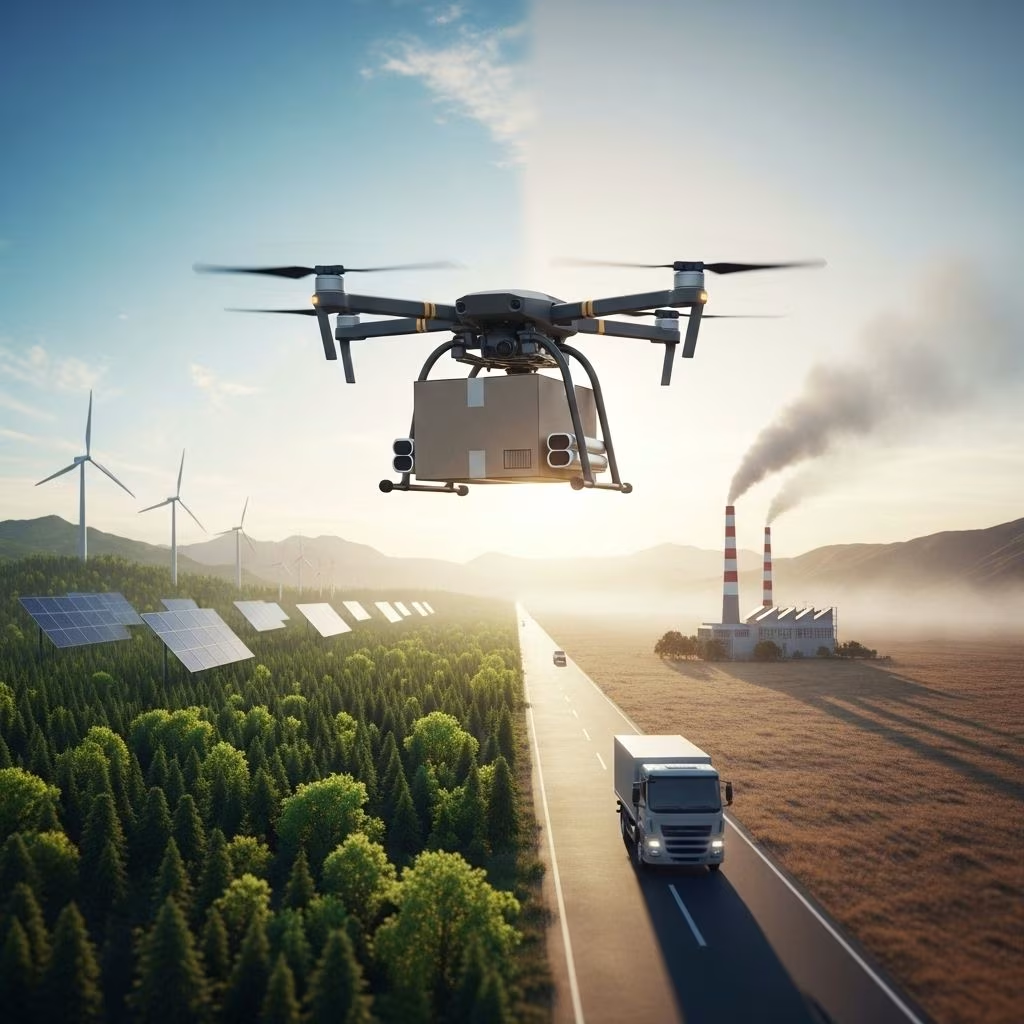
Are Drones Really the Most Climate-Friendly Way to Ship Packages?
Drone delivery has captured global attention as a potential breakthrough for sustainable shipping, especially as e-commerce grows and consumers demand ever-faster delivery. But do drones actually represent the most climate-friendly shipping option, and what are their limits? This article explores the nuances behind drone delivery’s environmental impact, from emissions data to practical deployment challenges.
Introduction: The Rise of Delivery Drones
As online shopping grows inexorably, package deliveries keep pace—leading to increased vehicle traffic, urban congestion, and higher greenhouse gas emissions from last-mile logistics. In response, several companies are investigating the use of unmanned aerial vehicles, commonly called drones, to deliver packages directly to consumers’ doorsteps.
On the surface, drones seem like environmental game-changers: powered by electricity, they bypass traffic, deliver quickly along direct flight paths, and operate without tailpipe emissions. However, a deeper analysis reveals a complex web of trade-offs, including energy grid mix, package size constraints, airspace regulation, new infrastructure needs, and complete life-cycle impacts.
Emissions and Energy Use: Drones vs. Traditional Delivery
The critical claim favoring drone delivery is that it uses much less energy and emits fewer greenhouse gases per package compared to traditional ground vehicles, especially for small payloads and short distances.
- A Carnegie Mellon University study found drones used for last-mile delivery can consume up to 94% less energy per package than traditional vans or trucks. The direct flight paths and electric propulsion of quadcopters prove vastly more efficient for small, lightweight parcels.
- Zipline, a leading medical drone delivery company, reported 98% lower delivery emissions for its drone service compared to car-based delivery over similar distances and payloads. This finding underscores the advantage of drones in specific use cases, primarily lightweight, high-value, time-sensitive goods.
Key energy-saving factors for drones include:
- Direct routes: No detours or idling in traffic, sharply reducing miles traveled.
- Electric propulsion: Drones are typically battery-powered—unlike diesel delivery vehicles—and can charge using a cleaner energy mix where available.
- Small payloads: Drones operate far below the weight limit for most road vehicles, using much less energy to move a single small package.
| Delivery Method | Energy Use per Package | Average Emissions per Package |
|---|---|---|
| Diesel Van | High | High (~70-200g CO2/km) |
| Electric Van | Medium-High | Lower (~20-70g CO2/km, grid-dependent) |
| Quadcopter Drone (Small Package) | Very Low | Very Low (up to 94%-98% less vs. vans) |
| Bicycle/E-cargo Bike | Very Low | Very Low (similar to or lower than drones) |
Note: Actual values depend on package size, delivery distance, and local grid emissions.
Key Limitations of Drone Sustainability
Drones are not a one-size-fits-all solution. Several caveats limit their overall climate impact:
- Payload capacity: Drones can generally deliver only small, light parcels—often under 2-5 kg—which excludes a large portion of typical deliveries.
- Range and battery limits: Most current delivery drones can operate only for short distances (often under 15-20 km per leg) before needing to recharge, restricting their use to hub-and-spoke or very local deliveries.
- Multiple warehouse requirement: To support drone delivery in cities, many decentralized distribution hubs must be built, leading to increased electricity use, real estate footprint, and logistics complexity.
- Airspace regulation and safety: Urban drone operation faces regulatory barriers, privacy issues, and collision risks, delaying widespread adoption.
- Battery manufacturing impact: Lithium-ion battery production carries a significant climate and ecological footprint, which can offset some emission gains, especially if the drone’s service life is short or end-of-life recycling is poorly managed.
As a result, while drones offer huge advantages for certain deliveries, they are not likely to replace vans or trucks for bulk, heavy, or longer-distance shipments in the near future.
The Scalability and Practicality Problem
Scaling drone delivery to handle a significant share of e-commerce deliveries would demand major investments in infrastructure and logistics.
- Supporting distributed drone hubs close to customers increases electricity consumption for running numerous small warehouses or lockers.
- If each package requires a dedicated drone flight, the aggregate energy and resource needs can become significant, potentially reducing the apparent environmental benefit.
- Operational factors—like weather, air congestion, and landing space—also complicate seamless scale-up for city-wide deployments.
Some analysts argue that the net emissions savings of drones may only be meaningful when last-mile logistics can be optimized to replace rather than supplement existing delivery vehicle trips, and when powered by a clean energy grid.
Beyond Tailpipe: Life-Cycle Impact of Drones
To fully understand a drone’s climate effect, one must look beyond direct emissions and consider the full life-cycle footprint:
- Manufacturing: Building drones and batteries requires mining, processing, and assembly that generate substantial emissions and resource use.
- Use phase: Energy use (and carbon savings) depends on drone efficiency, frequency of flights, and the carbon intensity of the local grid.
- Habitat and noise: Routine drone traffic can create disturbance in urban and wildlife areas, with potential secondary ecological impacts.
- End-of-life: Disposal and recycling of drones—especially batteries—pose an environmental challenge unless managed responsibly.
These factors indicate that while far cleaner at the point-of-use, drones are not impact-free and must be assessed using robust, full life-cycle analysis.
Alternatives: Electric Vans, E-Bikes, and Cargo Scooters
If drone delivery doesn’t fit every situation, what other low-carbon options exist for urban and suburban deliveries?
- Electric vans and trucks: Increasingly common among leading delivery companies, electric vehicles provide large payload capacities and route flexibility, with zero local emissions when charged from a clean grid. Their large upfront battery footprint is offset by the high number of packages delivered per route.
- E-cargo bikes and scooters: For dense urban areas, bikes — sometimes with electric assist and cargo trailers — are already among the most efficient, low-emission methods for last-mile delivery. They excel in congested environments, produce little noise, and require minimal energy to operate.
- Hybrid models: Combining delivery lockers or micro-hubs with e-bikes, scooters, or occasional drones for hard-to-reach or urgent parcels can optimize overall emissions and logistics efficiency.
| Delivery Solution | Main Strengths | Main Drawbacks |
|---|---|---|
| Drones | Extremely low emissions for light, fast, short-distance deliveries | Low payload, limited range, heavy regulation, new infrastructure needed |
| Electric Vans/Trucks | Large capacity, scales well, familiar supply chain | Higher energy use per package for small payloads, battery manufacturing impact |
| E-Cargo Bikes/Scooters | Ultra-low carbon, suitable for urban/campus/dense neighborhoods | Limited payload and range, weather constraints |
Urban vs. Rural: Where Do Drones Make Sense?
The key to maximizing the sustainability benefit of delivery drones lies in using them where they outperform alternatives. This is generally true for:
- Remote or hard-to-reach locations: Drones can bypass poor road infrastructure, water crossings, or mountainous terrain where road vehicles require long detours.
- Time-sensitive or high-value deliveries: Critical medical supplies (e.g., blood, lab samples, vaccines) benefit most from ultra-fast, direct delivery with minimal emissions.
- Congested urban cores: While dense city centers seem ideal, airspace limits and restricted landing zones may hamper adoption. In moderately dense neighborhoods with adequate landing spots, drones may provide both speed and carbon gain.
For routine, high-volume urban deliveries, electric vans, e-cargo bikes, or centralized locker solutions may prove more effective and sustainable overall.
Expert Insights and Current Research
Research on drone sustainability continues to evolve. The latest academic studies and real-world pilots suggest:
- Small quadcopters delivering lightweight goods show the biggest net emissions savings compared to vans, especially in areas with clean electricity.
- The margins of sustainability gains shrink when drone systems require extensive support infrastructure, or when battery manufacturing and disposal emissions are fully accounted for.
- Key drivers of total emissions are payload weight, trip distance, electricity grid mix, and overall logistics system design—not simply the swap of vehicle type.
- Drones are particularly valuable for reducing the carbon footprint of “last mile” delivery—the final leg from a distribution center to the consumer—where traditional vehicles are least efficient.
Frequently Asked Questions (FAQs)
Q: Are delivery drones always the greenest option?
A: No. While drones can greatly reduce emissions for small and urgent packages, especially over short distances, they are not suitable for bulk deliveries or where extra warehouse infrastructure offsets their efficiency gains.
Q: How do drones compare to e-bikes and electric scooters for sustainability?
A: Both drones and e-bikes offer extremely low per-package emissions for last-mile delivery, but e-bikes can carry more goods per trip and use even less energy per mile in many cases.
Q: What are the main obstacles to wide-scale drone delivery?
A: Regulatory restrictions, airspace management, safety concerns, payload limits, battery range, and the need for many decentralised distribution points are key barriers.
Q: Do drone deliveries create noise or other forms of pollution?
A: While drones are quieter than trucks or vans, they still produce noticeable buzzing, especially in residential areas, and can disturb wildlife if flown in sensitive regions.
Q: Will drones replace traditional delivery vehicles?
A: Unlikely in the near term. Drones will most likely complement existing fleets, handling urgent, remote, or high-value deliveries while electric vehicles and bikes dominate ordinary package logistics.
References
- https://dronedeliverycanada.com/industry/the-impact-of-drones-on-supply-chain-sustainability/
- https://www.commercialuavnews.com/the-sustainability-aspects-of-drone-technology
- https://engineering.cmu.edu/news-events/news/2022/09/16-last-mile-drones.html
- https://www.nature.com/articles/d41586-022-02101-3
- https://www.faa.gov/uas/advanced_operations/package_delivery_drone
- https://www.eea.europa.eu/en/analysis/publications/delivery-drones-and-the-environment


