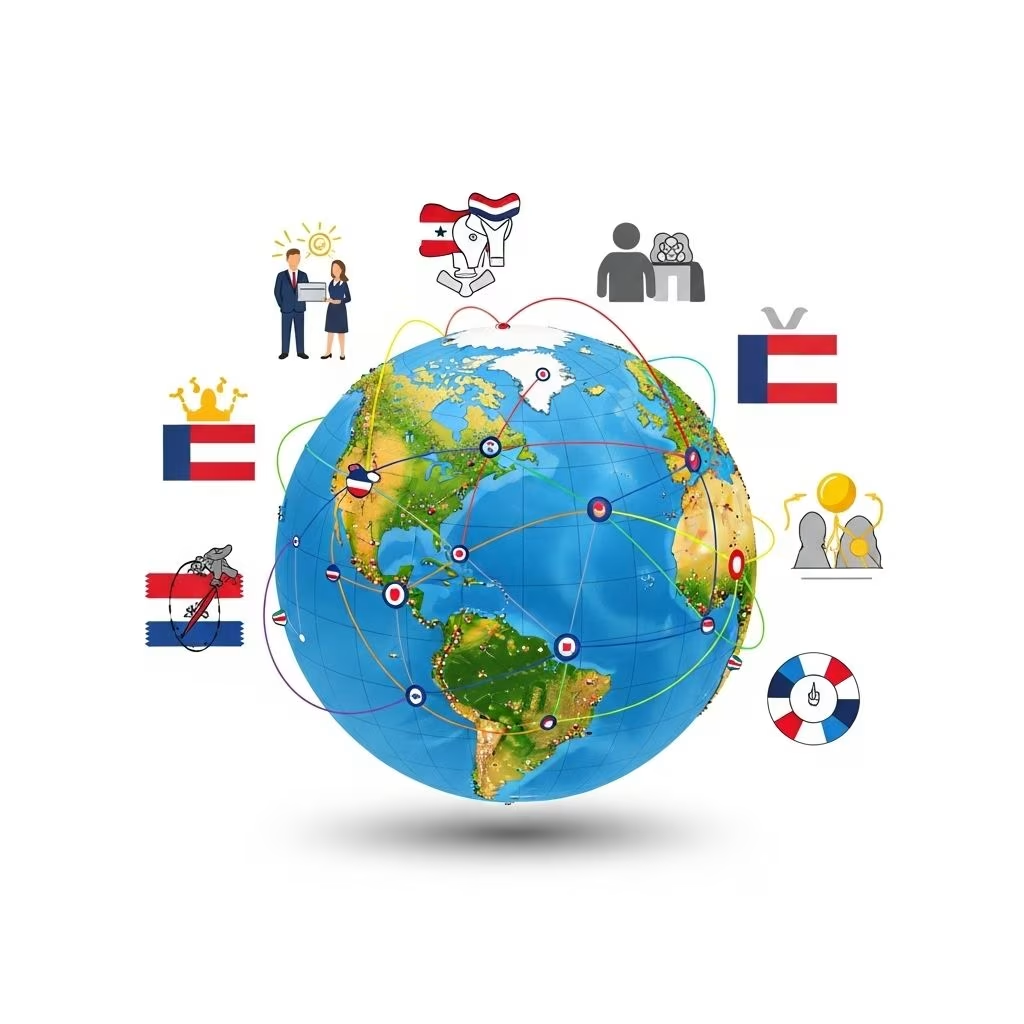
Throughout history, languages have woven the fabric of civilizations, connecting people and shaping cultures. While many nations foster a strong sense of identity around a single official language, there are remarkable countries where linguistic diversity is a defining feature. These multilingual societies not only house scores of languages but also nurture cross-cultural interactions that deeply influence every aspect of daily life. This article explores the world’s most multilingual countries, examining how they maintain linguistic harmony, why so many languages thrive within their borders, and what lessons they offer a rapidly globalizing world.
Understanding Multilingualism
Multilingualism is the use of two or more languages by an individual or a community. At a societal level, it reflects a complex interplay of ethnicities, histories, and cultural dynamics. In some countries, dozens or even hundreds of languages flourish side-by-side, sometimes with multiple official languages, while in others, informal multilingualism happens through trade, migration, or social necessity. The countries celebrated here make a unique case for the value and resilience of linguistic diversity.
Why Do Some Countries Become So Multilingual?
- Historical migration, colonization, and trade brought new languages and created hybrids.
- Diverse indigenous populations often each have their own language or dialect.
- Geographical features such as mountains and islands foster isolated groups, each maintaining their native tongues.
- Language policy: Some governments recognize and protect multiple languages officially or give them special status.
- Tourism and modern globalization emphasize the need for multilingual communication, especially in commerce and education.
The World’s Most Multilingual Countries
Below are some of the most linguistically diverse nations, highlighting their unique language landscapes, cultural dynamics, and how multilingualism informs daily life.
Papua New Guinea: The Undisputed Leader
Papua New Guinea stands unmatched as the world’s most multilingual country, harboring over 800 distinct languages within its borders. Approximately 95% of these languages are indigenous, spoken by communities spread across challenging terrain—isolated mountain valleys, forests, and islands. This isolation not only preserved countless languages but continues to create linguistic microclimates today.
- Official Languages: English, Tok Pisin, and Hiri Motu.
- Multilingual Reality: Most citizens speak several local languages alongside one or more official languages.
- Cultural Impact: Language is intimately tied to tribal identity, with oral traditions and storytelling central to community life.
Indonesia: Islands and Identities
With over 700 living languages, Indonesia is second only to Papua New Guinea in the scale of its linguistic mosaic. Spread across more than 17,000 islands, Indonesia’s geographic fragmentation has sustained enormous linguistic diversity.
- Official Language: Bahasa Indonesia, which serves as a lingua franca and unites the population for government, education, and media.
- Local Languages: Javanese, Sundanese, Madurese, Balinese, and many others; many Indonesians are at least bilingual.
- Daily Life: Local languages dominate in homes and communities, while Bahasa Indonesia is used for cross-group communication.
Nigeria: Africa’s Polyglot Giant
Nigeria is bursting with more than 500 languages, reflecting its vast ethnic and cultural complexity. The three most dominant are Hausa, Yoruba, and Igbo, which influence national politics, media, and identity.
- Official Language: English, a vestige of British colonialism and the medium of government and education.
- Major Regional Languages: Hausa (north), Yoruba (southwest), Igbo (southeast), plus countless others used at home and in local affairs.
- Communication: Most Nigerians speak several languages fluently, switching based on context—family, school, market, or public life.
India: The Subcontinent of Tongues
India possesses a linguistic tapestry like no other, with over 450 languages and hundreds of dialects spoken across its diverse regions.
- Constitutionally Recognized Official Languages: Hindi and English (the latter as an associate official language).
- 22 Scheduled Languages: including Bengali, Telugu, Marathi, Tamil, Urdu, Gujarati, Malayalam, Kannada, Oriya, Punjabi, Assamese, Maithili, and more. Each state typically recognizes its own official language(s).
- Everyday Multilingualism: Indians often speak a regional language at home, use Hindi or English in formal settings, and understand several other languages or dialects due to migration, media, and commerce.
South Africa: The Rainbow Nation of Eleven Official Languages
South Africa officially recognizes 11 languages, the highest number of official languages for any nation. The country’s language policy is a response to its complex colonial and indigenous history.
- Official Languages: Afrikaans, English, isiZulu, isiXhosa, isiNdebele, Sepedi, Sesotho, Setswana, siSwati, Tshivenda, and Xitsonga.
- Linguistic Diversity in Life: English unites business and government; isiZulu and isiXhosa are widely spoken at home; Afrikaans dominates the southern regions.
- Integration: Multilingual proficiency is common, especially in urban areas, facilitating cross-cultural harmony and fluid interactions.
Cameroon: Africa’s Linguistic Crossroads
Cameroon vividly demonstrates Africa’s linguistic wealth, with over 250 languages within its borders. The country embodies Africa’s crossroads, both geographically and culturally.
- Official Languages: French and English, a consequence of colonial rule by both France and Britain.
- Local Languages: Ewondo, Bassa, Fula, and many others are widely spoken in day-to-day life.
- Communication: Cameroonians often speak multiple African languages and either (or both) European official languages, a necessity in business and education settings.
Vanuatu: A Pacific Language Haven
This tiny archipelago in the South Pacific is among the world’s most linguistically dense nations, boasting about 110 languages for a population of barely 300,000 people.
- Official Languages: Bislama (a creole), English, and French.
- Local Languages: Dozens of distinct indigenous languages remain in use, especially on islands and in villages.
- Community Life: Multilingualism is routine, with people often fluent in their village language and one of the national languages.
Switzerland: Four Official Languages, One Nation
Switzerland is renowned for officially recognizing German, French, Italian, and Romansh, and for the everyday realities of its quadrilingual society. Although each canton typically favors one language, linguistic coexistence forms a core component of Swiss identity.
- Official Languages: German (majority), French, Italian, Romansh.
- Daily Realities: Most citizens speak only their canton’s main language natively, but learning other national languages is compulsory in school and increasingly common in large cities and tourist zones.
- Social Benefits: Multilingualism helps bridge regional divides and supports vibrant international trade and tourism.
Luxembourg: Europe’s Trilingual Heart
This small European nation places Luxembourgish, French, and German on equal official footing. Integration is so deep that most Luxembourgers shift seamlessly between languages depending on the setting.
- Official Languages: Luxembourgish predominates at home, German dominates primary education, and French is the main administrative and legal language.
- Other Languages: English is widely taught, and Portuguese is commonly spoken among immigrant communities.
Singapore: Diversity in Harmony
Singapore is remarkable for weaving its four official languages—English, Mandarin, Malay, and Tamil—into a harmonious, multilingual society. English functions as the language of administration and education, while the other three represent the city-state’s main ethnic groups.
- Official Languages: English, Mandarin Chinese, Malay, Tamil.
- Other Languages: Singlish (an English-based creole), regional Chinese dialects, and languages from immigrant groups.
- Policy: Government-mandated bilingual education equips most Singaporeans with functional proficiency in English and their designated mother tongue.
Aruba: Melting Pot in the Caribbean
Aruba, a Caribbean island part of the Kingdom of the Netherlands, is uniquely multilingual given its colonial history and geographic position.
- Official Languages: Dutch and Papiamento, a creole that blends Iberian, West African, and indigenous elements, is widely spoken.
- Education: Children also learn English and Spanish, reflecting economic ties to the Americas and Europe.
- Tourism Influence: Multilingualism is a necessity due to the heavy influx of tourists from diverse backgrounds.
Malaysia: A Mosaic of Mother Tongues
Although Malay is the only official language, Malaysia’s population is a complex blend of Malay, Chinese, Indian, and indigenous ethnic groups.
- Common Languages: Malay, English, Mandarin, Tamil, and numerous regional dialects.
- Reality: Malaysian citizens commonly speak three or more languages, reflecting the country’s multicultural heritage.
The Benefits and Challenges of Multilingual Societies
| Benefits | Challenges |
|---|---|
|
|
Multilingualism in Daily Life and Education
Multilingual societies foster unique approaches to education, media, and public engagement. Some implement strong language policies to foster equity and protect minority languages, while others urge citizens to master international tongues (like English or French) for economic advancement. Bilingual and trilingual education, public signage in multiple languages, and media in several tongues are common features in these environments.
Strategies for Sustaining Language Diversity
- Legal Protection: Constitutional guarantees for multiple official or recognized languages.
- Media Representation: Broadcasting news and entertainment in minority languages.
- Community Engagement: Grassroots efforts to keep traditional storytelling, poetry, and rituals alive in native tongues.
- Interlingual Communication: Using lingua francas (such as English or Bahasa Indonesia) to bridge language gaps while preserving local languages at home.
- Language Revitalization Programs: Initiatives to document, teach, and revive dying languages.
Frequently Asked Questions (FAQs)
What is the most multilingual country in the world?
Papua New Guinea is recognized as the most multilingual country, with over 800 living languages spoken by its diverse communities.
Why do some countries have so many languages?
Factors include indigenous diversity, geographical barriers, migration, colonization, and strong support for preserving local traditions and identities.
How do multilingual countries manage education?
Approaches vary—some prioritize one language for instruction while providing support for others, and some offer truly multilingual curricula. Many citizens learn several languages in school and at home.
What are the main challenges of high language diversity?
Challenges include providing government services in many tongues, crafting inclusive education, preventing language loss, and balancing unity with respect for linguistic identity.
Are there benefits to being multilingual?
Yes—multilingualism enhances cognitive flexibility, opens economic opportunities, strengthens communication, and enriches cultural knowledge.
Conclusion
Linguistic diversity is both an ancient inheritance and a living force in today’s most multilingual countries. These societies reveal the extraordinary adaptability of human communication and the immense cultural wealth created when dozens—or even hundreds—of languages coexist. Their continued vitality depends on deliberate policy, community involvement, and a shared respect for heritage languages as pillars of identity, wisdom, and creativity.
References
- https://www.languagetrainers.com/blog/what-are-the-most-multilingual-countries-in-the-world/
- https://timesofindia.indiatimes.com/world/worlds-10-most-multilingual-countries/articleshow/55366303.cms
- https://en.wikipedia.org/wiki/Multilingualism
- https://journals.publishing.umich.edu/jep/article/id/6262/print/
- https://www.tandfonline.com/doi/full/10.1080/13670050.2024.2409114