Finding Fibonacci in Hurricane Sandy
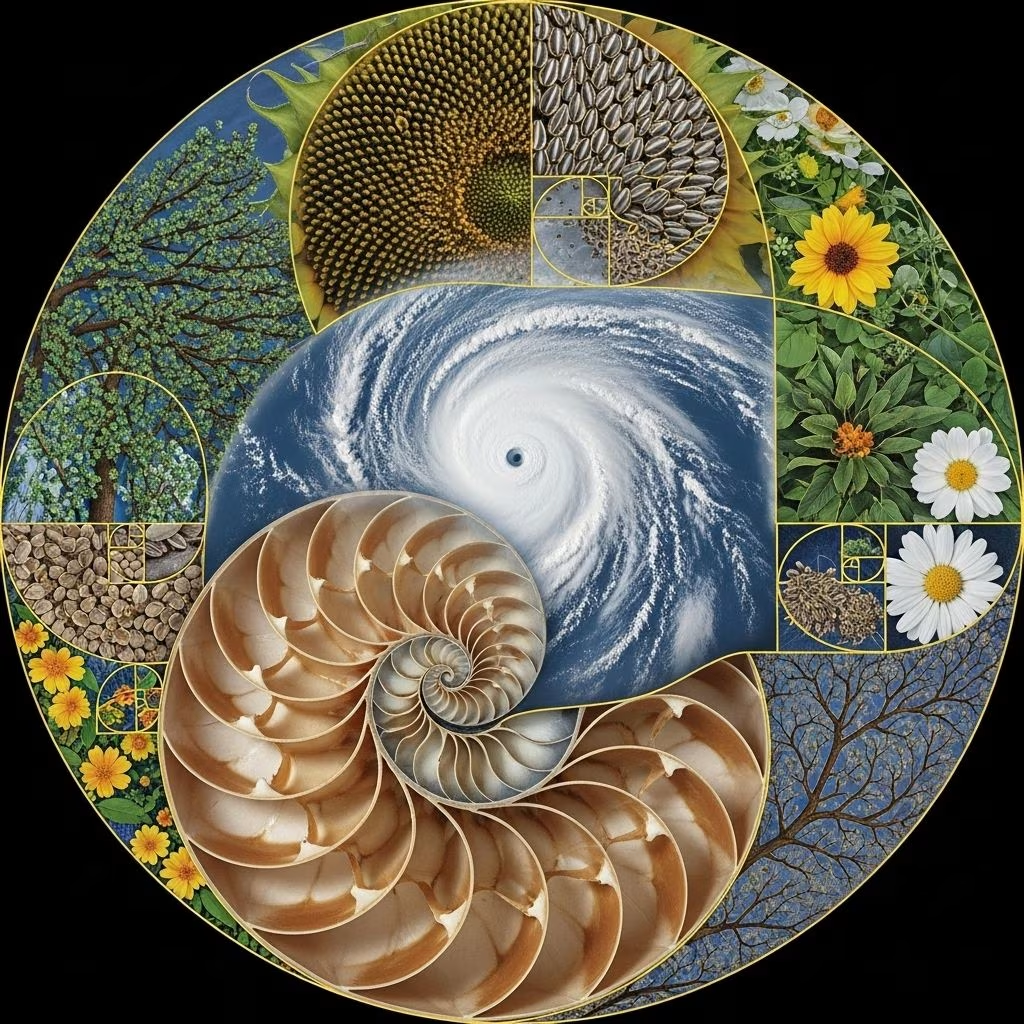
On October 29, 2012, Hurricane Sandy dominated headlines as it swept across the East Coast, but beneath its meteorological significance, the spiraling storm also captivated mathematicians and nature enthusiasts. Many saw in Sandy’s satellite images a familiar mathematical presence: the Fibonacci sequence and its associated spiral. This article explores what the Fibonacci sequence is, how its spiral is identified in storms such as Sandy, its relationship to the golden ratio, and why these patterns emerge so frequently in nature.
Understanding the Fibonacci Sequence
The Fibonacci sequence is a series of numbers in which each number (after the first two) is the sum of the preceding two. It begins: 0, 1, 1, 2, 3, 5, 8, 13, 21, 34…
Mathematicians have long marveled at how this simple rule leads to complex and beautiful results.
- Each new term: Add the previous two numbers.
- Growth: The sequence quickly grows in magnitude.
- Ratio between numbers: As the sequence progresses, dividing a term by its predecessor approaches phi (the golden ratio) ≈ 1.61803398875.
This approach towards the golden ratio links the Fibonacci sequence to spirals and shapes found in natural phenomena, including hurricanes.
The Golden Ratio and the Golden Spiral
The golden ratio (phi, approximated by 1.618…) has been described and revered for centuries as an archetype of balance and harmony.
- The ratio appears when a line or shape is divided in such a way that the ratio of the whole to the larger part equals the ratio of the larger part to the smaller.
- An associated construct, the golden spiral, increases in size by a factor of the golden ratio for every quarter turn it makes.
- In comparison, a Fibonacci spiral is made by drawing arcs through squares whose side lengths follow the Fibonacci sequence.
| Spiral Type | Construction | Key Characteristic |
|---|---|---|
| Golden Spiral | Growth tied exactly to the golden ratio; quarter turns enlarge by φ | Continuous curve, mathematical perfection. |
| Fibonacci Spiral | Arcs through squares sized by Fibonacci numbers | Discrete steps, approximates the golden spiral as it expands. |
Although the golden spiral and Fibonacci spiral are closely related, only the golden spiral is defined by the golden ratio alone, while the Fibonacci spiral is a practical construction using integer ratios.
Analyzing Hurricane Sandy’s Spiral Structure
When Hurricane Sandy formed, its vast, swirling shape from orbit resembled a spiraling pattern familiar to students of nature and mathematics. As some observers pointed out, this spiral looked more like a Fibonacci spiral than a purely golden spiral. But how close was it, really?
Measuring the Spiral
Using pixel measurements from satellite imagery, researchers analyzed the dimensions of Sandy’s apparent spiral:
- The first two squares observed in the spiral were each roughly 4×4 pixels.
- Subsequent squares (constructed by measuring the lengths of spiral segments) were estimated at: 4, 4, 8, 13, 22, 36, 58, and 95 pixels.
- This progression is not perfect, but closely matches the Fibonacci numbers sequence as spirals expand from the storm’s center.
Fibonacci vs. Golden Spiral in Sandy
Calculated differences show Sandy’s spiral was slightly closer to a Fibonacci spiral than to a true golden spiral, given the constraints of image resolution and real-world atmospheric dynamics. The pixel-count comparison and analysis of ratios between squares reveal a stronger fit to Fibonacci progression than exact golden ratio expansion.
Why Do Spirals Appear in Nature?
Fibonacci spirals and golden spirals appear in a remarkable variety of natural phenomena beyond hurricanes.
- Sunflowers: Seed arrangements spiral outward in patterns described by Fibonacci numbers, maximizing density and sunlight exposure.
- Shells: The nautilus shell’s chambers expand logarithmically, resembling Fibonacci or golden spirals.
- Galaxies: Spiral arms often mirror logarithmic spirals seen in mathematics.
- Pinecones: The number of spirals rotating clockwise and counterclockwise often corresponds to Fibonacci numbers.
- Human body proportions: Some ratios in our bodies are approximated by the golden ratio, with spiral growth evident in fingerprints and hair whorls.
These spirals reflect underlying efficiency or optimal packing principles. Evolution, growth patterns, and self-organization seem to favor the mathematical beauty of the Fibonacci sequence.
Fibonacci Spiral in Hurricanes: Does it Predict Severity?
The fascinating presence of a Fibonacci-like spiral in Sandy and other hurricanes begs a scientific question: Does the prominence of the spiral predict hurricane severity? A dedicated research effort examined hurricanes from 2002 to 2012. Data was collected on spiral tightness and compared to measures of hurricane strength, such as wind speed and barometric pressure.
- No significant correlation was found between rainfall amount and resemblance to the golden/Fibonacci spiral.
- A small correlation existed between days as a hurricane and spiral ‘looseness’—but it was not meaningful.
- Wind speed and low barometric pressure were the most correlated (0.513 and -0.470), though findings were weak.
- Conclusion: The more severe hurricanes tended to deviate from an ideal golden or Fibonacci spiral, suggesting that atmospheric turbulence and chaotic dynamics disrupt perfect mathematical order.
The study implies that while spirals are visually compelling, they do not serve as predictors for hurricane severity.
Causes Behind Spiral Shapes in Hurricanes
Why do hurricanes spiral? The answer lies in the physics of rotating air masses and conservation of angular momentum. As air moves toward the low pressure in the storm’s center, it spirals due to Coriolis force and the mechanics of fluid dynamics.
- The spiral’s form approximates global mathematical constants—sometimes closely, sometimes loosely.
- The dynamic environment of storms creates imperfect spirals, which can only approximate pure golden or Fibonacci structures.
Nature’s Intricate Web: Spirals Across Environments
From hurricanes and sunflowers to galaxies and snail shells, spiral patterns reveal a remarkable unity in the way natural systems organize themselves. This interconnectivity—apparent in Sandy’s satellite image—serves as a reminder of the universality of certain mathematical laws.
Fibonacci, Humans, and Environmental Awareness
The ubiquity of the Fibonacci sequence extends far beyond hurricanes. If you’ve ever gazed at the spirals in plants or observed swirling patterns in nature, it’s easy to feel connected to a bigger mathematical tapestry.
- Understanding spirals in nature can foster appreciation for environmental complexity and unity.
- Mathematicians and scientists see Fibonacci’s legacy as evidence of both the aesthetic and functional optimization of natural forms.
- For everyday observers, this awareness can deepen our sense of connection with the natural world.
Recognizing the role of Fibonacci in growth, arrangement, and self-organization encourages curiosity and can motivate us to protect the environments that exhibit these wondrous patterns.
Debate: Fibonacci Sequence vs. Golden Ratio
The relationship between the Fibonacci sequence and the golden ratio sparks debate in mathematical and nature circles. In the context of hurricanes:
- Many enthusiasts mistakenly refer to spiral shapes as “golden” when they may be more closely related to Fibonacci’s integer-based progression.
- Professionals suggest careful measurement is needed to distinguish between approximations and true golden spirals; after all, nature rarely achieves mathematical perfection.
- Satellite imagery, image resolution, and real-world irregularities introduce noise and prevent exact matching.
The take-home point: Whether labeled as golden or Fibonacci, these spirals reflect both the elegance and practicality of nature’s patterns.
Frequently Asked Questions (FAQs)
Q: What is the Fibonacci spiral?
The Fibonacci spiral is a curve drawn by connecting arcs through squares sized by Fibonacci numbers. As the curve expands, it approximates the golden spiral—though in discrete steps rather than a continuous transformation.
Q: Is Hurricane Sandy a perfect Fibonacci spiral?
No. While Sandy’s satellite image closely resembles a Fibonacci spiral, its structure is approximate, not exact. Natural phenomena rarely match perfect mathematical forms due to physical constraints and chaotic dynamics.
Q: Why are spirals so common in nature?
Spirals offer efficient packing, optimal growth, and energy distribution—reasons why evolution and physics tend to favor these forms. The mathematical logic of the Fibonacci sequence and golden ratio reflects nature’s inclination toward efficiency.
Q: Can spiral tightness predict hurricane severity?
Research shows that there is no reliable correlation between a hurricane’s spiral tightness and its severity. The more severe hurricanes actually tend to deviate from the ideal spiral patterns seen in mathematics.
Q: Are humans connected to the Fibonacci sequence?
Yes. Fingerprint patterns, DNA structure, and some bodily ratios approximate Fibonacci numbers or spirals. This signifies nature’s pervasive use of mathematical order.
The Wonder of Fibonacci in Our World
The presence of the Fibonacci spiral in Hurricane Sandy’s swirling clouds isn’t just a curiosity—it’s a testament to nature’s mysterious interconnectivity. From hurricanes and flowers to galaxies and human proportions, spirals continue to fascinate both scientists and laypersons, hinting at the profound mathematical underpinnings of the universe. Whether or not they can be used to forecast storm intensity, Fibonacci spirals remind us of the beauty, unity, and hidden logic underlying the world around us.
Key Takeaways
- Fibonacci spirals are prominent in nature, including hurricanes.
- Hurricane Sandy demonstrated a recognizable, though imperfect, Fibonacci pattern.
- Spiral tightness does not predict hurricane severity.
- Spirals illustrate nature’s quest for efficiency and order.
- Human beings are an integral part of this universal pattern—connecting us to the broader cosmos.
References
- https://petercompernolle.com/2012/fibonacci-or-phi
- https://csef.usc.edu/History/2013/Projects/J0804.pdf
- https://northeastcrackerbarrelnet.com/2017/12/03/fibonacci-spiral-in-hurricane-sandy/
- https://blogs.uoregon.edu/mjanesaad199/
- https://wolfiewolfgang.com/hurricane-sandy-and-fibonacci-sequence/
- https://prezi.com/p/jmj4rwxyeyxo/fibonacci-sequences-in-hurricanes/
- https://ritholtz.com/2012/10/fibonacci-hurricane-sandy/
- https://scitechdaily.com/natures-secret-code-new-findings-shatter-long-held-beliefs-about-fibonacci-spirals/