


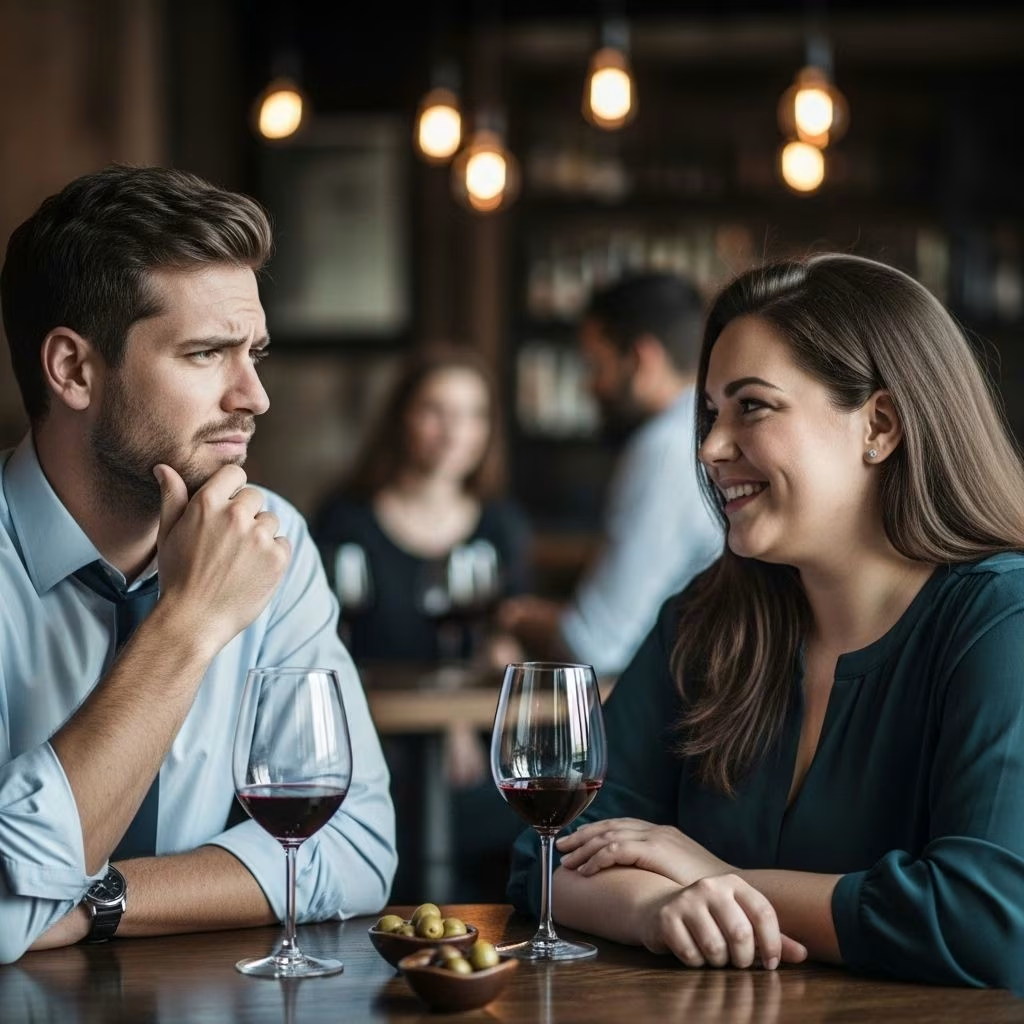
How Stress Affects Male Attraction: The Surprising Science
It’s widely assumed that men universally prefer thin women, but groundbreaking research suggests this preference is far more flexible—and surprisingly sensitive to stress. Multiple studies have found that when men are under psychological stress, they rate heavier female body types as more attractive compared to their unstressed counterparts. The implications challenge conventional beliefs about beauty standards and offer fresh insight into the intersection of psychology, environment, and body image.
The Study: Linking Stress and Attraction
A pivotal study conducted by researchers at the University of Westminster in London set out to explore whether acute psychological stress could alter men’s judgments of female attractiveness. In this controlled experiment, 81 men were divided into two groups: one group completed a stress-inducing task, while the control group performed no such task. Both groups then rated the attractiveness of various female body images, spanning emaciated to obese figures.
- The stressed group consistently rated heavier women as maximally attractive and offered higher overall ratings to larger body sizes.
- Stressed men also showed a widened range in what they considered attractive, compared to the unstressed group, who maintained a much narrower preference for thinner figures.
This experimental design controlled for potential confounders like age, hunger, and BMI, strengthening the argument that stress itself is the driver of shifting preferences.
Understanding the Evolutionary Roots
Why does stress have this effect? Scholars believe the answer lies in our evolutionary past. According to Dr. Martin Tovee, a key researcher on the study, body size ideals are not fixed; they adapt to environmental conditions. In contexts where resources are scarce, individuals may perceive heavier bodies as signals of plentiful energy reserves and high social status.
- Heavier body size signals stored fat, a buffer against food shortages.
- It can also indicate wealth and access to resources, desirable qualities in mate selection when survival is threatened.
- This is supported by cross-cultural findings: in lower-resource environments, a preference for heaviness is much more common, shifting to thinness only as affluence or food security increases.
Environmental Security Hypothesis
The results are consistent with what’s known as the Environmental Security Hypothesis: people’s attractiveness ideals shift toward more mature and resource-associated traits—such as a heavier body size—when they feel threatened by environmental stress, be it social, economic, or psychological.
Key Findings in Detail
| Group | Preferred Body Size | Range of Attractiveness |
|---|---|---|
| Stressed Men | Heavier/Overweight | Broader (More inclusive of various sizes) |
| Unstressed Men | Thinner/Normal Weight | Narrow (More exclusive preference) |
These patterns appeared across several studies, lending robust support to the underlying hypothesis.
Implications: Rethinking Standards of Beauty
Flexible Beauty Ideals: The findings suggest that body size preferences are not universally set or solely a product of modern media. Instead, they change in response to environmental cues and personal circumstances. Stress, in particular, appears to push men toward appreciating heavier women and broadening what they find attractive.
This nuance helps explain why beauty standards fluctuate across cultures and historical periods. In societies where famine or instability are common, heavier bodies are idealized; meanwhile, affluent societies with stable food supplies may gravitate toward thinness.
Expert Insights: Why Stress Changes Perception
- According to Dr. Igor Galynker (psychiatrist, Beth Israel Medical Center), stress has profound effects on how we process new information, both cognitively and emotionally. In other words, stressful situations may prompt individuals to reinterpret cues of health and fertility, prioritizing robustness over thinness.
- Evolutionary psychology posits that when resources are unpredictable, mate selection becomes more liberal—as a means of preserving the species by increasing the chance of successful reproduction.
Dr. Scott Bea, a clinical psychologist at Cleveland Clinic, notes that this “liberalization” under duress is reflected in old proverbs like “any port in a storm.” When options are scarce, standards adapt for practicality.
Broader Social and Psychological Relevance
Adaptation Beyond Attraction: The shift in attraction preferences is only one manifestation of how stress changes behavior and evaluation. The same principle applies to other areas: when one is stressed, desires and expectations in various domains—housing, food, companionship—become more pragmatic and inclusive.
Body Image and Self-Perception: The research carries significant implications for body image and self-esteem. Understanding that personal and societal stressors can unconsciously shift attraction ideals underscores the importance of providing diverse representations of beauty, particularly during public health or economic crises.
Cross-Cultural Perspectives: How Environment Shapes Beauty
Prior studies conducted in Malaysia, Africa, and other regions echo these results. In areas with habitual resource scarcity, heavier body types are often idealized for their connotations of health, fertility, and economic stability.
- Individuals who migrate from low-resource to high-resource areas tend to shift their preferences over time, aligning with local beauty standards.
- Such adaptability suggests that ideals are malleable, reflecting current conditions rather than fixed biological programming.
Implications for Health and Society
Beyond matters of individual attraction, these shifting standards have broad consequences:
- Health Education: Understanding that stress impacts beauty ideals can inform mental health and body positivity campaigns, especially during times of widespread uncertainty.
- Eating Disorders: Dr. Tovee points out that illnesses like anorexia nervosa involve distorted perceptions of ideal body size. Recognizing the impact of environmental stress on these perceptions may influence prevention and treatment strategies.
- Social Policy: As societies experience economic, political, or environmental upheaval, expectations and standards around body size may shift in unexpected ways, affecting everything from fashion industries to interpersonal relationships.
Frequently Asked Questions (FAQs)
Q: Does stress always make men prefer heavier women?
A: Experimental studies indicate a moderate but statistically significant shift in preferences toward heavier women during periods of psychological stress. However, individual responses may vary depending on additional personal and cultural factors.
Q: Are these shifts in preference permanent?
A: No, research suggests body size preferences are highly flexible and can shift back as environmental stressors change or disappear.
Q: Why is the preference for heavier women stronger in some cultures?
A: In environments where food insecurity is prevalent, heavier body sizes are valued as symbols of health and affluence. This changes as resource stability increases and culture shifts to different ideals.
Q: Does this only apply to men?
A: While the featured research focuses on men, related studies suggest that stress can also affect women’s perceptions of attractiveness, but the patterns may differ due to different evolutionary and social pressures.
Q: Can stress-induced preferences impact dating or marriage choices?
A: The study raises the question of whether men in high-stress environments are inclined to seek partners who do not fit conventional beauty norms. While the research does not directly measure real-world dating behavior, it suggests such preferences could plausibly influence broader mate selection strategies.
Takeaways: The Science of Attraction is More Flexible Than You Think
- Stress shifts attractiveness norms: Men’s preferences move toward heavier female body sizes when under environmental or psychological threat.
- Attraction is plastic: Body size ideals are continually shaped by both external environment and individual experiences—not hard-wired or universally fixed.
- Broader impact: These findings inform public discussion about body image, cultural standards, and health, providing evidence that stress and environment are key forces in shaping collective ideals of beauty.
- Cultural and personal relevance: Knowing how stress influences attraction can encourage greater self-acceptance and empathy toward others facing similar pressures.
In sum, while stress’s influence on attraction might be subtle in daily life, it powerfully underscores how environment and psychology jointly create, and recreate, our understanding of what is beautiful.
References
- https://www.ncl.ac.uk/press/articles/archive/2012/08/stressmakesmenappreciateheavierwomen.html
- https://abcnews.go.com/Health/stressed-men-prefer-heavier-women-study/story?id=16950542
- https://pmc.ncbi.nlm.nih.gov/articles/PMC3414440/
- https://www.prevention.com/weight-loss/a20433146/health-news-roundup-stressed-men-prefer-heavier-women-study/
- https://pmc.ncbi.nlm.nih.gov/articles/PMC4312235/
- https://archive.jsonline.com/blogs/news/165625926.html
- https://www.livescience.com/34573-stress-decreases-attractiveness.html
- https://phys.org/news/2012-08-stress-men-heavier-women.html


