


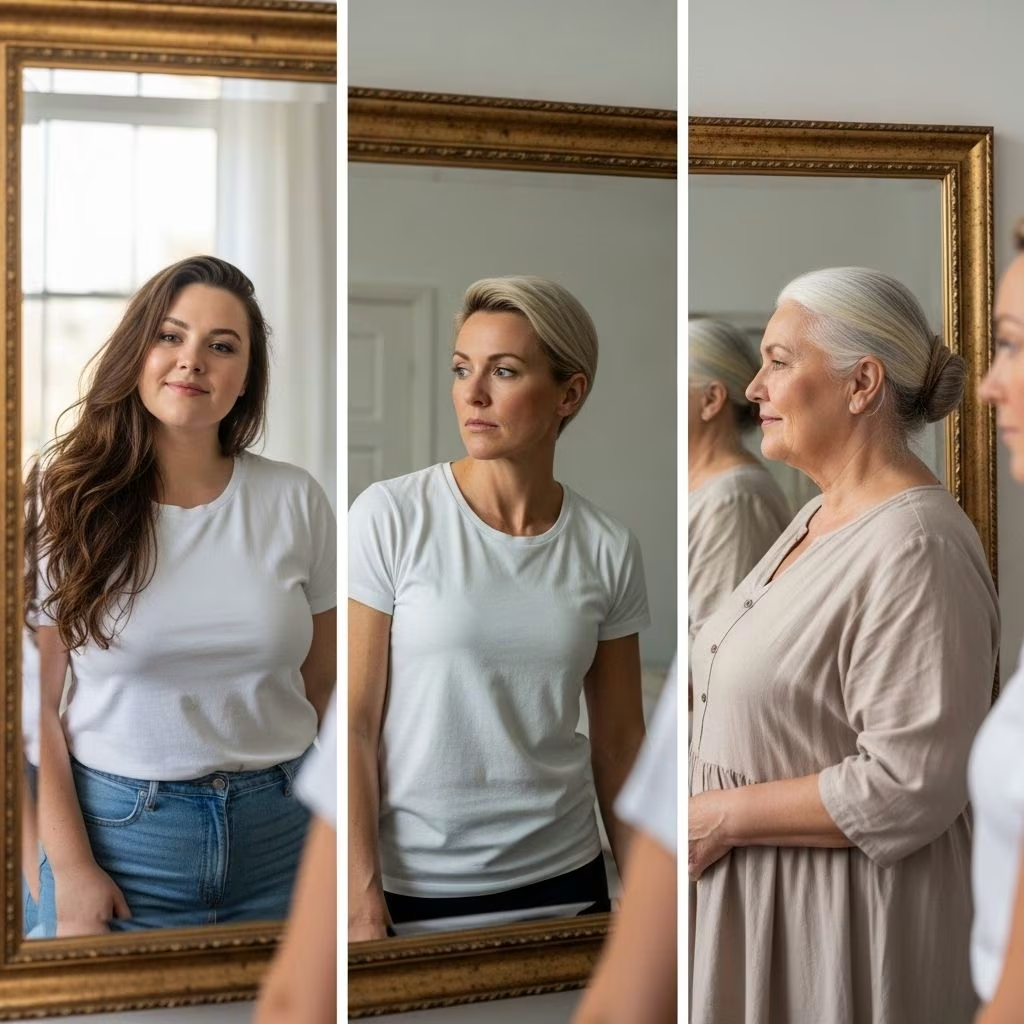
How Do You See Your Body?
Many women look in the mirror and see a distorted reflection—one that feels larger, rounder, or fundamentally different than reality. For some, even as they approach healthy or below-average weights, insecurities simmer: “Am I bigger than I really am?” This nagging question permeates daily routines, confidence, and apparel choices for countless women in midlife and beyond.
Unpacking the Statistics: Women’s Body Image Distortion
According to a comprehensive USDA study, an astounding 40% of healthy-weight and underweight women aged 35 to 55 consider themselves ‘fat’. This isn’t merely a fleeting thought but a persistent belief that shapes self-esteem, wardrobe decisions, and even overall well-being. The roots of this widespread body misjudgment can be traced to a blend of personal experience, media-driven ideals, and shifting standards for femininity.
- Media Amplification: Constant exposure to ‘ideal’ bodies on TV, social media, and advertising sharpens self-critique.
- Pressure from Peers and Family: How others talk about bodies deeply affects personal perception.
- Clothing Choices: Everyday apparel either boosts or bruises confidence, amplifying self-judgment with every glance in the mirror.
Perception vs. Reality: A Photo Experiment
To challenge body image assumptions, Prevention magazine selected three healthy-weight women, asking each to identify her unaltered photograph from a lineup that included:
- A true-to-life image
- An image where she appeared 10 pounds heavier
- An image where she appeared 10 pounds lighter
- Photos highlighting either a larger upper or lower body
The surprising result? Half of the participants selected the altered, “heavier” versions as their own real bodies. For many, the expectation of “looking bigger” visually overpowered objective reality.
Women’s Stories: Seeing Ourselves Through a Funhouse Mirror
Jennifer Wiley
Age 35, 5′ 5½”, 145 pounds
Jennifer is a pharmaceutical sales director who proudly claims an athletic build. She’s more muscular than most, but since becoming a mother, finds herself fixating on her “large” thighs.
- “All I could see were the big white thighs,” Jennifer admitted, after picking an altered image with a significantly larger lower body as her real self.
- Her husband accurately identified her true photo, suggesting those closest to us may see us more objectively than we do ourselves.
- Since participating in the experiment, Jennifer lost 7 pounds, motivated not by self-loathing but by a clearer understanding of her body’s truth.
Kathryn Kercher
Age 36, 5′ 3½”, 119 pounds
Kathryn, a marketing director, finds that clothes profoundly influence her self-perception:
- “A good outfit can make me feel great, but if something doesn’t fit right I start thinking my body is the problem.”
- Working out, especially yoga, reliably boosts her mood and her body confidence.
- Through the photo experiment, Kathryn recognized her self-critique was often more about fashion than flesh.
- Now, she’s far more selective when shopping, investing in clothes that fit and flatter over bargains that disappoint.
Lynne Pierce
Age 40, 5’6″, 107 pounds
Lynne is a lifelong athlete—she cycles, walks, plays tennis, and exercises frequently. She describes herself as “tall and, I hate to say, thin.”
- Despite others seeing “thinness,” Lynne rues her “scraggly arms” and wants more muscle definition.
- In the photo lineup, Lynne and her family all mistakenly chose an image that made her appear 10 pounds slimmer. She genuinely couldn’t distinguish between her real and the airbrushed images.
- This confusion suggests even the thinnest among us can struggle with seeing ourselves accurately.
The Psychology of Body Image Distortion
Why is reality so easily blurred? The following table outlines the key psychological contributors to body image distortion:
| Factor | Impact on Body Perception |
|---|---|
| Media & Social Media | Promotes unattainable beauty standards, intensifies self-critique |
| Peer & Family Attitudes | Comments or teasing reinforce insecurity |
| Personal Experience | Past negative feedback can trigger chronic doubt |
| Clothing Fit | Ill-fitting clothes exaggerate flaws in one’s mind |
| Mental Health Status | Anxiety or low mood increases negative self-perception |
Research by the Mental Health Foundation confirms the link between higher body dissatisfaction and poorer quality of life, psychological distress, and increased risk of disordered eating.
Gender, Culture, and Individual Variation
Body image struggles are not confined to one gender or age. However, societal expectations most often target women with rigid standards. Cultural ideals, long-term health conditions, and even sexual orientation can intensify these feelings.
- Cultural Ideals: Some cultures value curves, others praise thinness—the resulting confusion can distort individual perception.
- Social Discrimination: Media portrayals often exclude diverse body types, deepening marginalization and shame for those who differ.
Social Media and Advertising: Adding Fuel to the Fire
Recent surveys highlight the potent role of digital media:
- 21% of adults report that advertising images have caused them to worry about their body image.
- 22% of adults and 40% of teenagers say social media has heightened their body image anxiety.
On platforms flooded with filters and retouched images, the distance between expectation and reality grows wider, fostering discontent and shame among viewers.
The Emotional Toll of Distorted Body Image
How deeply does this warped perception affect individuals?
- 20% of adults feel shame, and 34% feel low mood about their bodies in a given year.
- 13% of adults report having suicidal thoughts rooted in body image concerns.
- The impact is even greater for teens, with 37% feeling upset and 31% feeling ashamed about body image.
Rethinking Self-Perception: The Aftermath
After their photo reality check, several of Prevention’s participants noted significant life changes:
- Trudy swapped baggy, shapeless clothing for tailored pieces, drawing compliments and renewed self-assurance.
- Kathryn became more deliberate in shopping, prioritizing what made her feel good rather than settling for bargains.
- Jennifer started a healthy weight loss journey—not from self-hatred, but from coming to terms with her body’s strengths.
- JoAnne, unique in having identified her real image correctly, discovered that her spouse and colleagues saw her as slimmer than she imagined, validating that “the number on the scale doesn’t matter as much.”
These testimonials underscore a single crucial point: body image is not reality—it’s perception.
Strategies for Healthier Body Image
So, how can women (and men) bridge the gap between how they see themselves and how they truly are?
- Be media literate: Question the images you see online. Most are edited or manipulated.
- Select your circle: Surround yourself with people who value you for more than appearance.
- Curate your closet: Invest in clothes that fit well and boost confidence, instead of chasing trends.
- Talk kindly to yourself: Replace negative self-talk with positive affirmations.
- Be physically active: Focus on exercise as a way to feel good, not just look good.
- Spring-clean digital feeds: Unfollow or mute accounts that heighten self-doubt or promote unhealthy body ideals.
- Seek help when needed: Professional counseling or support groups can be transformative for those struggling deeply.
Frequently Asked Questions (FAQs)
Q: Why do so many women see themselves as bigger than they are?
A: A toxic mix of media messages, peer pressure, past criticism, and personal insecurities often cause women to overestimate their body size, especially if they’ve internalized “ideal” proportions promoted by society.
Q: Can negative body image affect my mental health?
A: Yes. Research links body dissatisfaction to increased risks of anxiety, depression, low self-esteem, disordered eating, and in some cases, suicidal thoughts.
Q: How can I see myself more accurately?
A: Cultivate self-awareness, limit exposure to unrealistic images, surround yourself with positivity, and consider photo or mirror experiments—like those described above—to recalibrate your self-view.
Q: Is it normal to have days when I dislike my body?
A: Absolutely. Body image fluctuates day to day. What matters is fostering a supportive inner dialogue and not allowing bad days to set permanent emotional tone.
Q: When should I ask for help?
A: If body image anxieties become overwhelming or harmful—affecting mental health, eating habits, or daily function—consider speaking with a friend or a mental health professional for support.
Final Thoughts: Finding Peace in Your Own Skin
The mirror may magnify insecurities, but it doesn’t define you. Body image is shaped by a swirl of outside influences and private beliefs. While you may never erase all doubts, mindful self-compassion, community support, and a balanced perspective can shift the balance. Ultimately, learning to see your real body—free from distortion—may unlock a sense of peace more vital than any number on a scale.
References
- https://www.prevention.com/weight-loss/a20443468/how-do-you-see-your-body/
- https://www.mentalhealth.org.uk/explore-mental-health/articles/body-image-report-executive-summary
- https://www.prevention.com
- https://www.prevention.com/health/health-conditions/a41897328/what-hot-flashes-are-telling-you-about-your-health/
- https://www.prevention.com/weight-loss/a20499252/the-unbelievable-way-meditation-could-be-the-missing-piece-of-your-weight-loss-puzzle/
- https://www.prevention.com/health/health-conditions/a44798692/weight-gain-exhaustion-hashimoto-thyroiditis-my-diagnosis/
- https://www.prevention.com/health/a20485574/you-have-a-precondition-heres-what-it-really-means-and-what-you-need-to-do-to-stay-healthy/
- https://www.prevention.com/weight-loss/a36065492/rethinking-body-weight/


