


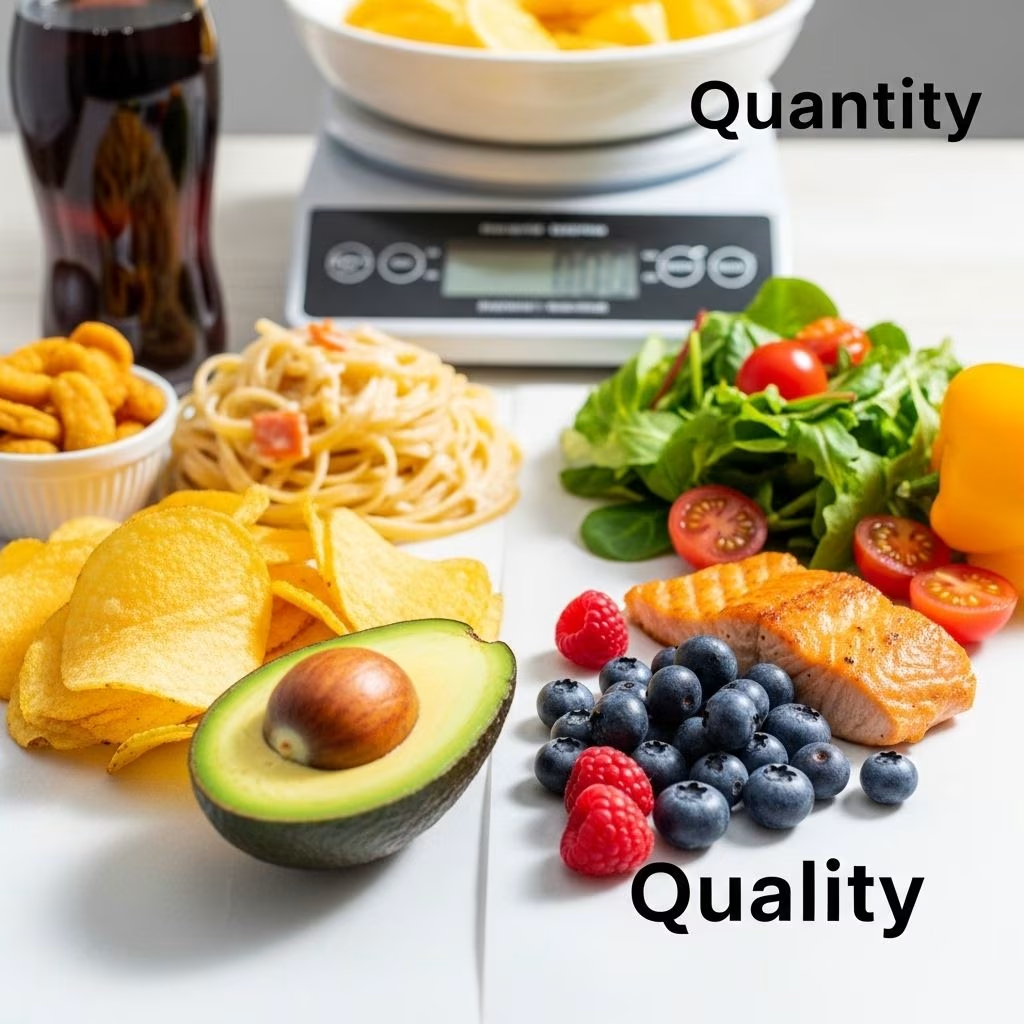
The New Calorie Counting Theory: Why Quality Matters More Than Quantity
For decades, the dieter’s mantra has been simple: calories in, calories out. By meticulously tracking every snack and meal, we’re told we can lose weight or maintain discipline. Yet, mounting evidence and expert voices suggest that calorie counting is not only an outdated strategy, but it may also undermine your well-being and weight loss goals.
Understanding the Shift: From Counting Calories to Mindful Eating
Traditional calorie counting focuses solely on numbers – how much energy you consume and expend. However, Jonathan Bailor, author of The Calorie Myth: How to Eat More, Exercise Less, Lose Weight, and Live Better, argues that the body’s natural mechanisms are far more sophisticated and self-regulating than previously recognized. Bailor spent years researching why common weight loss strategies were making people “sick and sad” rather than happy and healthy. Central to his thesis is the concept of the set point weight – a stable, biologically-determined weight where your body naturally hovers, regardless of conscious calorie counting.
- Set point theory: Your body maintains a default weight based on complex internal controls.
- Quality over quantity: The nutritional value of calories matters more than the mere number.
How Your Body Naturally Counts Calories
According to Bailor, “The body is designed to balance itself out.” If you eat foods high in nutritional quality—lean proteins, whole vegetables, healthy fats—your brain essentially counts the calories for you. It manages energy expenditure and hunger signals, keeping you near your set-point.
- High-quality foods promote satiety and stabilize blood sugar.
- Processed, low-nutrient foods disrupt the system, pushing your set-point higher.
- Calorie tracking is unnecessary if you choose foods that naturally signal fullness and nourish you.
The implication is clear: recalibrating your set-point by focusing on quality—rather than obsessively counting calories—may be the key to lasting change.
The Decline of Traditional Calorie Counting
Many popular programs, including Weight Watchers, have reconsidered their stance on calorie counting, introducing points systems and focusing on food quality. Yet, the legacy of calorie counting persists, with many still relying on apps or journals to log every bite.
Emerging research shows why this approach may be flawed:
- Calorie counting ignores metabolic differences between individuals.
- Low-calorie diets often lead to poor nutrition, low energy, and diet fatigue.
- Most people regain weight after calorie-restriction ends.
Why Counting Calories Fails for Most People
Bailor’s research indicates that strict calorie counting leads to failure over 95% of the time and can even make people heavier in the long run. Dieters experience hormonal changes, slowed metabolism, and elevated hunger that drive weight regain. For Bailor and countless others, this realization marked a turning point:
- Counting leads to fatigue and frustration.
- Set-point disruption from low-quality foods triggers unwanted weight gain.
- Long-term success comes from food quality and lifestyle, not arithmetic.
Set Point Theory: The Body’s Hidden Regulator
Your weight is not simply the result of willpower or mathematical calculations. Set-point theory suggests that your body has a preferred weight range, controlled by genetics, hormones, and lifestyle factors. Dieting with poor-quality foods may increase your set-point, making future weight loss more difficult.
| Traditional Calorie Counting | Set Point Theory |
|---|---|
| Focuses on calorie numbers | Focuses on food quality and body regulation |
| Can ignore nutritional value | Values nutrient-rich, whole foods |
| Often leads to weight regain | Promotes sustainable weight maintenance |
| Induces hunger and fatigue | Balances appetite and metabolism |
Common Myths About Calorie Counting
- Myth 1: All calories are equal.
- Myth 2: Eating fewer calories always results in weight loss.
- Myth 3: Tracking calories ensures success.
- Myth 4: Weight management is entirely about willpower.
- Myth 5: Dieting is necessary for everyone.
Quality Beats Quantity: Making Calories Work for You
So, what makes a quality calorie? Foods packed with nutrients, fiber, protein, and healthy fats fuel the body’s natural balancing mechanisms. For Bailor, it means getting back to basics:
- Eating primarily whole, unprocessed foods.
- Eliminating refined sugars and starches.
- Prioritizing vegetables, lean proteins, nuts, and seeds.
- Focusing on satiety and nourishment rather than deprivation.
Each of these steps helps to lower your set-point, making it easier to maintain a healthy weight without feeling deprived.
Calorie Counting vs. Intuitive Eating: What Works?
Some studies show that calorie counting can lead to more consistent short-term weight loss compared to intuitive eating, but there are tradeoffs:
- Calorie counting can work for those who thrive on structure and discipline.
- Intuitive eating emphasizes listening to hunger and fullness cues.
- Weight loss may be slower with intuitive eating, but it’s more sustainable and less stressful.
Experts suggest that adopting a quality-focused approach may blend the best of both worlds—leading to steady, long-term results without the need for constant tracking.
Risks and Downsides of Calorie Restriction
- Severe calorie restriction can lower metabolism, making future weight loss harder.
- Low-calorie diets often lack essential nutrients, impacting skin, bones, and energy.
- Restrictive eating can promote binge cycles and emotional stress.
- Obsessive tracking can undermine mental health and social life.
Letting Your Body Count Its Own Calories: A Practical Guide
If you want lasting results, Bailor recommends learning to trust your body’s innate intelligence:
- Eat foods as close to their natural state as possible.
- Prioritize protein, fiber, and healthy fats.
- Eliminate processed grains and added sugars.
- Cook your own meals whenever possible.
- Eat until satisfied, not stuffed.
According to Bailor, this approach resets your set-point to a lower, healthier range, allowing you to lose weight and keep it off—without unending math.
Expert Insights: Sustainable Weight Loss Strategies
Registered dietitians and weight loss researchers generally agree: lasting results come from making sustainable, nutritious choices rather than short-term deprivation.
- Mindful eating and portion control can support healthy habits.
- Behavior change and goal-setting are crucial for success.
- Building self-efficacy and social support helps maintain results.
- Calorie counting may jumpstart weight loss for some, but most benefit from focusing on quality.
Frequently Asked Questions (FAQs)
Q: Do calories matter at all if I eat healthy foods?
A: Calories do matter, but your body naturally regulates intake if you’re consistently eating high-quality foods. This means you may not need to track every calorie.
Q: Can I lose weight with intuitive eating instead of calorie counting?
A: Yes, intuitive eating can result in weight loss, though the process can be slower than strict calorie counting. The main advantage is sustainability and improved well-being.
Q: What kinds of foods disrupt my set-point?
A: Foods high in refined sugars, artificial ingredients, and processed grains can raise your set-point, making it harder to lose weight and maintain it.
Q: What are the dangers of chronic calorie restriction?
A: Chronic restriction can lead to slowed metabolism, nutrient deficiencies, weakened immunity, and mental fatigue.
Q: How can I tell if my set-point has changed?
A: Signs include easier weight maintenance, reduced cravings, higher energy levels, and eating until satisfied without gaining unwanted weight.
Q: Are popular calorie-counting apps helpful?
A: Apps can support self-monitoring and feedback, but tend to focus on quantity over quality. Their effectiveness depends on how they’re used and the user’s goals.
Key Takeaways
- Obsessive calorie counting is ineffective for most people.
- Focus on food quality, not just quantity, to reset your body’s natural weight regulator.
- Sustainable weight loss comes from mindful eating, nutritious choices, and trusting your body.
- Avoid processed and low-nutrient foods to lower your set-point and facilitate easier weight maintenance.
Related Resources
- Is the Pink Salt Trick for Weight Loss Effective?
- 19 Best Ways to Lose Belly Fat for Good
- 100 Easy Ways To Cut 100 Calories
- The 22 Best Foods for Weight Loss
- Does Apple Cider Vinegar for Weight Loss Work?
- How Your Cortisol Levels Can Impact Weight Gain
If you’re ready to break free from the tyranny of calorie counting, consider shifting your mindset. Place quality first, and let your body take care of the numbers.
References
- https://www.prevention.com/weight-loss/a20466505/the-new-calorie-counting-theory/
- https://www.prevention.com/weight-loss/diets/a20437109/calorie-counting-is-better-for-weight-loss/
- https://www.prevention.com/weight-loss/g20504855/5-reasons-to-never-count-another-calorie/
- https://mhealth.jmir.org/2016/1/e19/
- https://www.prevention.com/food-nutrition/a64365995/4-3-intermittent-fasting-vs-calorie-counting-weight-loss-study/
- https://www.prevention.com/weight-loss/diets/a38916282/calorie-deficit-diet/
- https://www.prevention.com/weight-loss/g20432475/15-ways-to-cut-hundreds-of-empty-calories-a-day/
- https://www.prevention.com/weight-loss/diets/a44398007/intermittent-fasting-diet-no-better-for-weight-loss-than-calorie-counting-study/
- https://pmc.ncbi.nlm.nih.gov/articles/PMC5639963/
- https://www.prevention.com/weight-loss/a20477639/the-calorie-counting-trick-to-beat-cravings/


