The Ultimate Guide to Watching the 2024 Total Solar Eclipse
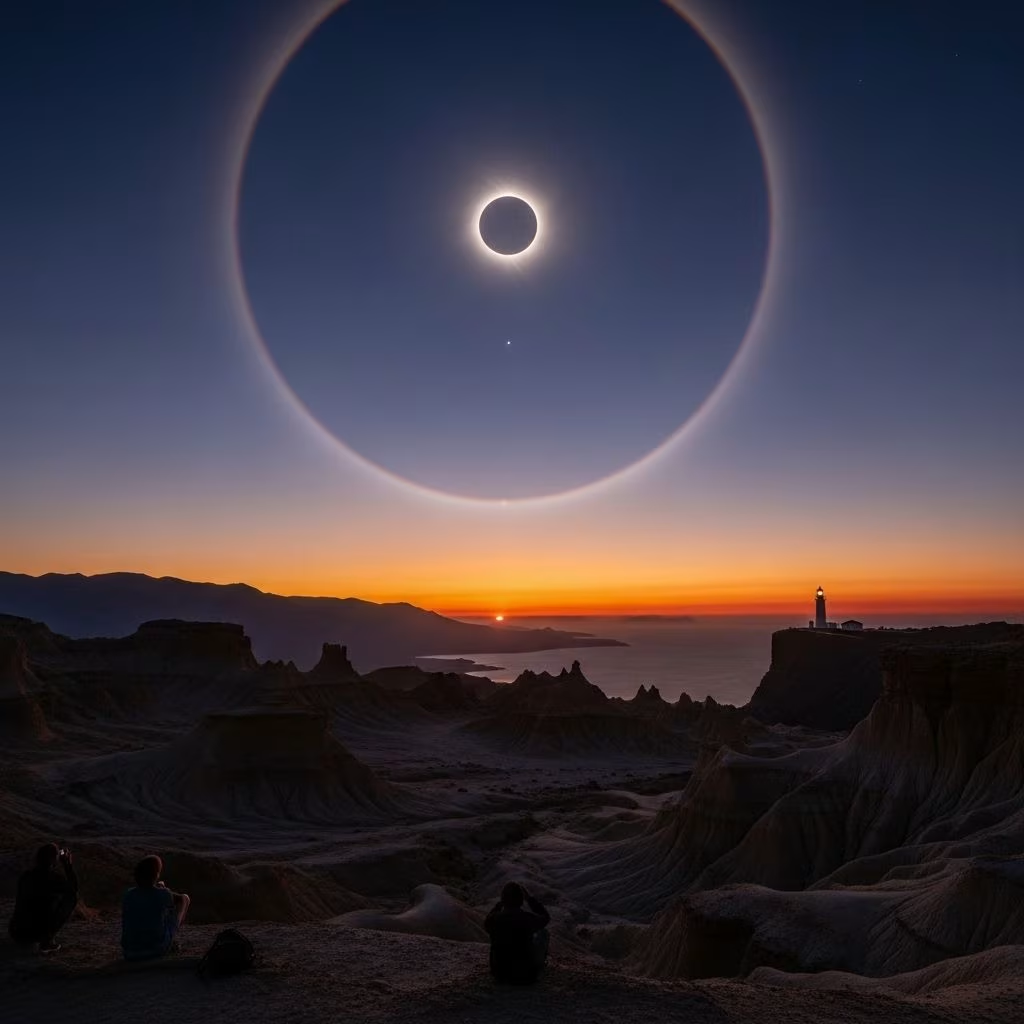
On April 8, 2024, skywatchers across North America were treated to one of nature’s most spectacular events: a total solar eclipse. This breathtaking phenomenon, where the Moon completely covers the Sun, cast a dramatic shadow—the path of totality—over Mexico, the United States, and Canada. For those fortunate enough to be in this path, the experience was unforgettable and awe-inspiring, combining celestial wonder, scientific significance, and moments of communal celebration.
What Is a Total Solar Eclipse?
A total solar eclipse occurs when the Moon passes directly between the Earth and the Sun, perfectly aligning to temporarily block the Sun’s light and plunge daytime into darkness. This rare event offers a unique chance to witness the Sun’s corona, the outermost layer of the solar atmosphere, which is usually hidden by the Sun’s dazzling brightness.
Path of Totality: Where the Eclipse Was Visible
The path of totality was the narrow swath of land where viewers experienced full darkness as the Moon’s shadow raced across the continent. For the 2024 eclipse, this path began on Mexico’s Pacific coast, passed through the central United States, and exited North America via eastern Canada. Only locations directly within this path saw the total eclipse; areas just outside saw a partial eclipse where only a portion of the Sun was covered.
| Country | Entry Point | Exit Point |
|---|---|---|
| Mexico | Mazatlán | Torreón |
| United States | Texas | Maine |
| Canada | Ontario | Newfoundland |
- Within the U.S., 15 states were crossed by the path of totality, including Texas, Oklahoma, Arkansas, Missouri, Illinois, Kentucky, Indiana, Ohio, Michigan, Pennsylvania, New York, Vermont, New Hampshire, Maine, and Tennessee’s northwest corner.
- The eclipse lasted up to 4 and a half minutes at certain prime locations, with totality times and viewing conditions varying by city.
- Major cities directly in the path included Dallas, San Antonio, Austin, Indianapolis, Cleveland, and Buffalo.
Top Places to Watch the Solar Eclipse in 2024
Travelers and eclipse chasers planned months in advance to position themselves within this narrow shadow. Below are some of the best destinations along the eclipse path, each offering their own unique atmosphere, events, and eclipse viewing potential.
1. Mazatlán, Mexico
Mazatlán, along the Pacific coast, was where the Moon’s shadow first touched North America. With clear skies more likely in April and beautiful coastal views, it was a top choice for eclipse travelers.
2. San Antonio, Texas
San Antonio was among the first major U.S. cities to experience totality. With excellent tourist infrastructure, vibrant local culture, and historic sites like the Alamo, it offered both astronomical and travel rewards. The city hosted special events in parks and open spaces.
3. Austin, Texas
The state capital was just on the edge of the path, but areas to the north and west of the city provided prime totality views. Austin’s busy music and food scenes added to the appeal.
4. Dallas, Texas
Dallas stood directly in the path, with some neighborhoods able to experience more than three minutes of totality. Wide open parks and surrounding rural areas provided unobstructed views, and the city coordinated large public gatherings.
5. Hot Springs National Park, Arkansas
Moving northeast, Hot Springs National Park offered a nature-immersive eclipse experience, allowing visitors to relax in the famous natural springs before and after the celestial show.
6. Little Rock, Arkansas
As Arkansas’s capital city, Little Rock combined easy access, eclipse-focused festivities, and local hospitality, making it a strong choice for families and groups.
7. Poplar Bluff, Missouri
This small city was a local favorite for its open skies and charm, drawing statewide crowds eager for clear, extended views of the eclipse.
8. Carbondale, Illinois
Known as the “Eclipse Crossroads,” Carbondale was on the path of the 2017 and 2024 eclipses, making it a legendary spot for eclipse tourism. Southern Illinois University hosted events, lectures, and family-friendly activities.
9. Cleveland, Ohio
Cleveland provided a central location for many in the Midwest. Museums, parks, and the Lake Erie shore became lively eclipse-viewing centers.
10. Buffalo and Rochester, New York
These upstate New York cities took part in the spectacle as the path crossed into the Northeast. Wide, open spaces at Niagara Falls and guided tours along the Erie Canal offered memorable backdrops.
11. Montreal, Quebec
East of the U.S. border, Montreal, one of Canada’s largest and most vibrant cities, experienced totality with French-Canadian flair, public gatherings, and scientific outreach.
Solar Eclipse Timeline in Major Cities
The eclipse’s exact timing varied by location. The following table gives sample times for start and end of totality in a selection of cities along the path:
| City | Totality Begins | Totality Ends | Duration (min:sec) |
|---|---|---|---|
| Dallas, TX | 1:40 p.m. CDT | 1:44 p.m. CDT | 4:00 |
| Idabel, OK | 1:45 p.m. CDT | 1:49 p.m. CDT | 4:00 |
| Little Rock, AR | 1:51 p.m. CDT | 1:54 p.m. CDT | 3:00 |
| Paducah, KY | 2:00 p.m. CDT | 2:02 p.m. CDT | 2:00 |
| Carbondale, IL | 1:59 p.m. CDT | 2:03 p.m. CDT | 4:00 |
| Cleveland, OH | 3:13 p.m. EDT | 3:17 p.m. EDT | 4:00 |
| Buffalo, NY | 3:18 p.m. EDT | 3:22 p.m. EDT | 4:00 |
| Montreal, QC | 3:26 p.m. EDT | 3:30 p.m. EDT | 4:00 |
What to Expect During Totality
- The sky darkens dramatically, resembling dusk in a matter of moments as temperatures drop and stars become visible.
- Birds and animals may change behavior, as if night has suddenly arrived.
- During totality (when the Sun is entirely covered), it is safe to view celestial features like the corona with the naked eye, but eclipse glasses must be worn during all other eclipse phases.
- You may notice a 360-degree twilight effect along the horizon, creating a surreal gold and orange glow.
Essential Eclipse Viewing Safety Tips
Watching an eclipse is unforgettable, but eye safety is critical. Here’s how to enjoy the event safely:
- Always wear eclipse glasses: Only remove your glasses during the brief period of totality. Certified ISO 12312-2 compliant eclipse viewers are essential to avoid eye damage.
- Do not use regular sunglasses—they do not offer sufficient protection.
- Children should be especially supervised while viewing the eclipse.
- Use solar filters if observing through cameras, telescopes, or binoculars.
- Stay up-to-date with weather and traffic advisories, as eclipse travel can cause congestion in popular regions.
Planning Your Eclipse Experience
- Book accommodation well in advance. Hotels and campsites in the path of totality fill quickly for major eclipses.
- Check local community calendars for eclipse festivals, lectures, and group viewing opportunities.
- Optimal viewing is often found on high ground or in open fields to avoid trees and urban obstructions.
- Many organizations, including national parks and local astronomy groups, host organized viewing parties with expert guidance and activities for families.
Special Highlights Along the Path
- Nature Parks: From Hot Springs National Park’s scenic forests to Cuyahoga Valley National Park in Ohio, natural settings offered low-light pollution and a more immersive experience.
- Urban Gatherings: Cities like Dallas and Cleveland set up large-scale outdoor events, concerts, and science talks to create a festival-like atmosphere.
- Historic Sites: Viewing the eclipse near landmarks such as the Alamo, Niagara Falls, or Old Montreal allowed visitors to combine sightseeing with skywatching.
- Cultural Insights: In each region, local traditions and cuisine added depth to the eclipse trip, from Tex-Mex feasts to Quebecois treats.
Alternative Viewing Spots
For those not wanting crowded hotspots, smaller towns and rural communities along the path were ideal for a quieter, more personal view. Many small towns in the Midwest, upstate New York, and rural Quebec saw lower visitor volume and clearer local skies.
Frequently Asked Questions (FAQs)
Q: What if I missed totality—will I see anything?
A: If you’re outside the path of totality, you’ll witness a partial solar eclipse. While impressive, the Sun will never be completely covered, and you’ll need protective glasses for the entire event.
Q: How often do total solar eclipses occur?
A: Total solar eclipses occur somewhere on Earth roughly every 18 months. However, they are rare for any specific location—often once every few decades or longer.
Q: When is the next total solar eclipse over North America?
A: After 2024, the next total solar eclipse to cross North America will occur in 2044, with only a handful of partial or annular eclipses in between.
Q: Can I take photos of the eclipse?
A: Yes, but never aim cameras or smartphones directly at the Sun without special solar filters. For best results, use a tripod and solar lens, and follow camera safety guidelines. Remember, capturing the experience is wonderful, but don’t forget to put the camera down and enjoy the moment directly.
Q: What happens to animals during an eclipse?
A: Animals may become confused by the dimming light and sudden darkness. Birds often quiet, crickets may begin chirping, and some pets behave as if night has fallen.
Resources for Eclipse Watchers
- For authoritative eclipse maps and safety instructions, see NASA’s eclipse portal and the American Astronomical Society eclipse pages.
- For weather updates and clear sky advice, check local and national meteorological services before traveling.
- Consider solar eclipse mobile apps for timing and location planning. Many allow you to enter your coordinates to see the exact eclipse schedule at your spot.
Final Thoughts: Observing Nature’s Spectacle
Whether seen in a bustling city or from a tranquil countryside meadow, the 2024 total solar eclipse was a spectacular reminder of nature’s rhythms and humanity’s shared wonder. Careful planning, safe viewing, and a spirit of curiosity ensured an experience that will remain vivid in the memories of millions for years to come.
References
- https://blog.gaiagps.com/2024-north-america-total-solar-eclipse-map/
- https://svs.gsfc.nasa.gov/5219/
- https://www.greatamericaneclipse.com/april-8-2024
- https://science.nasa.gov/eclipses/future-eclipses/eclipse-2024/where-when/
- https://nso.edu/for-public/eclipse-map-2024/
- http://xjubier.free.fr/en/site_pages/solar_eclipses/TSE_2024_GoogleMapFull.html
- https://www.weather.gov/fwd/eclipse2024
- https://www.timeanddate.com/eclipse/map/2024-april-8
- https://www.ncei.noaa.gov/news/take-your-head-out-clouds-view-2024-total-solar-eclipse
- https://eclipsewise.com/solar/solar.html