


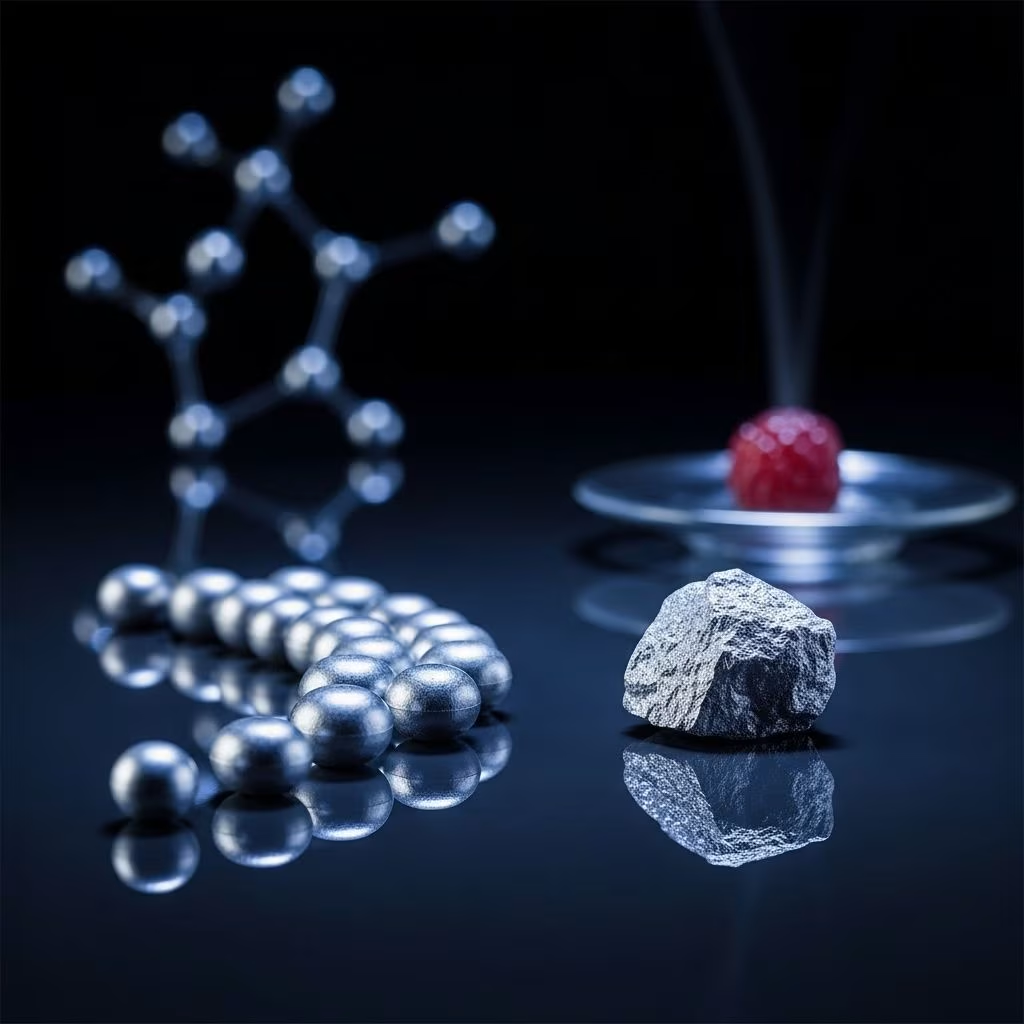
Introduction to Indium
Indium is a rare, silvery-white post-transition metal, softer than lead and best known for its extraordinary ductility and technological versatility. Classified as element 49 on the periodic table, indium’s properties lie between those of its vertical neighbors, gallium and thallium, offering a distinctive profile that makes it indispensable in modern industry and research.
The element was first discovered in 1863 by Ferdinand Reich and Hieronymous Richter, who noticed its unique spectral indigo line. Since then, indium has found its way into advanced electronics, medicine, and even experimental sensory science.
Physical and Chemical Properties
- Appearance: Indium is bright, silvery-white, and highly lustrous.
- Ductility and Malleability: Extremely soft (Mohs hardness 1.2), indium can be cut with a knife and leaves visible marks on paper.
- Crystal System: Indium crystallizes in a body-centered tetragonal structure.
- Melting/Boiling Point: Indium melts at 156.60 °C (313.88 °F) and boils at 2072 °C (3762 °F), making it suitable for low-melting-point alloys and special applications.
- Density: 7.31 g/cm³, denser than gallium but lighter than thallium.
- Superconductivity: Indium becomes a superconductor below 3.41 K, opening avenues in quantum technology.
- Chemical Stability: Stable in air and water; dissolves in acids, forms a blue-violet flame when heated.
- Electron Configuration: [Kr] 4d10 5s2 5p1
These properties position indium among the most versatile metals of group 13, known for its ability to cold weld, wet glass, and impart improved hardness to alloys.
Unique Physical Traits
- Shear Strength Exceeds Tensile Strength: A rare mechanical phenomenon making indium useful in specialized solders.
- Putty-like Consistency: Pure indium can be stretched or deformed with minimal force, enabling intricate machining.
- Low Vapor Pressure: Molten indium rapidly vaporizes near its boiling point, important for vapor deposition tech.
Sources and Occurrence
Indium is not abundantly found in nature. It typically exists in trace amounts with zinc, lead, iron, and copper ores. The world’s cultivated soils hold more indium than non-cultivated lands, due to industrial residue. Major mining and refining efforts concentrate on extracting indium as a minor byproduct from these ores.
Although indium constitutes only a minor presence in the earth’s crust, modern electronics and resource recycling efforts are transforming how we obtain and refine this element.
Industrial and Technological Uses
Indium’s array of physical and chemical features have made it invaluable in several modern industries:
- Semiconductors: Indium forms critical compounds (e.g., indium phosphide, indium nitride) used in high-speed transistors and optoelectronic devices like LEDs, lasers, and photodetectors.
- Liquid Crystal Displays (LCDs): The touch-screen revolution owes much to indium tin oxide (ITO), which provides transparent conductivity in smartphone, tablet, and flat-panel technologies.
- Solders and Alloys: Indium-based solders offer low melting points and exceptional wetting ability, essential for joining delicate components in electronics and aerospace.
- Thermal Management: Indium is used for thermal interface materials, promoting heat dissipation in microprocessors and other high-performance hardware.
- Seals and Coatings: Indium’s malleability makes it ideal for vacuum seals in scientific instruments and mirrors, where airtight bonds are critical.
- Nuclear Instrumentation: Its ability to measure thermal neutron flux makes indium a go-to material for detectors and radiation shields.
- Dental Applications: Indium-gold alloys are present in dental crowns, adding hardness without brittleness.
Key Compounds and Emerging Uses
- Indium Nitride (InN): Used in nanorods for high-speed electronics.
- Indium Tin Oxide (ITO): Enables transparent electrical contacts, crucial for interactive screens and solar cells.
- Indium Antimonide: Central to infrared detectors, night vision, and imaging technologies.
Health Benefits and Medical Uses
While indium is not considered an essential element for human health, it has found a niche in medicine and nutritional supplements:
- Radiopharmaceuticals: Indium-111 isotopes are employed in imaging scans, especially to tag antibodies and locate infection or cancer within tissues.
- Supplement Claims: Some dietary supplements claim indium’s ability to boost energy, support immune function, or enhance hormonal balance. However, clinical evidence supporting these benefits is limited and controversial; most reputable scientific organizations do not recognize indium as nutritionally essential.
Attempts to quantify indium’s benefits in supplements remain heavily debated, with some reports highlighting possible toxicity if consumed in large amounts. Systematic, long-term studies are lacking. For medical use, indium’s value is based on its radioactive isotopes rather than its metallic form.
Safety Note
Oral or environmental exposure to indium is generally low, but excessive intake can pose health risks. Most industrial handling protocols require gloves and ventilation to prevent inhalation or skin contact.
Taste and Sensory Profile
Indium’s taste is a topic of both curiosity and mild controversy. Contrary to popular metals such as copper and zinc (which have a clear metallic taste), indium is reported to have a relatively mild or neutral taste profile when placed on the tongue.
- Taste Properties: The bland sensory effect is due to its low reactivity; indium does not rapidly form ions or compounds in contact with saliva or mucous membranes.
- Experimental Reports: Some anecdotal accounts describe indium as having a faint, slightly sweet or metallic tang, but these findings are not widely published in scientific literature.
It should be emphasized that direct consumption or tasting of indium is not recommended due to potential health hazards, including the risk of cumulative toxicity.
Environmental Impact and Safety
Indium’s environmental footprint is largely associated with mining, ore refining, and the disposal of indium-containing electronic waste.
- Biosafety: Indium compounds are not known to bioaccumulate or cause widespread ecological harm at regulated levels. Occupational exposure, however, should be managed carefully.
- Resource Scarcity: The scarcity of indium in the earth’s crust has prompted concerns about future supply for high-tech sectors.
- Waste Recycling: Growing e-waste initiatives are now focused on reclaiming indium from discarded devices, reducing mining and environmental toxicity.
Comparison Table: Indium vs. Other Elements
| Property | Indium | Gallium | Thallium |
|---|---|---|---|
| Atomic Number | 49 | 31 | 81 |
| Appearance | Silvery-white, shiny | Silvery, soft | Grayish, very soft |
| Melting Point (°C) | 156.6 | 29.8 | 304 |
| Boiling Point (°C) | 2072 | 2204 | 1473 |
| Density (g/cm3) | 7.31 | 5.91 | 11.85 |
| Main Industrial Use | Semiconductors, LCDs, solders | Electronics, alloys, semiconductors | Batteries, electronics, medicine |
| Taste | Neutral/mild metallic | Unknown/safe not to taste | Toxic/not recommended |
Frequently Asked Questions (FAQs)
Q: Is indium safe to touch or handle?
A: Indium is soft and nonreactive at room temperature but is best handled with care due to potential dust or vapor toxicity in industrial settings.
Q: Can indium be found naturally?
A: Natural indium is rare, most commonly found as a trace impurity in zinc and copper ores.
Q: What are the main uses of indium in everyday technology?
A: Indium powers modern LCD screens, touch panels, LEDs, solders, and important semiconductor devices.
Q: Does indium have a taste?
A: Indium itself is reported to have a neutral or slightly sweet metallic taste, but tasting it directly is not safe or recommended.
Q: Is indium used as a dietary supplement?
A: Indium is present in some supplements, but scientific evidence for health benefits is questionable and possible risks must be considered.
Conclusion
Indium stands out as a post-transition metal with a unique blend of softness, ductility, and technological utility. With critical roles in touch screens, semiconductors, and medical imaging, indium is essential for cutting-edge devices and research. The intrigue surrounding its sensory profile and claims about health benefits further fuel its place in science and industry. As electronic waste recycling and conservation grow, the future of indium promises greater sustainability and wider application. Awareness of indium’s environmental and safety issues ensures responsible use in an ever-evolving technological world.
References
- https://en.wikipedia.org/wiki/Indium
- https://byjus.com/chemistry/indium/
- https://www.indium.com/blog/the-interesting-physical-properties-of-indium-metal/
- https://www.britannica.com/science/indium
- https://periodic-table.rsc.org/element/49/indium
- https://www.indium.com/products/metals/indium/
- https://melscience.com/US-en/articles/indium-metal-can-be-bitten-through/
- https://chemicalengineeringworld.com/indium-element-properties-and-information/


