


Introduction
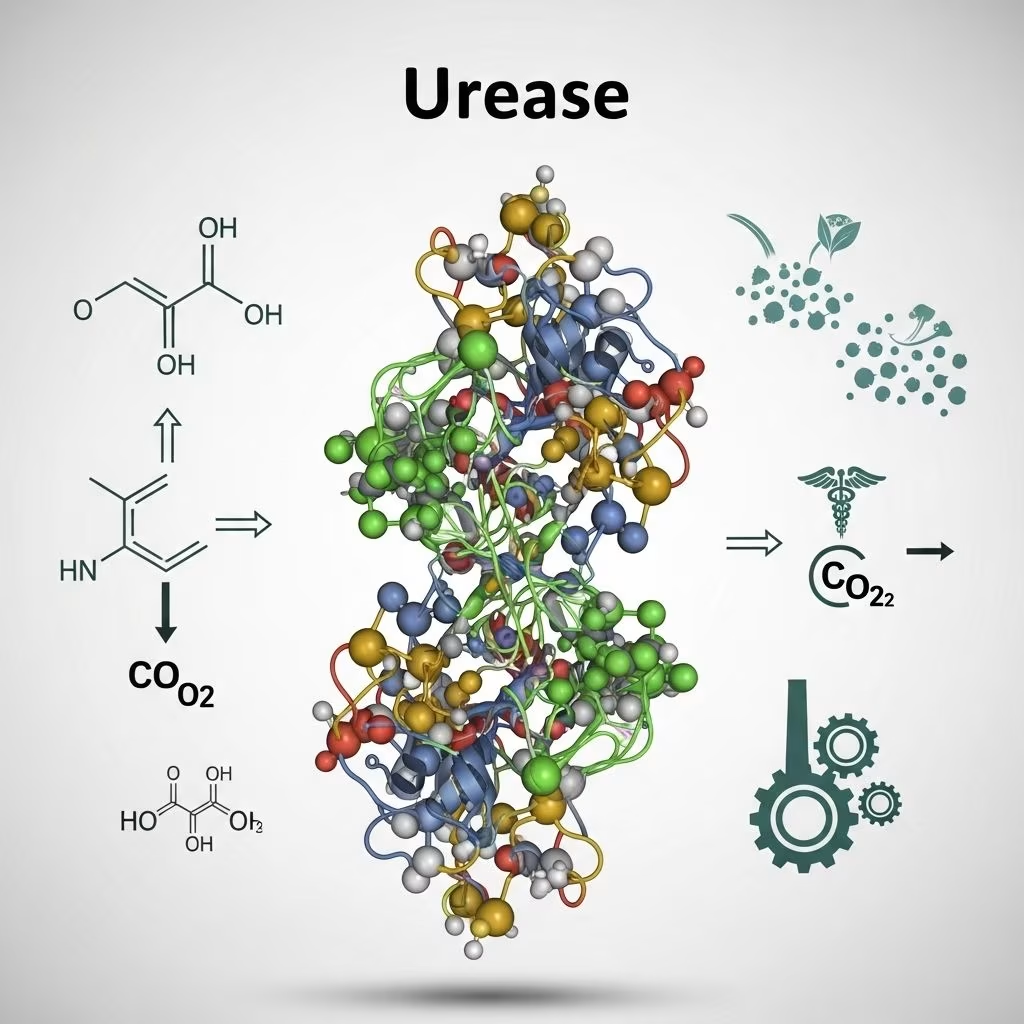
Urease is a nickel-dependent enzyme, classified under the hydrolase family (EC 3.5.1.5), whose primary function is to catalyze the hydrolysis of urea into ammonia and carbon dioxide. Not only fundamental to nitrogen metabolism in various organisms, this enzyme has also shaped scientific research and industrial technologies. Its discovery and study have illuminated essential principles in biochemistry and medicine, with applications ranging from diagnostics to agriculture.
Biochemistry of Urease
At the heart of urease’s significance lies its role in converting urea, a common nitrogenous compound, into ammonia and carbon dioxide:
| Chemical Reaction | Equation |
|---|---|
| Hydrolysis of Urea | (NH2)2CO + H2O → CO2 + 2NH3 |
The reaction occurs in two stages. First, ammonia and carbamic acid are produced, and the carbamate rapidly hydrolyzes further to release additional ammonia and carbonic acid. This process raises the environmental pH due to the release of basic ammonia, influencing numerous physiological and ecological systems.
Structure and Mechanism
Urease is a high molecular weight metalloenzyme and relies on nickel ions at its active site for catalytic activity. Structurally, plant ureases like those from jack bean consist of large protein complexes (480–545 kDa), composed of hundreds of amino acids and characterized by abundant cysteine residues. The active site contains a pair of nickel ions that are essential for activity; in rare circumstances, manganese or cobalt can substitute nickel in vitro, but lead ions are inhibitory.
Bacterial ureases differ structurally, typically comprising three distinct subunits (one large catalytic α-subunit and two smaller β- and γ-subunits) forming a trimeric complex. An exceptional class is observed in Helicobacter pylori, whose urease has two subunits assembled into a dodecameric structure, giving rise to heightened activity crucial for survival in acidic environments such as the human stomach.
- Optimal pH: Most ureases exhibit maximal activity near neutral pH (6.5–7.5).
- Optimal Temperature: Optimal activity is typically around 60°C, but varies between species and sources.
Natural Occurrence
Urease is widespread across nature, found in:
- Many bacteria (notably Proteus, Helicobacter, and Klebsiella species)
- Fungi and some algae
- Plants (especially legumes like jack bean)
- Some invertebrates
Its ecological role is most evident in the nitrogen cycle, where urease facilitates the breakdown of nitrogenous wastes in soils and aquatic environments, aiding in nutrient recycling. In agriculture, plant-derived ureases play a role in soil nitrogen management and fertilizer utilization.
Benefits of Urease
- Key Driver in Nitrogen Cycle: Urease helps convert urea into usable forms, enabling plants and microbes to access nitrogen easily, thus supporting crop yield and ecosystem health.
- Facilitates Nutrient Recycling: In decomposition, urease enables rapid recycling of nitrogen from animal waste and dead organisms.
- Supports Soil Fertility: Agriculturally significant, it enhances soil fertility by making nitrogen bioavailable.
- Diagnostic Marker: Urease assays are used to identify pathogenic microorganisms, notably H. pylori in ulcer diagnosis.
Uses of Urease
- Medical Diagnostics: The urease test is widely employed to detect certain bacterial infections such as Helicobacter pylori, which is associated with gastritis and peptic ulcers. This forms the basis of breath and biopsy tests for clinical diagnosis.
- Agriculture and Fertilizer Management: Urease inhibitors and urease activity are critical in managing fertilizer applications to reduce ammonia loss and environmental pollution, boosting nitrogen use efficiency.
- Biotechnology: Used in biosensors for urea quantification in clinical and industrial settings.
- Waste Treatment: Utilized in processing nitrogenous wastes from livestock and poultry, improving environmental management.
- Research and Education: Historically, urease was the first crystallized enzyme and is still employed as a model for studying enzyme properties.
Selected Applications Table
| Sector | Application | Role of Urease |
|---|---|---|
| Clinical Medicine | H. pylori detection | Rapid urease test |
| Agriculture | Fertilizer management | Nitrogen conversion, minimizing loss |
| Environmental Management | Waste treatment | Decomposition of urea |
| Biotechnology | Biosensors | Quantitative urea analysis |
Urease in Health and Disease
Urease plays complex roles in health:
- Pathogenic Virulence Factor: Several bacteria utilize urease as a virulence factor, enabling them to colonize host tissues and evade hostile environments. Ammonia generated locally helps neutralize acidic environments, as in the stomach with H. pylori, and contributes to bacterial persistence.
- Toxic Effects: Ammonia released by urease can cause tissue damage. Chronic exposure is linked to several diseases, including ulcers, urinary tract infections, atherosclerosis, and, potentially, rheumatoid arthritis due to molecular mimicry triggering autoimmunity.
- Immunogenic Protein: Urease induces the formation of antibodies detectable in serum, which can be leveraged as disease biomarkers. However, its immunogenicity may also fuel inflammatory or autoimmune responses.
Taste and Sensory Properties
Urease itself is an odorless, tasteless protein in its purified form. Its most important impact on taste arises indirectly:
- Ammonia Production: Upon hydrolyzing urea, urease releases ammonia, which possesses a strong, pungent odor and an acrid, alkaline taste. This is relevant in processes where urease activity affects sensory quality, such as in food spoilage or certain fermented products.
- Environmental Influence: Increased ammonia generation from urease-containing waste or food results in noticeable changes in odor and, rarely, alkaline taste. However, enzymatic urease in its pure protein form does not impart flavor.
- Food Science: In legumes and beans where urease is natively present, breakdown products from urea hydrolysis may influence taste, but rarely in finished foods due to further cooking and processing.
Potential Risks and Toxicity
- Toxic Ammonia Levels: Excessive urea breakdown can raise ammonia concentrations, which are harmful to living tissues and can lead to cellular damage, especially in clinical contexts or waste management.
- Promotion of Infection: Pathogenic bacteria with high urease activity pose greater risks for infectious diseases.
- Autoimmune Potential: Urease sequences can trigger autoantibody generation via molecular mimicry, potentially aggravating chronic conditions.
Frequently Asked Questions (FAQs)
Q: What makes urease essential in agriculture?
A: Urease is essential for converting urea-based fertilizers into forms usable by plants, increasing crop yield and ensuring efficient nitrogen cycling.
Q: How is urease detected in clinical diagnostics?
A: Urease activity is measured through rapid urease tests, breath tests, or tissue biopsies, most notably for the detection of Helicobacter pylori infection in the stomach.
Q: Does urease have any taste?
A: No, purified urease is tasteless. Its main impact on sensory properties arises from the ammonia produced during urea hydrolysis, which has a pungent odor and acrid taste.
Q: What conditions does excessive urease activity contribute to?
A: Excess urease activity may contribute to urinary tract infections, gastritis, peptic ulcers, atherosclerosis, and possibly autoimmunity through molecular mimicry.
Q: Can urease be safely used in biotechnology and medicine?
A: Yes, with proper controls. In biotechnology, urease is used in censored environments such as biosensors and analytical laboratories to ensure safety and accuracy.
Conclusion
Urease is a fundamental enzyme with far-reaching implications across biology, medicine, agriculture, and industry. Its ability to efficiently hydrolyze urea underpins crucial nutrient cycles and supports various technological and clinical applications. Understanding its benefits, uses, and indirect effects on taste enhances the strategic utilization of urease in science and society while emphasizing the importance of managing its risks in health and environment.
References
- https://en.wikipedia.org/wiki/Urease
- https://www.nature.com/articles/s41598-020-65107-9
- https://pmc.ncbi.nlm.nih.gov/articles/PMC3816311/
- https://www.pearson.com/channels/microbiology/asset/e0dff444/bacteria-use-the-enzyme-urease-to-obtain-nitrogen-in-a-form-they-can-use-from-ur?discipline=physics
- https://www.britannica.com/science/urease
- https://www.ncbi.nlm.nih.gov/books/NBK2417/


