


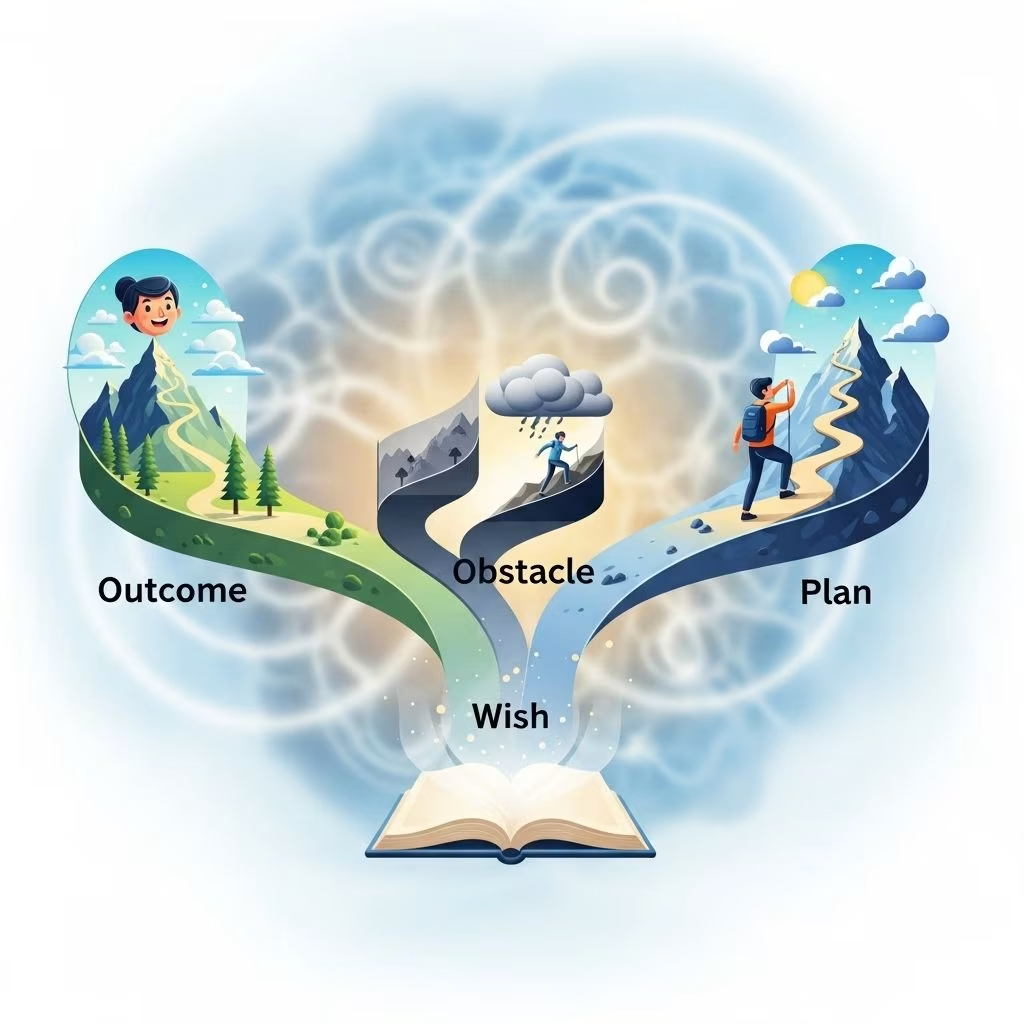
Mental Contrasting, operationalized in the WOOP model (Wish, Outcome, Obstacle, Plan), has emerged as one of the most effective, science-backed approaches to turning goals and dreams into tangible realities. In recent years, the integration of WOOP into imagery practice has provided a robust framework not just for envisioning success, but for understanding and overcoming the obstacles that too often stand in the way of real change. This guide explores the origins, science, application, and best practices of WOOP in the context of imagery training, motivation, and habit formation.
Introduction to Mental Contrasting and WOOP
For decades, conventional wisdom and popular psychology have championed positive thinking and visualization as core strategies for achievement and wellbeing. However, research by psychologist Gabriele Oettingen and colleagues has revealed a paradox: simply dreaming of a desired future, while temporarily uplifting, often decreases a person’s motivation to act. In response, Oettingen developed a research-driven alternative called Mental Contrasting with Implementation Intentions (MCII); popularly known as WOOP: Wish, Outcome, Obstacle, Plan.
The WOOP approach is not just an iteration of typical visualized imagery. It systematically combines positive future imagery with a realistic assessment of internal and external barriers, then links these insights to concrete action plans. WOOP is now backed by over 20 years of research demonstrating its effectiveness in academic, professional, health, and personal development settings.
Theoretical Background and Origins
The WOOP method originated from Oettingen’s critique of the “cult of optimism.” Early studies found that indulging in visualizing success without a plan or accounting for obstacles actually led participants to expend less effort on their goals, often dimming motivation rather than increasing it.
- Mental Contrasting is the key process: Imagining a goal, then mentally contrasting with the main obstacle (especially internal obstacles) that might prevent achievement.
- This approach breaks the “daydreaming trap”—where positive thinking can satiate the drive to work by giving a premature sense of accomplishment.
- WOOP, as an acronym, stands for Wish, Outcome, Obstacle, Plan. This four-stage structure keeps the visualization grounded in reality and orients it towards effective action.
Cultural Context and Critique
Across societies, the push for positive thinking shows variation—ranging from the American “dream big” culture to more nuanced, often realistically skeptical perspectives in Europe. Oettingen observed that cultural attitudes towards positivity and negativity shape individual approaches to goal pursuit and emotional management. The WOOP method serves as a bridge, ensuring optimism is paired with constructive, reality-based strategy.
The WOOP Model Framework: Step by Step
The WOOP process is both simple in form and profound in impact. Its sequential steps can be practiced individually or guided by coaches, counselors, or therapists. Here is how the framework unfolds:
| Step | Description |
|---|---|
| 1. Wish | Identify a meaningful, feasible, and challenging goal or desire. |
| 2. Outcome | Visualize the best possible result of attaining the wish, focusing on emotional and tangible benefits. |
| 3. Obstacle | Imagine and pinpoint the most critical personal, internal barrier that could prevent success. This is often the hardest but most important step. |
| 4. Plan | Develop a concrete action plan with clear implementation intentions (If obstacle X arises, then I will do Y). |
- At each stage, mental imagery is harnessed: not only to see the desired future, but to feel and anticipate obstacles and solutions with clarity and realism.
- WOOP often concludes with a self-created reminder or cue, reinforcing the “if-then” plan in daily life.
Key Benefits of WOOP in Imagery Practice
- Enhances Motivation: By picturing obstacles as well as dreams, WOOP triggers problem-solving mindsets and sustained energy.
- Promotes Self-Regulation: The systematic approach cultivates self-awareness, impulse control, and emotional regulation without the setbacks of mere wishful thinking.
- Increases Goal Attainment: Evidence shows marked improvement in achieving goals in diverse fields, from academics to sports and personal development.
- Resilience Building: Preparing for setbacks in advance fosters grit and adaptive coping when actual obstacles arise.
- Cross-Domain Effectiveness: WOOP works for individual aspirations, team goals, health behavior change, and habit formation alike.
Scientific Research and Evidence
WOOP is one of the most rigorously studied motivational, imagery-based self-regulation methods. Research in peer-reviewed psychology and neuroscience journals finds consistent outcomes:
- Children taught WOOP in classroom settings showed greater academic progress and persistence on challenging tasks as compared to controls using only positive visualization.
- Adults using WOOP-based imagery showed increased follow-through on health behaviors (exercise, healthy eating, quitting smoking), financial savings, and relationship goals.
- MCII (WOOP) has outperformed pure positive thinking and simple planning models in real-world experiments across cultures.
Why Does WOOP Work?
- The contrast between hopeful imagery and recognized obstacles triggers a cognitive state that primes strategy and vigilance, not complacency.
- The “plan” phase, using implementation intentions (if-then planning), automates behavior and bridges the intention-action gap.
- WOOP can be taught quickly, has minimal resource requirements, and is accessible via apps or printable guides.
Integrating WOOP with Imagery: Practical Techniques
Mental imagery is more than visualization; it is a process of experiential simulation; the mind rehearses not just outcomes but also coping with stress, confrontation, and temptation. WOOP amplifies classic imagery practice by:
- Engaging the imagination not only for the positive result, but for vividly experiencing the barrier—making the solution feel realistic.
- Helping the practitioner “pre-feel” frustration, resistance, and the satisfaction of overcoming them, which deepens mental preparation and resilience.
To practice WOOP-based imagery effectively:
- Use a quiet, distraction-free space. Take several minutes for each step—allow images, sensations, and emotions to arise fully.
- For the “Outcome” phase, invoke as many senses as possible: sight, sound, touch, even internal sensations of pride and fulfillment.
- For the “Obstacle” and “Plan,” focus inward: what emotional, habitual, or cognitive pattern tends to block progress? Imagine from the “inside out,” visualizing a moment when the obstacle typically occurs, and then the action (Plan) that interrupts or redirects it.
Applications Across Life and Professions
- Education: Students use WOOP to overcome procrastination, develop learning routines, improve test performance, and build optimism with grounded strategies.
- Health & Wellness: The method supports lasting change in physical activity, diet, substance use, relapse prevention, and medical adherence.
- Sports Psychology: Athletes utilize WOOP to bridge the gap between motivational imagery and on-field execution, anticipating anxiety and distraction in advance.
- Workplace & Careers: Professionals at all levels employ WOOP to develop habits, navigate career transitions, lead teams, and support mental wellness in high-stress environments.
- Therapy & Coaching: WOOP is a go-to technique for counselors, coaches, and therapists who want to move beyond positive thinking to evidence-based, empowering action plans.
WOOP Versus Positive Thinking: A Scientific Perspective
| WOOP (Mental Contrasting) | Positive Thinking Alone |
|---|---|
| Combines desires with reality by visualizing both outcome and personal obstacle; fosters proactivity and resilience. | Focuses only on the positive future; can decrease motivation by creating a false sense of completion. |
| Backed by 20+ years of randomized controlled trials; used in diverse domains. | Mixed evidence; may improve mood but not significantly goal attainment. |
| Promotes sustainable change through ‘If-Then’ implementation intentions. | No planning for obstacles; vulnerable to setbacks and excuse-making. |
Guided WOOP Imagery: Step-by-Step Guide
Below is a practical, research-based guide for integrating WOOP into personal or coaching practice using mental imagery.
- Wish
Identify a heartfelt wish or goal that is both important and realistically attainable. Example: “I want to finish my degree with high marks.”
- Outcome
Visualize the best result. Engage all senses while picturing the outcome. Example: Standing on stage at graduation, feeling proud, hearing loved ones applaud.
- Obstacle
Focus on yourself and imagine the main internal obstacle. This could be a habit, feeling, belief, or external temptation. Example: “I often get distracted and procrastinate when I feel overwhelmed.”
- Plan
Formulate a specific response using if–then planning. Example: “If I start procrastinating, then I will break the task into 20-minute sessions and take a 5-minute break.”
- Write down or repeat your WOOP sequence daily. Rehearse the mental imagery regularly, particularly before situations where old habits or obstacles typically arise.
- Use apps, cue-cards, or scheduled reminders to strengthen your WOOP habit.
Frequently Asked Questions
What is the difference between WOOP and standard visualization techniques?
Standard visualization focuses on seeing a positive future; WOOP adds the essential step of imagining obstacles and devising actions, making the method much more effective for long-term change.
Is WOOP effective for overcoming anxiety or negative self-talk?
Yes, research indicates WOOP helps individuals face and address inner barriers—like anxiety or self-doubt—through structured, solutions-focused mental imagery supported by planning.
Can children or adolescents use WOOP effectively?
WOOP is user-friendly and has shown significant benefits for school-age children and teens, improving perseverance, behavior, and academic performance.
How often should WOOP be practiced for best results?
Daily repetition is ideal, especially for building new habits or tackling entrenched obstacles. Brief, regular WOOP sessions reinforce motivation and strategy.
Are there digital tools to help practice WOOP?
Yes, WOOP is available as a free app and as printable worksheets from reputable sources, making consistent practice accessible.
References and Further Reading
- Oettingen, G. (2014). Rethinking Positive Thinking: Inside the New Science of Motivation.
- WOOP official site: woopmylife.org
- Peer-reviewed studies: “Mental Contrasting with Implementation Intentions (MCII)” — see published articles via PubMed Central and leading psychology journals.
References
- https://marcr.net/marcr-for-career-professionals/career-theory/career-theories-and-theorists/the-woop-model/
- https://pttcnetwork.org/wp-content/uploads/2021/10/Handout-WOOP.pdf
- https://woopmylife.org
- https://pmc.ncbi.nlm.nih.gov/articles/PMC4106484/
- http://goodmedicine.org.uk/stressedtozest/2015/05/how-woop
- https://positivepsychology.com/mental-contrasting/
- https://psychwire.com/free-resources/q-and-a/1ux8o97/the-science-of-motivation
- https://pmc.ncbi.nlm.nih.gov/articles/PMC5559239/


