


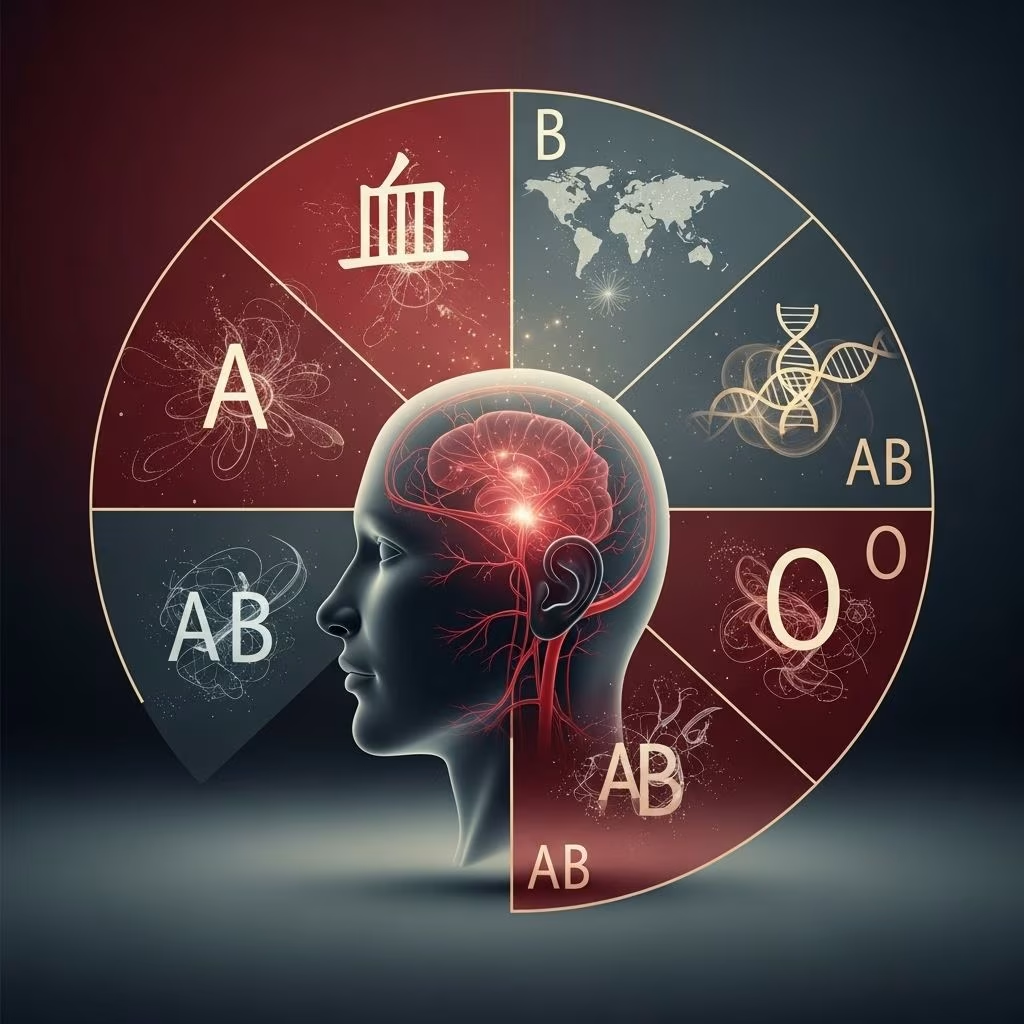
Do you believe your blood type reveals secrets about your personality? The idea that your blood group could influence your character is known as blood type personality theory. Originating in Japan and still popular in East Asian culture, this belief system offers detailed personality descriptions based on whether your blood type is A, B, AB, or O. But how did this idea start, what does it actually claim, and what does the science say?
What Is Blood Type Personality Theory?
Blood type personality theory suggests that certain character traits are inherently linked to the four main blood types identified in the ABO blood grouping system. According to this theory, people tend to manifest particular behaviors, social tendencies, and temperaments based on their blood types. Popularized in Japan as ketsueki-gata, the idea remains pervasive despite a lack of scientific agreement.
- Type A: Thoughtful, reserved, and meticulous individuals.
- Type B: Creative, passionate, and individualistic personalities.
- Type AB: A blend of A and B traits, seen as rational yet unpredictable.
- Type O: Outgoing, confident, and natural-born leaders.
While today this concept is often compared to Western astrology, it originated as an attempt to find a physiological basis for personality differences. But how did this unconventional theory take root?
The Origins: From Science to Pop Culture
The origins of blood type personality theory date back to the early 20th century. In 1927, Japanese professor Takeji Furukawa published a paper titled “The Study of Temperament Through Blood Type” in the scholarly journal Scholarly Reports.1 Furukawa suggested that blood group differences caused distinct personality profiles and proposed using these insights in fields as varied as education and employee selection.
Although Furukawa’s initial research was speculative and lacked rigorous data, the idea struck a chord with the public. Over the years, the theory was widely publicized in the Japanese media, further fueled by bestselling books and coverage in television, magazines, and films. By the 1970s and 1980s, ketsueki-gata had become a cultural phenomenon in Japan, also spreading to South Korea and Taiwan.
Key historical points:
- 1927: Furukawa introduces theory in Japan.
- 1970s-1980s: Ketsueki-gata gains renewed popularity due to media coverage and bestselling books.2
- Today: Beliefs about blood type and personality are embedded in popular culture, dating, media, and even some workplaces in Japan and South Korea.3
The ABO Blood Group System Explained
The blood type personality theory relies on the ABO blood grouping system. This system categorizes blood into four types—A, B, AB, and O—based on the presence or absence of two antigens (A and B) on the surface of red blood cells.
| Blood Type | Antigen(s) Present | Antibodies Present |
|---|---|---|
| A | A | Anti-B |
| B | B | Anti-A |
| AB | A and B | None |
| O | None | Anti-A and Anti-B |
Blood type is determined genetically and influences compatibility for blood transfusions, but the extension to personality traits is unique to East Asian cultural thinking.4
Personality Traits Associated with Each Blood Type
Theories about blood type personalities often include detailed lists of positive and negative traits for each group. Below are the most frequently cited characteristics.
Blood Type A Personality Traits
- Positive: Loyal, dependable, organized, thoughtful, cautious, punctual, sensitive, kind, and polite
- Negative: Stubborn, anxious, easily stressed, tense, withdrawn, perfectionistic, overly cautious
People with type A are often seen as loyal, responsible, and detail-focused, but may also be nervous or have trouble adapting to change.
Blood Type B Personality Traits
- Positive: Creative, passionate, independent, decisive, adventurous, individualistic, cheerful
- Negative: Selfish, uncooperative, unpredictable, hyper-focused, impulsive, sometimes erratic
Type B is often described as nonconformist and free-spirited, but sometimes fickle and less concerned with the needs of others.
Blood Type AB Personality Traits
- Positive: Rational, adaptable, sociable, composed, caring, creative, logical, intuitive
- Negative: Indecisive, critical, forgetful, self-centered, unstable, sometimes seen as mysterious
AB is thought of as a blend of A and B, capable of empathy and analysis, but with unpredictability and internal conflict.
Blood Type O Personality Traits
- Positive: Confident, outgoing, optimistic, leadership-oriented, resilient, generous
- Negative: Arrogant, insensitive, jealous, unpredictable, sometimes seen as domineering
Type O personalities are perceived as energetic, sociable, and natural leaders who may sometimes come across as too direct or selfish.
How Blood Type Personality Theory Took Hold in Japan and Beyond
While the notion of blood type determining personality may seem peculiar elsewhere, it holds enduring cultural relevance in Japan, South Korea, and Taiwan.
- Popular in dating: Individuals sometimes seek partners with compatible blood types, believing it will lead to harmonious relationships.
- Workplace preference: Some employers ask for blood type information, assuming it may predict work style or group dynamics.
- Media and entertainment: Books, movies, and even manga regularly reference or center on blood type personalities.
- Children’s education: Parenting magazines and some educational materials provide suggestions based on a child’s blood type traits.
Despite modern skepticism, ketsueki-gata remains a cultural touchstone, akin to horoscopes in the West.5
Scientific Evidence: What Does Research Say?
Though millions believe in blood type personalities, scientific evidence is lacking. Numerous psychological studies have tested for connections between ABO blood type and personality factors using large datasets. No statistically significant correlations have been found.6
- Genetic studies confirm no causal link between ABO blood types and major personality traits.
- Some research hints minor links (e.g., impulsivity), but results are inconsistent and usually not replicable.
- Experts argue any connection is cultural myth rather than biological reality.
Personality is complex, shaped by a blend of genes, upbringing, experiences, and cultural norms—not blood alone. The popularity of blood type personality theory may stem more from its simplicity and appeal than from genuine science.
Common Criticisms and Limitations of Blood Type Personality Theory
The theory’s enduring popularity does not shield it from criticism. Key objections include:
- Lack of scientific support: Repeated studies show no robust link between ABO blood groups and basic temperament or personality dimensions.
- Overgeneralization: Attributing shared complex behaviors to a single genetic marker oversimplifies human psychology.
- Self-fulfilling prophecy: Belief in blood type traits may nudge people to act in ways that align with expectations.
- Potential discrimination: In rare cases, decisions about hiring or relationships are influenced by blood type beliefs.
Ultimately, while the blood type personality theory remains a vital and fascinating part of East Asian culture, the overwhelming consensus in psychology and genetics is that blood type does not determine personality.
Blood Type, Personality, and the Human Tendency Toward Typologies
Why does blood type personality theory persist? Experts suggest that humans are drawn to typologies and simple explanations for complex phenomena. Systems like astrology, Myers-Briggs, and even blood group personality enable people to make sense of themselves and others—providing a framework for self-understanding, connection, and social interaction.
- Typologies are easy to remember and socially engaging—they provide interesting talking points.
- They promote a sense of belonging to a group.
- Used responsibly, such frameworks can encourage self-reflection—although they risk pigeonholing or stereotyping.
Applications and Cultural Significance Today
Even without scientific backing, blood type personality theory continues to influence:
- Romantic compatibility charts in Japanese and Korean magazines
- Job placement in some Japanese companies
- Character descriptions in anime and pop culture
- Icebreaker questions in everyday life
For many, knowing and discussing blood type acts less as a literal guide and more as a cultural ritual and an opportunity for social bonding. As with other personality systems, most people take these descriptions lightly or humorously.
Summary Table: Blood Type Personality Traits
| Blood Type | Key Positive Traits | Key Negative Traits |
|---|---|---|
| A | Organized, loyal, sensitive, reliable | Anxious, stubborn, tense |
| B | Creative, passionate, individualistic | Selfish, erratic, uncooperative |
| AB | Loyal, rational, caring, adaptable | Indecisive, forgetful, critical |
| O | Confident, outgoing, generous | Arrogant, insensitive, unpredictable |
Frequently Asked Questions (FAQs)
Is blood type personality theory scientifically proven?
No. The majority of well-designed scientific studies have found no strong correlation between ABO blood type and personality traits. The theory is considered a cultural belief system rather than a scientific fact.
Where did blood type personality theory originate?
The theory originated in Japan in the early 20th century with psychologist Takeji Furukawa and gained popularity through books, magazines, and mass media.
Why do people still believe in blood type personality?
Typology-based systems are appealing because they simplify complex personalities into recognizable categories, promote social bonding, and appeal to a desire for self-knowledge. Cultural momentum in Japan and Korea also keeps the idea alive.
Can blood type affect anything besides transfusions?
Blood type is clinically relevant for safe transfusions and certain health risks, but has not been shown to meaningfully impact personality, mood, or behavior.
Is it harmful to believe in blood type personality?
Generally, it is a harmless cultural pastime. However, it can be problematic if used to stereotype, discriminate, or make important decisions about hiring, relationships, or education based solely on blood type.
Final Thoughts
Blood type personality theory is an enduring example of how cultural narratives take root and persist, even in the absence of scientific evidence. While fascinating as a social and cultural curiosity, it is best approached with skepticism and an appreciation for the true complexity of human personality.
References
- https://psychcentral.com/health/blood-type-personality
- https://www.betterhelp.com/advice/personality/blood-type-personality-what-does-your-blood-say-about-you/
- https://www.waldenu.edu/programs/health/resource/what-your-blood-type-says-about-you
- https://www.japan-experience.com/plan-your-trip/to-know/understanding-japan/culture-blood-type
- https://www.blood.co.uk/news-and-campaigns/the-donor/latest-stories/is-your-personality-linked-to-your-blood-group/
- https://www.healthline.com/health/blood-type-personality
- https://www.90daykorean.com/korean-blood-type-personality/
- https://savvytokyo.com/a-crash-course-in-japans-blood-type-theory/


