


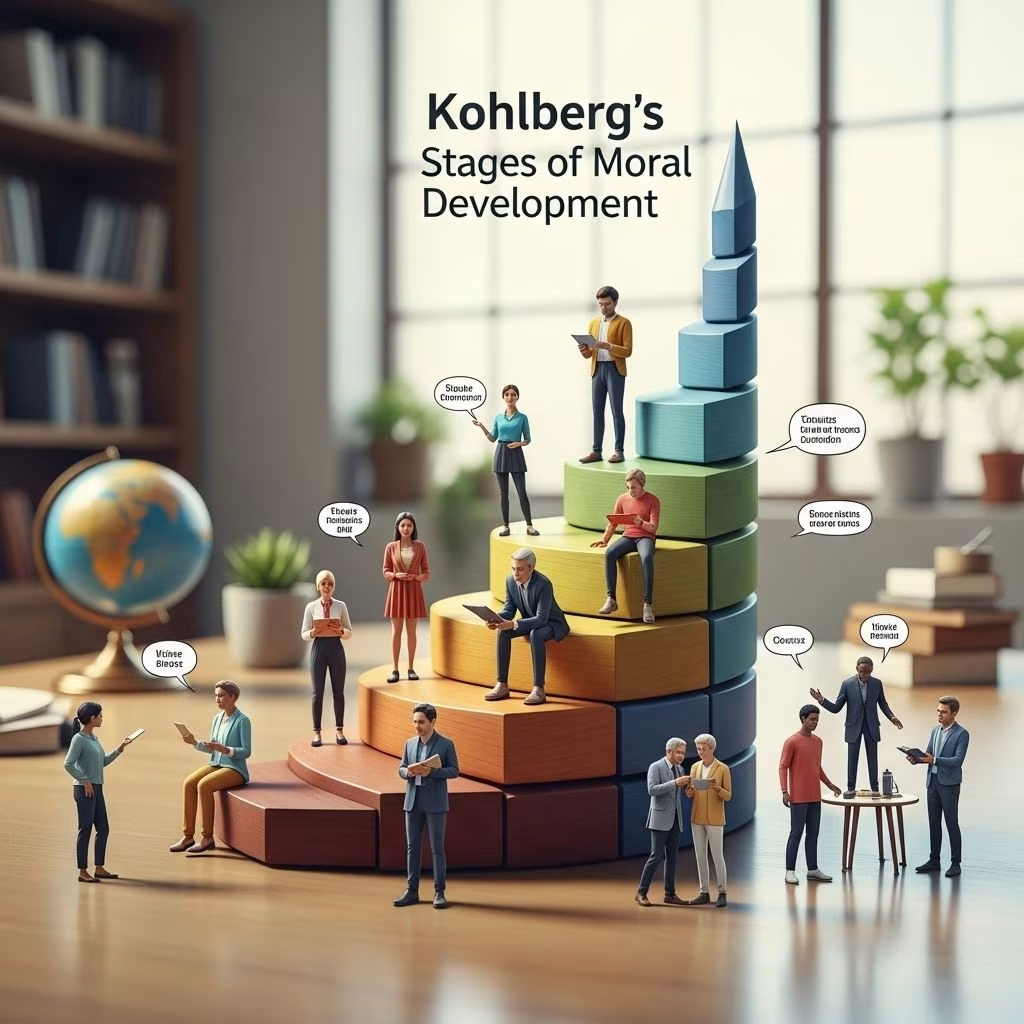
Kohlberg’s Theory of Moral Development: An Overview
Lawrence Kohlberg’s theory of moral development stands as a foundational framework in developmental psychology, offering a systematic approach to understanding how individuals reason morally from childhood through adulthood. Influenced by earlier work from Jean Piaget, Kohlberg proposed that people’s ability to judge what is right or wrong unfolds in clearly defined stages, each representing a higher level of moral understanding. Through decades of research, including interviews with children and analysis of responses to moral dilemmas, Kohlberg identified three primary levels of moral reasoning, each divided into two distinct stages for a total of six stages.
Understanding the Theoretical Framework
Kohlberg’s stages are organized as a developmental sequence, progressing from simple, externally driven perspectives of morality to complex, abstract, and principled reasoning. Every individual must pass through these stages in order, without skipping steps. The development of moral reasoning is closely tied to cognitive development, as the ability to consider multiple perspectives and hypothetical scenarios matures with age.
| Level | Stage | Moral Focus |
|---|---|---|
| Preconventional | 1. Obedience and Punishment Orientation | Avoiding punishment, obeying authority |
| 2. Instrumental Purpose Orientation (Self-Interest) | Gaining rewards, satisfying personal needs | |
| Conventional | 3. Interpersonal Accord and Conformity | Seeking social approval, maintaining relationships |
| 4. Authority and Social Order Maintaining | Obeying laws, respecting authority, maintaining social order | |
| Postconventional | 5. Social Contract Orientation | Upholding social contracts, individual rights, and democratic processes |
| 6. Universal Ethical Principle Orientation | Following self-chosen ethical principles of justice, dignity, and equality |
The Three Levels and Six Stages of Moral Development
Level 1: Preconventional Morality
Preconventional morality is the least mature form of moral reasoning, typically seen in children under the age of nine. At this level, morality is externally controlled—motivated by the direct consequences to oneself rather than internalized values.
- Stage 1: Obedience and Punishment Orientation
Individuals at this stage act to avoid punishment and obey authority. The rightness or wrongness of actions is determined by what gets one disciplined. Example: A child refrains from stealing because they fear being scolded or punished. - Stage 2: Instrumental Purpose Orientation (Self-Interest)
Morality at this stage is guided by self-interest and the pursuit of rewards. Actions are seen as right if they serve the person’s own needs. Reciprocity is understood as “You scratch my back, and I’ll scratch yours.” Example: A child shares their snack because they expect their peer will share back next time.
Level 2: Conventional Morality
Conventional morality is characteristic of older children, adolescents, and many adults. At this level, social rules and the opinions of others take center stage.
- Stage 3: Interpersonal Accord and Conformity
Sometimes called the “Good Boy/Girl” orientation, the focus is on living up to social expectations, seeking approval, and maintaining relationships. A person asks: “What will others think of me if I do this?” Example: A teenager refuses to cheat on a test because it would make them look dishonorable among peers. - Stage 4: Authority and Social Order Maintaining Orientation
Individuals at this stage respect authority, laws, and societal order. The emphasis shifts to maintaining the functioning of society, obeying rules because they are necessary for the collective good. Example: An adult pays taxes not because of fear or reward, but because it ensures society can function fairly.
Level 3: Postconventional Morality
Postconventional morality emerges in some adults and is the rarest level. Here, moral reasoning is abstract, focused on universal principles and ethical codes that may transcend laws and social conventions.
- Stage 5: Social Contract Orientation
Individuals understand that laws and rules are based on social agreements and should be changed if they fail to promote justice. Moral decisions are made by balancing individual rights with societal good. Example: A citizen supports civil rights reforms, believing laws need to evolve to ensure greater fairness. - Stage 6: Universal Ethical Principle Orientation
At this pinnacle, people follow internalized, self-chosen ethical principles, such as justice, respect, and equality, even if these conflict with established laws. Behavior is guided by a commitment to these universal ideals. Example: A person participates in civil disobedience, believing it is morally right to oppose unjust laws peacefully.
Application: The Moral Dilemma Method
To assess moral reasoning, Kohlberg used moral dilemmas, with the Heinz dilemma as his most famous case. Participants are told a story (for example, a man must decide whether to steal a drug he cannot afford to save his wife’s life) and asked what the character should do and why. The reasoning behind their answers—not the decision itself—determines their placement on Kohlberg’s scale.
- Responses at Stage 1: “Heinz shouldn’t steal the drug because he’ll be punished.”
- Responses at Stage 6: “Heinz should steal the drug because everyone has a right to life, regardless of the law.”
Progressing through the stages requires increasing cognitive complexity, reflection, and ability to take multiple perspectives into account.
Key Features of Kohlberg’s Theory
- Invariant Sequence: Individuals progress through the stages in order; no stage is skipped.
- Cultural Universality: Kohlberg argued that these stages are universal, though not everyone reaches the highest stages.
- Focus on Reasoning: The emphasis is on the reasoning process, not on the decision itself.
- Developmental Continuum: Not age-dependent—people move at different rates and may remain at a given stage for life.
Strengths and Criticisms of the Theory
Strengths
- Clear Structure: Offers a well-defined set of stages for understanding moral growth.
- Influential in Education and Psychology: Provides a strong basis for moral education and counseling intervention.
- Empirical Approach: Uses open-ended dilemmas to measure actual reasoning rather than just theoretical knowledge.
Criticisms
- Gender and Cultural Bias: Critics like Carol Gilligan argue it overemphasizes justice and neglects moral values like care and empathy, and may not apply equally across cultures.
- Emphasizes Thought Over Action: Focuses on reasoning, not on real-life behavior.
- Stages Are Not Always Sequential: Real-world decisions may not neatly fit into one stage; some individuals use mixed reasoning depending on context.
Real-World Applications
- Education: Teachers and parents can design curricula and interventions that foster advanced moral reasoning and help students progress to higher stages.
- Criminal Justice: Understanding offenders’ reasoning can inform rehabilitative approaches and ethical training.
- Social Work: Practitioners can tailor guidance and expectations to a client’s stage of reasoning, encouraging developmentally appropriate growth.
- Leadership: Organizations can use Kohlberg’s framework to guide ethical decision-making, policy creation, and conflict management.
Frequently Asked Questions (FAQs)
Q: What distinguishes Kohlberg’s theory from Piaget’s model of moral development?
A: While Piaget identified two major stages of moral development focused on children, Kohlberg expanded the framework, proposing three levels and six stages that apply from childhood through adulthood, with an emphasis on the reasoning process rather than age brackets.
Q: Are all individuals likely to reach the highest stages of moral development?
A: According to Kohlberg, most individuals do not reach the postconventional level (stages 5 and 6); many remain at the conventional level throughout their lives. Cognitive development, education, and life experiences influence advancement.
Q: Can moral development ‘regress’ or move backward?
A: Kohlberg’s theory posits that progression is unidirectional—individuals move forward through the stages, not backward. However, context and cognitive stress may cause temporary reliance on earlier-stage reasoning.
Q: Does Kohlberg’s theory apply equally across cultures and genders?
A: While Kohlberg believed his stages were universal, critics have found that cultural context, gender, and the value placed on care or justice can shape moral reasoning, suggesting the theory may not fully capture all perspectives.
Q: How is Kohlberg’s theory applied in contemporary psychology?
A: Today, Kohlberg’s stages inform education, counseling, law, and leadership training by offering a framework to assess and foster moral reasoning, though practitioners often supplement it with newer models to address its limitations.
Key Takeaways
- Kohlberg’s theory describes moral reasoning as developing in three sequential levels, each containing two stages.
- Moral development progresses from a focus on self-interest and avoiding punishment through social conformity, to internalized ethical principles.
- The theory shapes approaches in education, social work, law, and leadership ethics, though is subject to ongoing critique and refinement.
References
- https://socialworkexams.com/kohlbergs-theory-of-moral-development-a-guide-for-social-work-practice/
- https://www.britannica.com/science/Lawrence-Kohlbergs-stages-of-moral-development
- https://sproutsschools.com/kohlbergs-6-stages-of-moral-development/
- https://www.youtube.com/watch?v=bounwXLkme4&vl=en
- https://www.sketchy.com/mcat-lessons/the-moral-development-theory
- https://www.simplypsychology.org/kohlberg.html
- https://www.appstate.edu/~steelekm/classes/psy2664/kohlberg.htm


