


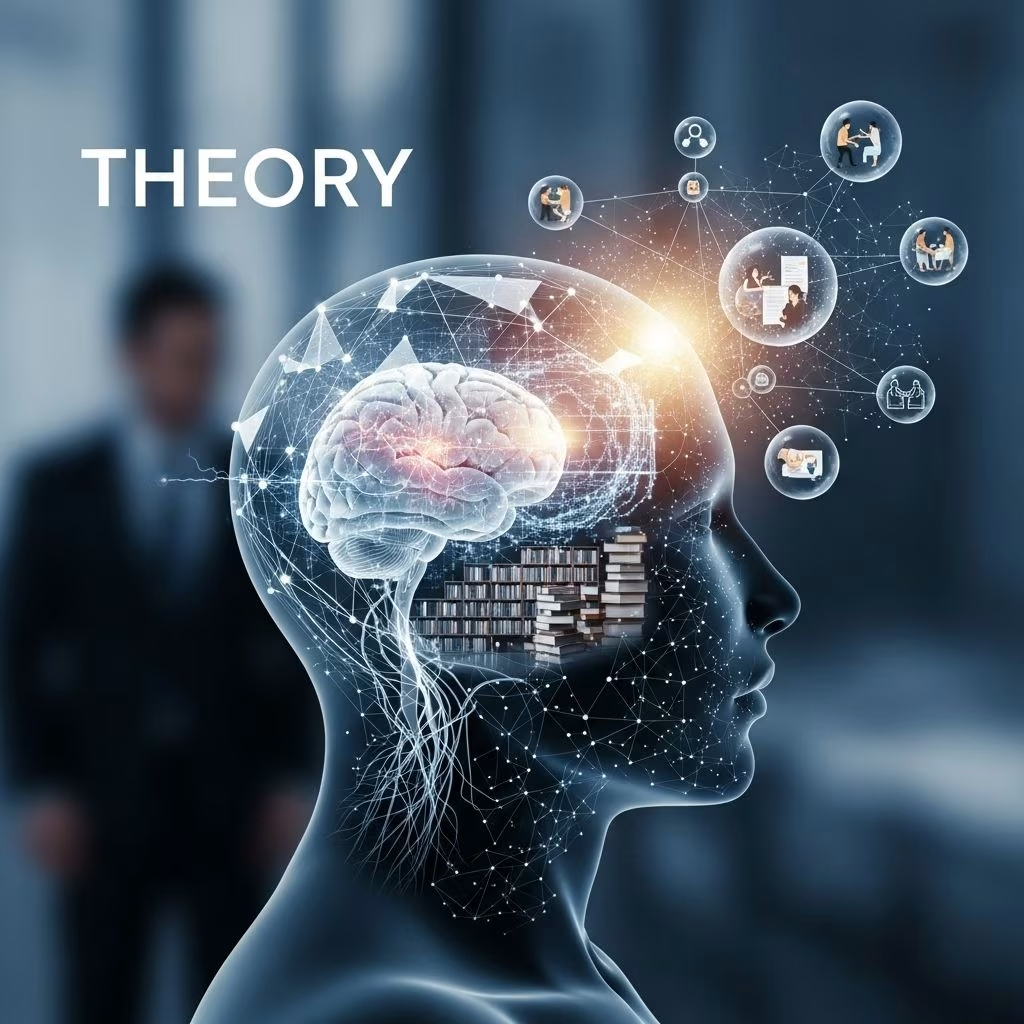
Theories are foundational to science and psychology—they provide frameworks for understanding, predicting, and explaining behavior, mental processes, and other phenomena. By systematically organizing existing knowledge and suggesting new avenues for research, theories shape our worldview and guide critical thinking in both scientific inquiry and real life.
Defining ‘Theory’: A Scientific Perspective
A theory in science, and particularly in psychology, is a well-substantiated explanation of some aspect of the natural or mental world that is based on a body of facts repeatedly confirmed through observation and experiment. Scientific theories are not mere guesses or speculations; they are rigorously constructed explanations that help scientists and researchers make sense of complex phenomena.
- Theories are tested, supported, and refined through empirical research.
- They are broader in scope than hypotheses, which are specific predictions tested by experiments.
- Scientific theories must be falsifiable—capable of being disproven by new evidence.
The Role of Theories in Psychology
Within psychology, theories help explain behaviors, cognitive processes, emotional responses, and developmental changes. These frameworks allow researchers to interpret findings, make predictions, and develop interventions that can positively influence mental health and human well-being.
- Offer explanations: Theories answer ‘why’ and ‘how’ questions about mental processes and behavior.
- Guide research: Theories suggest hypotheses, drive the design of experiments, and organize findings.
- Promote progress: As evidence accumulates, theories evolve, helping the field advance.
Distinguishing Theory from Hypothesis
| Aspect | Theory | Hypothesis |
|---|---|---|
| Definition | Comprehensive explanation for a broad range of phenomena, based on evidence | Specific, testable prediction about what will happen under certain conditions |
| Scope | Broad; integrates many findings and concepts | Narrow; focuses on a single study or experiment |
| Testing | Supported or challenged by results of many studies over time | Directly tested within a single study |
| Purpose | Explains ‘why’ and ‘how’ | Predicts ‘what’ will happen |
How Are Theories Developed?
Theories in psychology (and science overall) are typically developed through the interplay between observation, experimentation, and critical analysis.
- Observation: Researchers notice patterns or phenomena that raise questions.
- Hypothesis Formation: A testable, focused statement is posed to explore the phenomenon.
- Experimentation: Studies are conducted, generating data to support or refute the hypothesis.
- Synthesis: Over time, findings from many studies are integrated into a broader explanatory framework—a theory.
- Ongoing Testing: Theories are modified, refined, or replaced as new evidence emerges.
Key Characteristics of Scientific Theories
Several essential characteristics distinguish robust scientific theories:
- Testability: Theories must be capable of being tested and potentially falsified.
- Parsimony: The theory should be as simple as possible while accounting for all the facts.
- Empirical Support: Theories remain viable only while supported by evidence from research and observation.
- Predictive Power: The best theories predict phenomena and outcomes that can be verified through study.
- Coherence: The explanation should make logical sense and fit with what is known in the field.
- Utility: Theories should help guide further research and suggest practical applications.
Examples of Psychological Theories
Psychology has produced a number of influential theories that have shaped our understanding of human behavior and mental life. Some major examples include:
- Psychoanalytic Theory (Sigmund Freud): Explains personality and behavior based on the unconscious mind, childhood experiences, and inner conflicts.
- Behaviorism (John B. Watson, B.F. Skinner): Focuses on observable behavior and environmental influences, introducing concepts like conditioning.
- Cognitive Development Theory (Jean Piaget): Examines how children’s thinking evolves in stages from birth to adolescence.
- Humanistic Psychology (Carl Rogers, Abraham Maslow): Emphasizes personal growth, self-actualization, and individual potential.
- Social Learning Theory (Albert Bandura): Highlights the role of imitation, modeling, and social context in learning and behavior.
Theories vs Everyday Usage: Common Misconceptions
Outside science, the term theory is frequently misunderstood. In everyday language, ‘theory’ is often used to mean a hunch, guess, or speculation. In contrast, scientific theories are comprehensive, evidence-based explanations with a history of rigorous testing.
- Common misconception: A theory is just an opinion or guess.
Scientific reality: It’s a well-supported framework tested and refined by data.
Functions of Theory in Psychology and Science
Theories serve vital functions in psychological research and scientific advancement:
- Organizing knowledge: Theories integrate and explain existing findings.
- Guiding inquiry: By suggesting questions and hypotheses, theories drive new research.
- Predicting outcomes: Well-crafted theories allow scientists to anticipate phenomena or results.
- Solving problems: Theories often lead to practical interventions or strategies to address issues in mental health, education, and more.
Evolution and Modification of Theories
Theories in psychology are always provisional; they are regularly modified, refined, or even replaced as new evidence emerges. This ongoing process ensures that scientific understanding remains current, accurate, and useful.
- Refinement: Small changes and updates occur as new data becomes available.
- Paradigm shifts: Occasionally, major changes (or new theories) replace older models as in the transition from psychoanalytic approaches to behaviorism or cognitive science.
- Falsification: When a theory can no longer explain new findings, it may be discarded.
How Do Theories Differ from Laws?
In science, both theories and laws describe and explain phenomena, but they serve different purposes:
- Laws summarize observed phenomena, usually in mathematical form, and predict occurrences under specific conditions.
- Theories explain why those phenomena occur and are generally broader and more complex in scope.
Case Studies: Theory Application in Psychology
Case studies illustrate how psychological theories are used in practice to understand and address real-world issues.
- Attachment Theory: Used to interpret patterns of relationship between parents and children, guide therapies, and predict outcomes.
- Social Learning Theory: Utilized in designing educational programs and understanding behavioral development in diverse settings.
- Self-Concept Theory: Helps psychologists assess personal growth, self-esteem, and mental health.
Why Some Theories Become Discredited
Theories are only as good as the evidence supporting them. Occasionally, widely accepted theories are disproven or rejected due to new findings or methodological flaws. For example:
- Vaccine-autism link: A once-popular theory suggesting vaccines cause autism was later debunked and discredited due to fraudulent research.
- Parenting as cause of autism: Similarly, the theory that parental actions caused autism has been replaced by a focus on genetics and early intervention.
Theories and Psychological Perspectives
Theories often arise within different psychological perspectives—distinct approaches that emphasize specific aspects of mental processes and behavior. Some major perspectives include:
- Biological Perspective: Focuses on genetic, neurological, and physiological processes.
- Cognitive Perspective: Emphasizes thinking, memory, problem-solving, and decision-making.
- Behavioral Perspective: Stresses observable actions and environmental determinants.
- Humanistic Perspective: Prioritizes individual experience, free will, and personal growth.
- Psychodynamic Perspective: Examines unconscious motives and childhood influences.
Frequently Asked Questions (FAQs)
Q: Why are theories important in psychology?
A: Theories are critical because they organize existing knowledge, guide new research, and help psychologists predict and influence behavior.
Q: Can theories be incorrect?
A: Yes. Theories are constantly tested, and if evidence disproves a theory, it may be revised or replaced.
Q: Are scientific theories similar to opinions or guesses?
A: No. Scientific theories are robust, evidence-based explanations subject to rigorous testing, while opinions or guesses lack systematic evidence.
Q: How do theories lead to new discoveries?
A: Theories suggest new hypotheses and research questions, guiding scientists to test and uncover novel phenomena.
Key Takeaways
- Theories provide structured explanations of broad phenomena, especially in psychology.
- They are built from evidence, subject to change, and essential for scientific growth.
- Distinguishing between theories, laws, and hypotheses clarifies the scientific method.
- Applying theories helps address real-world problems and advance psychological wellbeing.
References
- https://thedecisionlab.com/reference-guide/psychology/psychological-theories
- https://positivepsychology.com/self-concept/
- https://www.gcu.edu/blog/psychology-counseling/perspectives-psychology
- https://inside.choc.org/early-signs-of-autism/
- https://www.coursehero.com/tutors-problems/Writing/53007010-httpswwwverywellmindcomlearning-theories-in-psychology-an-ove/


