


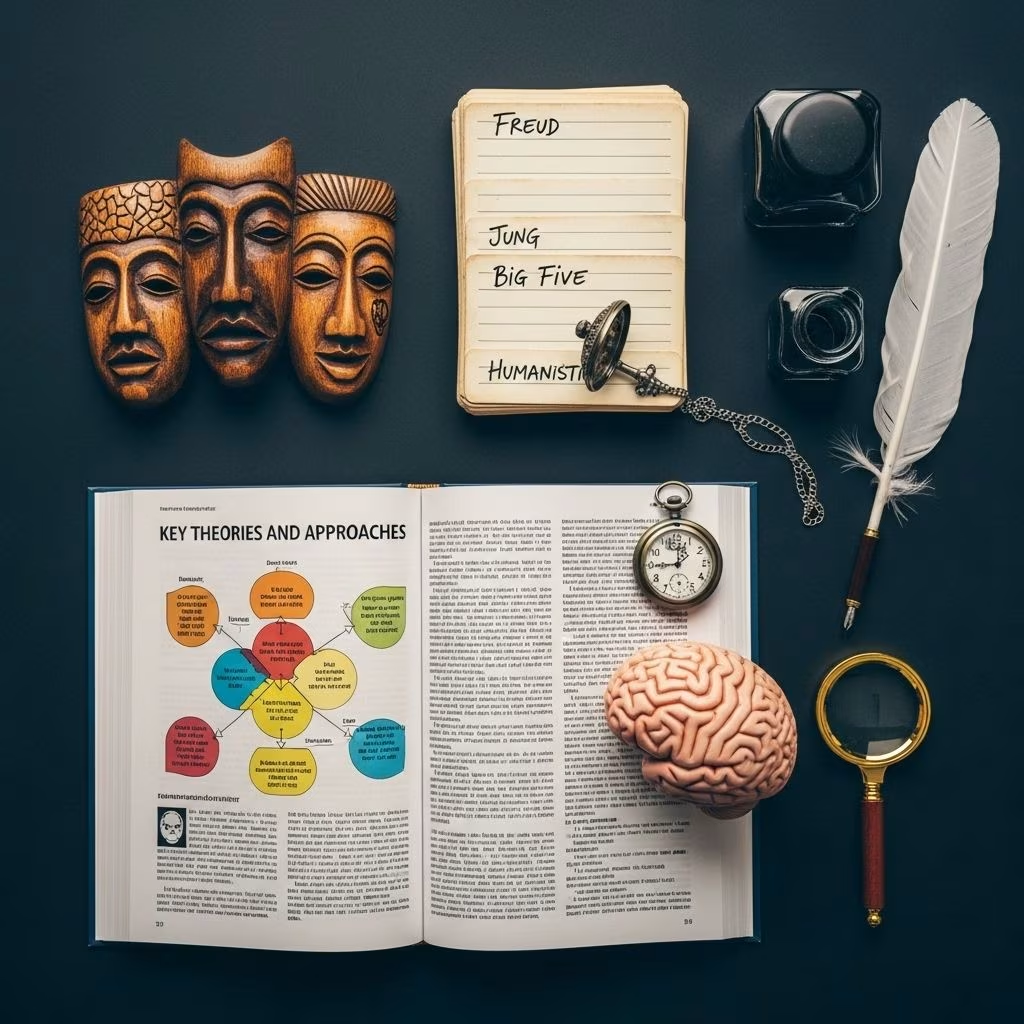
Personality Psychology: A Comprehensive Study Guide
Personality psychology is a rich and diverse field dedicated to understanding the complex patterns of thoughts, feelings, and behaviors that make each person unique. Spanning foundational theories to contemporary research and assessment methods, this guide presents an in-depth exploration of how psychologists conceptualize, measure, and apply knowledge about personality.
What Is Personality Psychology?
Personality psychology seeks to explain the enduring traits and patterns that shape how individuals consistently think, feel, and behave over time and across situations. By examining psychological forces, biological factors, environmental influences, and cultural context, personality psychologists aim to answer fundamental questions about why people differ.
- Personality consists of stable, organized traits and patterns unique to each individual.
- Traits might include intelligence, disposition, values, emotional tendencies, and attitudes.
- Personality is shaped by a dynamic interplay of internal and external factors over the lifespan.
Key Goals of Personality Psychology
- Describing personality: Identifying traits and patterns in behavior and thought.
- Explaining personality: Investigating how these traits form, develop, and interact.
- Predicting behavior: Using personality knowledge to foresee how individuals will act in various situations.
- Applying understanding: Improving well-being, interventions, workplace dynamics, and mental health.
Theories of Personality: Major Approaches
The study of personality is guided by several influential theories, each offering a distinctive framework for understanding how personality develops and is expressed. The following sections summarize the most prominent perspectives in the field.
| Theory | Key Figures | Core Ideas |
|---|---|---|
| Psychoanalytic | Sigmund Freud | Unconscious drives, early childhood, Id-Ego-Superego, defense mechanisms |
| Neo-Freudian | Jung, Adler, Horney, Erikson | Social and cultural influences, less emphasis on sexuality, ego development |
| Trait | Allport, Cattell, Eysenck, Costa & McCrae | Stable, measurable traits, Big Five Model (OCEAN), factor analysis |
| Humanistic | Maslow, Rogers | Self-actualization, free will, positive growth, personal meaning |
| Behavioral / Social-Cognitive | Skinner, Bandura | Environmental reinforcement, observational learning, reciprocal determinism |
| Biological | Eysenck, behavioral geneticists | Genetic, neurobiological, and evolutionary bases of personality |
| Cultural | Cross-cultural psychology | Culture, social norms, and values shape personality expression |
Psychoanalytic Theory: Freud’s Foundations
Sigmund Freud’s psychoanalytic theory remains one of the most influential and widely discussed models of personality development. Freud believed:
- The unconscious forces—including hidden motives, wishes, and conflicts—drive behavior and shape personality.
- The structure of personality includes the Id (instinctual drives), Ego (reality-oriented mediator), and Superego (morality and ideals).
- Early childhood experiences are crucial in forming lasting personality patterns.
- Defense mechanisms, such as repression and denial, are psychological strategies to manage anxiety produced by internal conflicts.
Levels of Consciousness
- Conscious: Current awareness and thoughts.
- Preconscious: Accessible memories and information.
- Unconscious: Deep-seated drives and conflicts.
Instincts in Personality
- Life Instincts (Eros): Needs for survival, reproduction, pleasure.
- Death Instincts (Thanatos): Aggressive, destructive urges.
Defense Mechanisms
- Repression: Blocking distressing memories from consciousness.
- Projection: Attributing one’s own unacceptable feelings to others.
- Denial: Refusing to accept reality.
- Rationalization: Creating logical justifications for behaviors.
Neo-Freudian Theories
Psychoanalysis inspired a group of thinkers known as the Neo-Freudians. They agreed with many Freudian concepts but emphasized social, cultural, and interpersonal factors more than instinct and sexuality.
- Carl Jung: Introduced ideas about the collective unconscious and archetypes—universal symbols and themes found across cultures.
- Alfred Adler: Focused on social motivations, inferiority complex, and striving for superiority.
- Karen Horney: Stressed the importance of social relationships, basic anxiety, and rejecting Freud’s emphasis on sex.
- Erik Erikson: Developed psychosocial stages of development, highlighting the role of identity and life transitions.
Trait Theories: Measuring Individual Differences
Trait theorists define personality in terms of stable, measurable qualities that vary among people. These traits can be quantified and used to predict behavior.
- Gordon Allport: Identified thousands of traits and classified them as cardinal, central, and secondary.
- Raymond Cattell: Used factor analysis to reduce traits to 16 major factors.
- Hans Eysenck: Proposed three broad dimensions: extraversion, neuroticism, and psychoticism.
- Big Five Model (Costa & McCrae): One of the most influential, focusing on five core traits:
- Openness (to experience)
- Conscientiousness
- Extraversion
- Agreeableness
- Neuroticism
Humanistic Theories: Emphasizing Growth and Free Will
The humanistic approach highlights positive human values, personal growth, and the search for meaning.
- Abraham Maslow: Proposed a hierarchy of needs culminating in self-actualization—fulfilling one’s potential.
- Carl Rogers: Stressed unconditional positive regard, congruence between self-concept and experience, and the capacity for change.
Behavioral and Social-Cognitive Theories
These theories focus on how external environments and cognitive processes influence personality.
- B.F. Skinner (Behaviorism): Personality is shaped by reinforcement and punishment; learned responses drive behavior.
- Albert Bandura (Social-Cognitive): Emphasized observational learning, modeling, and reciprocal determinism—the mutual influence between person, environment, and behavior.
Biological Perspectives
Biological approaches to personality explore the genetic, neurological, and evolutionary origins of differences between individuals.
- Heritability studies show that genetics contribute substantially to traits like extraversion and neuroticism.
- Brain imaging technologies allow researchers to map personality traits onto neural circuits.
Cultural Influences on Personality
Personality is never shaped in isolation—culture, ethnicity, and social norms play essential roles in how personality traits are developed, valued, and expressed. Cross-cultural psychologists study:
- How values like collectivism or individualism shape behaviors and attitudes.
- The impact of social roles, traditions, and expectations.
- How personality assessments must be adapted for different cultural contexts.
Methods in Personality Research
To answer questions about personality, psychologists use a variety of research methods:
- Case studies: In-depth analysis of individuals, often used historically (e.g., Freud’s patients).
- Surveys and questionnaires: Standardized instruments to measure traits and attitudes across groups.
- Experimental studies: Controlled tests of specific hypotheses about personality processes.
- Correlational studies: Exploring relationships between variables, such as personality and life outcomes.
Personality Assessment Techniques
Personality assessment is crucial for research, clinical practice, and self-understanding. Common tools include:
- Self-report inventories: Standard scales (e.g., MMPI, Big Five Inventory) where individuals rate themselves on various traits.
- Projective tests: Ambiguous stimuli (e.g., Rorschach Inkblot, TAT) designed to reveal unconscious aspects by interpreting responses.
- Behavioral assessments: Observing actual behaviors under different conditions.
- Clinical interviews: Structured and unstructured discussions used in diagnostic contexts.
Challenges in Personality Assessment
- Self-report biases—social desirability, inaccurate self-perception.
- Cross-cultural validity—adapting tests for different backgrounds.
- Reliability and validity—ensuring measures accurately capture consistent traits.
Applications of Personality Psychology
Knowledge about personality has broad uses across psychology and many other fields:
- Psychotherapy: Tailoring approaches to individual personality styles.
- Occupational psychology: Matching careers and work environments to personality traits.
- Health psychology: Understanding how traits impact risk factors and coping strategies.
- Education: Adapting teaching methods to different learners’ personalities.
- Relationships: Clarifying sources of compatibility and conflict.
Limitations and Contemporary Perspectives
While major theories have propelled personality psychology, there are ongoing challenges and debates:
- Nature vs. nurture: The dynamic interplay between genetic inheritance and environmental influences.
- Culture and context: The need for theories and assessments relevant across diverse social backgrounds.
- Integration of perspectives: Growing interest in synthesizing biological, cognitive, and social approaches.
Frequently Asked Questions (FAQs)
Q: What is the definition of personality in psychology?
A: Personality refers to the enduring patterns of thoughts, feelings, and behaviors that distinguish individuals over time and across situations.
Q: Why do psychologists study personality?
A: Understanding personality helps explain personal differences, predict behaviors, improve mental health interventions, and foster well-being in work and social relationships.
Q: Can personality change across the lifespan?
A: While core traits tend to be stable, life experiences and contexts can influence personality development and expression.
Q: What are the main methods used to assess personality?
A: Common methods include self-report inventories, projective tests, observational techniques, and interviews.
Q: How do culture and environment impact personality?
A: Culture shapes values, social roles, and behaviors, influencing how personality traits are formed, expressed, and interpreted across societies.
Conclusion
Personality psychology provides a vital lens for understanding human diversity and individuality. Whether through classical theories or modern assessment methods, the field continues to evolve, offering insights applicable to therapy, education, work, and everyday life. By exploring personality from multiple perspectives, psychologists and students can appreciate the complexity and unique qualities that shape each person.
References
- https://godsonug.files.wordpress.com/2017/09/psyc-333-study-guide-margaret-amankwah-poku.pdf
- https://www.pearson.com/channels/psychology/study-guides/13219/introduction-to-personality-psychology-understanding-yourself-and-others
- https://study.com/academy/lesson/personality-psychology-definition-theories-quiz.html
- https://www.apa.org/ed/precollege/topss/lessons/personality.pdf
- https://www.kaptest.com/study/ap-psychology/ap-psychology-personality-notes/
- https://psu.pb.unizin.org/psychology100/chapter/chapter-11/


