


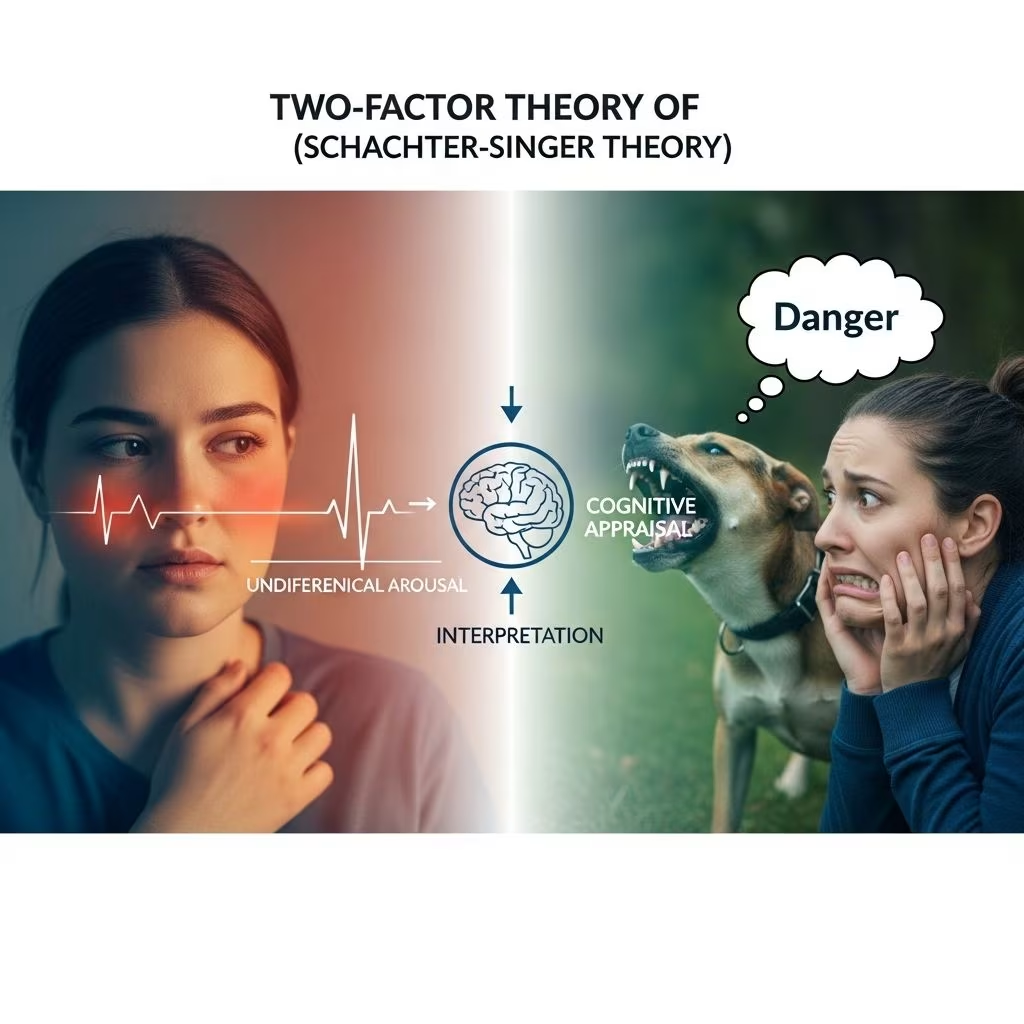
Introduction to the Two-Factor Theory of Emotion
The Two-Factor Theory of Emotion, widely known as the Schachter-Singer Theory, represents a significant contribution to our understanding of how emotions are formed. Proposed in 1962 by psychologists Stanley Schachter and Jerome Singer, this theory posits that emotion results from the combination of two critical factors: physiological arousal and cognitive interpretation of that arousal. Unlike earlier theories that focused on either the body or the mind alone, the two-factor theory asserts that both bodily reactions and mental processes are vital in the identification and labeling of emotions.
Key Concepts of the Two-Factor Theory
- Physiological Arousal: A physical change in the body triggered by an external or internal event (e.g., increased heart rate, sweating, trembling).
- Cognitive Interpretation (Appraisal): The mental process of assessing the situation and environmental cues to assign a label to the physiological state (e.g., feeling ‘afraid’, ‘excited’, or ‘angry’).
The interplay between these two elements is what produces the discrete emotional experience. Schachter and Singer theorized that we first experience physiological arousal, and then use the context and information around us to interpret and label that arousal as a specific emotion.
Step-by-Step Breakdown
- An event occurs (e.g., you see a snake).
- Your body responds physiologically (heart races, palms sweat).
- You search your environment for cues to understand why your body feels this way.
- You label your emotion based on both your bodily state and your interpretation (“I’m scared because I see a snake”).
Historical Context: Prior Theories of Emotion
The study of emotion has a long history in psychological science. Before the Two-Factor Theory, two main models dominated:
- James-Lange Theory: Proposed that physiological arousal directly creates an emotional experience (“I feel afraid because my heart is pounding”).
- Cannon-Bard Theory: Argued that physiological arousal and emotional experience occur simultaneously but independently (“The snake made my heart race, and made me feel afraid, at the same time”).
The Two-Factor Theory offered a compromise, suggesting both physiological arousal and cognitive processes are essential for the full emotional experience.
The Schachter & Singer Experiment
To empirically test their theory, Schachter and Singer devised a now-famous experiment in 1962. The basic method and findings were as follows:
Experiment Design
- Participants: 184 male college students
- Procedure: Participants were told they would receive a vitamin injection (really, some were given epinephrine—adrenaline—and others a saline placebo)
- They were placed into four groups:
- Informed: Told the true effects of the injection
- Uninformed: Not told of any side effects
- Misinformed: Told false effects
- Control: Given placebo/saline injection
- The next stage involved situational manipulation, with an actor (confederate) in the room behaving either euphorically or angrily.
- Researchers observed participants and collected self-reported emotional states.
Results & Conclusions
- Those without an explanation for their physiological arousal were more likely to adopt the mood of the “stooge” (the confederate’s behavior), displaying either greater euphoria or anger.
- Participants who knew why they were physically aroused (e.g., those who had been properly informed about the side effects) did not attribute their feelings to the situation and reported weaker emotional responses.
- This demonstrated that cognitive appraisal of the context was essential in labeling the emotion, supporting the Two-Factor Theory.
A Closer Look: How the Two-Factor Theory Works
The following flowchart illustrates the emotional process according to Schachter and Singer’s model:
- Eliciting Event → Physiological Change → Cognitive Appraisal → Behavior Change/Subjective Feeling
| Step | Description | Example |
|---|---|---|
| Eliciting Event | The trigger for emotional response | Seeing a snake on a trail |
| Physiological Arousal | Body changes: heart rate, sweating, tremors | Pounding heart, tense muscles |
| Cognitive Appraisal | Interpreting the body’s reaction using context | Assessing whether the snake is dangerous |
| Emotion Labeling | Assigning an emotion (fear, excitement, etc.) | Feeling “afraid” |
Why Is the Two-Factor Theory Important?
- It explains why emotional experiences can differ even when the body reacts similarly in different situations.
- It highlights that context and cognition are crucial in shaping how we feel.
- It offers insight into how misunderstandings or mislabeling of arousal can lead to misattribution of emotions (e.g., misinterpreting excitement for fear or vice versa).
Applications and Examples
Understanding the Two-Factor Theory can help explain various real-world phenomena, such as:
- Stage Fright or Public Speaking: People often interpret a racing heart and sweaty palms as anxiety (fear). However, with a different cognitive appraisal, the same symptoms might be attributed to excitement.
- Love and Attraction: Research suggests that physiological arousal in certain stressful situations (such as a high bridge) can be misattributed to romantic attraction if the context includes an appealing person.
- Sports and Competition: The physical symptoms before a contest can be labeled as positive motivation or debilitating anxiety, depending on one’s interpretation.
Criticisms and Limitations of the Theory
- Experimental Criticisms: The original Schachter & Singer experiments had several methodological weaknesses, including biased measurement and artificial laboratory settings that may not extend to real-world emotion experiences.
- Role of Unconscious Emotion: Some emotional responses seem to occur rapidly—without conscious cognitive appraisal (as in the case of reflexive fear from a sudden loud noise).
- Individual Difference: The theory may underestimate the effects of personal history, temperament, and learning on emotion—factors that influence how we interpret bodily arousal.
- Alternative Theories: The Cannon-Bard theory argues that physiological arousal and emotional feeling can occur simultaneously and independently, challenging the sequential process described by Schachter and Singer.
Comparing the Major Theories of Emotion
| Theory | Core Idea | Role of Cognition | Role of Physiology |
|---|---|---|---|
| James-Lange | Emotion results from physiological arousal. | Limited/indirect | Primary |
| Cannon-Bard | Physiological arousal and emotion occur simultaneously and separately. | Limited | Equal to feeling |
| Two-Factor (Schachter-Singer) | Emotion results from physiological arousal and cognitive appraisal. | Essential | Essential |
Real-World Implications and Misattribution of Arousal
The concept of misattribution arises from the Two-Factor Theory—when people misinterpret the cause of their physiological arousal and, as a result, mislabel their emotions.
- Anxiety mistaken for romantic attraction—as in experiments where people who crossed a scary bridge (heightened arousal) were more likely to report romantic feelings for someone they met at the bridge’s end.
- Anger after physical exertion—after a workout, people might be more easily provoked, confusing physical arousal from exercise for emotional agitation.
Frequently Asked Questions (FAQs)
What is the Two-Factor Theory of Emotion?
The Two-Factor Theory, developed by Schachter and Singer, explains that emotion arises from the combination of physiological arousal and a cognitive label applied to that arousal.
Why is cognitive labeling important in this theory?
Without cognitive labeling, the physiological arousal alone does not specify which emotion will be experienced. The mind must interpret environmental cues to assign the correct emotion.
How does the Two-Factor Theory differ from the James-Lange and Cannon-Bard theories?
The James-Lange theory claims emotions result directly from physiological changes, while the Cannon-Bard theory asserts that emotional and bodily responses occur simultaneously. The Two-Factor Theory, uniquely, proposes that both the body’s arousal and cognitive interpretation are needed for emotional experience.
Are there any criticisms of the Two-Factor Theory?
Yes. Critics point to the artificial nature of the experiments, potential bias in self-reports, and the theory’s lesser ability to explain immediate ‘gut’ emotional reactions that precede conscious thought.
What are some practical uses for understanding this theory?
The theory can be applied in therapy, stress management, sports psychology, and understanding how misattributions might impact relationships and decision-making.
Summary
The Two-Factor Theory of Emotion (Schachter-Singer Theory) remains influential in psychology, emphasizing the complex relationship between our body’s physiological states and our mental interpretations. By understanding this interplay, we gain deeper insights into why we feel the way we do, how context shapes feeling, and why emotions can be so unique to each individual and situation.
While not without limitations, the Two-Factor Theory continues to inform research, therapy, and real-world understanding of human emotion.
References
- https://www.ebsco.com/research-starters/economics/two-factor-theory-emotion
- https://www.simplypsychology.org/schachter-singer-theory.html
- https://www.youtube.com/watch?v=gwfn6ffh-tk
- https://en.wikipedia.org/wiki/Two-factor_theory_of_emotion
- https://fiveable.me/key-terms/ap-psych/two-factor-theory
- https://psu.pb.unizin.org/psych425/chapter/schachter-singer-two-factor-theory/


