


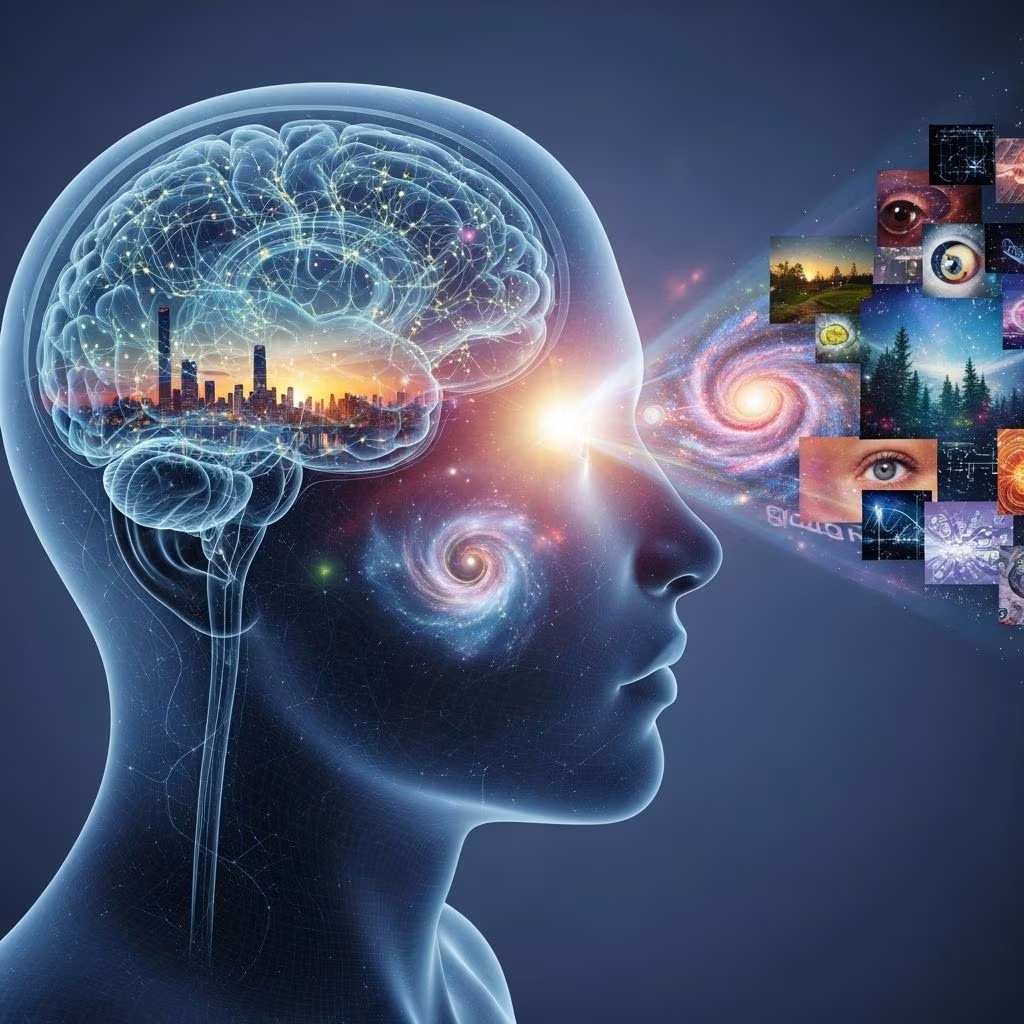
Understanding Perception: Making Sense of Sensory Information
Perception is a fundamental cognitive process that enables individuals to interpret and understand the environment by organizing, identifying, and interpreting sensory input. It transforms raw sensory data into meaningful experiences, allowing us to navigate daily life, make decisions, and connect with others.
Unlike mere sensation—which refers to the detection of sensory stimuli through receptors—perception involves higher-order mental processes that give meaning to what we see, hear, feel, smell, and taste.
The Stages of the Perceptual Process
The perceptual process involves several distinct stages. Each plays a crucial role in how we translate environmental stimuli into conscious experiences.
| Stage | Description |
|---|---|
| Sensation | Physical stimulation is detected by sensory receptors (eyes, ears, skin, etc.). This raw data is transmitted to the nervous system. |
| Attention | Not all sensory data is processed; the brain selects or filters out stimuli to focus on what is most relevant or salient at a given moment. |
| Organization | Selected information is arranged using mental frameworks or patterns to make sense of the input. Gestalt principles significantly influence this stage. |
| Interpretation | The brain assigns meaning, recognizing objects and drawing conclusions based on experience, context, and expectation. |
Step-by-Step Overview
- Sensation: Environmental stimuli (such as light, sound, or texture) activate sensory organs. This is often called bottom-up processing.
- Attention: The mind unconsciously filters stimuli, highlighting certain aspects for further processing while ignoring others.
- Organization: Sensory data is organized into recognizable patterns. For example, the visual system uses proximity and similarity to group shapes into meaningful forms. Gestalt psychology theories describe how our brains tend to perceive holistic patterns rather than isolated bits.
- Interpretation: You make sense of organized data, assigning meaning through high-level cognition (top-down processing), influenced by context and prior experience.
Bottom-Up and Top-Down Processing
Perception is shaped by two main forms of processing:
- Bottom-Up Processing: Begins with sensation. Data flows from sensory input to the brain, where basic features are assembled into patterns. This form is often associated with automatic, data-driven recognition.
- Top-Down Processing: Involves higher-level cognition. The brain applies context, expectations, knowledge, and experiences to interpret the sensory data. For instance, when you hear an ambiguous sound, your brain uses previous experiences to decide whether it’s thunder or a car backfiring.
Most perception combines both forms, balancing raw sensory information with complex interpretation and prediction.
Gestalt Principles: Organizing Our Perceptions
Gestalt psychology offers one of the most influential frameworks in understanding how we organize sensory input into meaningful patterns.
- Figure/Ground: Our minds separate objects (figures) from their backgrounds (ground).
- Similarity: We group elements that are similar in size, shape, or color.
- Proximity: Elements that are close to each other are perceived as belonging together.
- Continuity: Patterns are perceived as continuous rather than disjointed.
- Closure: The mind fills in missing information to perceive complete forms.
These principles help explain why we can quickly recognize familiar shapes in abstract images or why we can follow a line through a complex diagram.
Models of Perceptual Recognition
To explain how we recognize and categorize objects, researchers have proposed various models:
- Template-Matching Model: Recognition occurs when sensory input matches a stored template in memory.
- Feature-Matching Model: The brain recognizes objects based on the presence of key features or attributes rather than whole templates.
Both models highlight how the brain efficiently categorizes new information by comparing it to internal references.
Perceptual Set: The Role of Expectation and Experience
A perceptual set is a mental predisposition that influences how we perceive stimuli, driven by our experiences, expectations, beliefs, and even emotions.
- Selector: We focus on certain features in the sensory data while ignoring others based on our expectations.
- Interpreter: Prior knowledge helps us understand and classify what we notice, and draw inferences from it.
Variables such as emotion, motivation, culture, and personal experience shape our perceptual set and consequently influence what we notice and how we interpret it.
Factors That Influence Perception
- Context: The environment and situation can significantly shape the meaning attached to sensory input.
- Expectations: What we anticipate shapes what we perceive and how we focus our attention.
- Emotion: Our current feelings can alter both what we notice and how we interpret sensory information.
- Motivation: Personal desires and goals can draw our attention to particular stimuli and influence perception.
- Culture: Shared practices, language, and values affect how we organize and assign meaning to sensory experiences.
- Personal Experience: Individual histories form frameworks for recognizing, organizing, and interpreting sensory input.
Examples of Perceptual Differences
- Loud Noise: The same sound (proximal stimulus) can be perceived as thunder, fireworks, or gunfire depending on a person’s context and prior experience.
- Mystery Object in Water: Touching a rough object in a lake leads to different perceptions (fish, rock, weed) depending on prior encounters and cultural background.
Bruner’s Model of Perceptual Process
Psychologist Jerome Bruner proposed a model to explain how perceptions form, especially in social contexts:
- Stage 1: On encountering an unfamiliar stimulus, people are open to various informational cues from the surroundings.
- Stage 2: As cues accumulate, people resolve ambiguity by categorizing the target based on familiar features.
- Stage 3: Once a category is chosen, new cues are interpreted selectively to confirm the initial categorization, and conflicting cues are ignored or distorted.
Perceptual Ambiguity and Context
Sensory signals are inherently ambiguous, and context plays a decisive role in resolving that ambiguity. Neuronal systems in the brain use context to convert basic sensory codes into rich mental representations, allowing learned associations and memory retrieval to color and refine perception over time.
Neuroscientific Insights Into Perception
Recent neuroscience research has revealed the cellular processes underlying perceptual context. Neuronal networks create connections between sensory events and contextual information, helping us learn associations and draw upon memory to interpret new stimuli. This transformation is essential for the mental recreation of reality and supports enduring, coherent perception.
Applications of Perceptual Processing
- Communication: Understanding how perception works helps explain why people interpret messages differently.
- Learning: Perceptual processing influences how efficiently we absorb and recall information.
- Productivity: Training attention and interpretation skills can improve focus and reduce errors.
Common Perceptual Errors
- Selective Perception: Focusing only on cues that fit our expectations, ignoring contradictory information.
- Stereotyping: Using simplified categories based on incomplete data can lead to errors in perception.
- Halo Effect: Allowing one positive (or negative) attribute of a stimulus to influence our overall interpretation.
- Projection: Attributing personal feelings or motivations to others based on our own state.
Why Perception Matters
The perceptual process is vital for interpreting daily experiences. It allows us to recognize dangers, seize opportunities, learn from others, and create meaning. An enhanced understanding of perception can improve relationships, optimize communication, foster learning, and allow for greater empathy with individuals from different backgrounds.
Frequently Asked Questions (FAQs)
Q: What is the difference between sensation and perception?
A: Sensation involves the detection of raw stimuli by sensory organs, while perception is the mental process that organizes and interprets this data to assign meaning.
Q: What are gestalt principles?
A: Gestalt principles are rules by which the brain organizes sensory input, such as grouping by similarity, continuity, and figure-ground distinctions.
Q: What is a perceptual set?
A: A perceptual set is a mental readiness to perceive certain stimuli in specific ways, shaped by expectations, prior experiences, emotion, and culture.
Q: Can perception be improved?
A: Perception skills can improve with training, greater awareness, and varied experiences, allowing us to be more attentive and open to diverse data.
Q: Why do people perceive the same event differently?
A: Differences in context, personal experience, cultural background, and perceptual set lead individuals to interpret events and stimuli in distinct ways.
References
- https://focuskeeper.co/glossary/what-is-perceptual-processing
- https://pmc.ncbi.nlm.nih.gov/articles/PMC6329607/
- https://www.simplypsychology.org/perceptual-set.html
- https://www.ebsco.com/research-starters/psychology/perception
- https://en.wikipedia.org/wiki/Perception
- https://socialsci.libretexts.org/Bookshelves/Communication/Interpersonal_Communication/I.C.A.T_Interpersonal_Communication_Abridged_Textbook_(Gerber_and_Murphy)/03:_The_Perception_Process_and_Perception_of_Others/3.01:_The_Perception_Process
- https://kpu.pressbooks.pub/introconsumerbehaviour/chapter/the-perceptual-process/


