


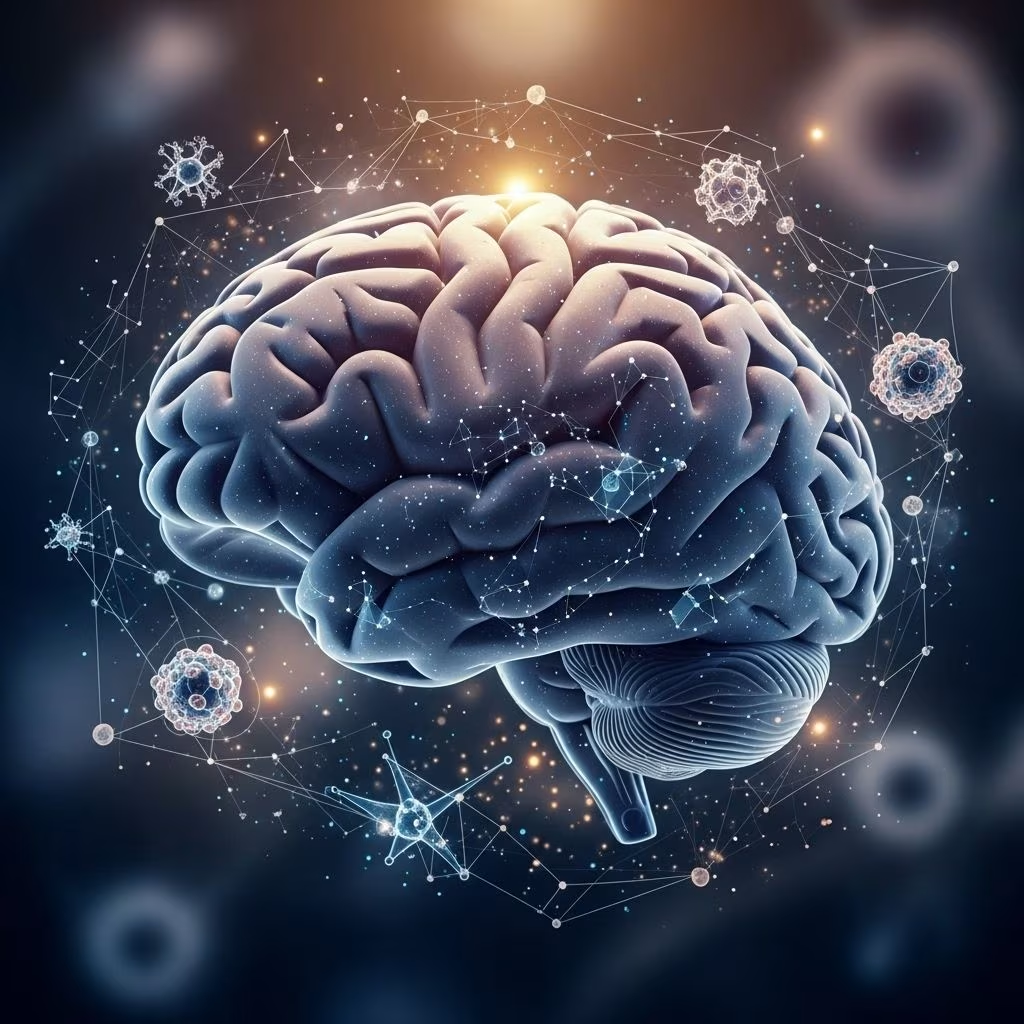
The human brain is the most complex organ in the body, responsible for controlling thought, memory, emotion, and practically every voluntary and involuntary process that keeps us alive. One of the most common curiosities about the brain is its actual size and how this relates to its powerful capabilities. This article answers that question by exploring brain size and structure, interesting facts, and commonly asked questions based on current scientific understanding.
Overview: The Human Brain’s Size and Structure
The brain is the control center of the nervous system. Protected by the skull, it is composed of soft nervous tissue and contains billions of neurons communicating via synapses. Despite its remarkable power, the brain is relatively compact, fitting comfortably within our skulls.
- Shape: The brain resembles a wrinkled, walnut-like organ, with many folds and grooves increasing its surface area.
- Weight: On average, the adult brain weighs about 3 pounds (around 1.36 kilograms).
- Volume: The average volume is about 1,200 to 1,400 cubic centimeters, nearly filling a two-liter soda bottle.
- Surface Area: If flattened, the cerebral cortex’s surface would cover roughly 2,500 cm², about the size of four A4 sheets of paper.
The brain is made up of approximately 60% fat, making it the fattiest organ in the human body, and the rest consists mostly of water, protein, carbohydrates, and salts. Neurons represent only about 10% of brain cells, with glial cells — which provide support and insulation — forming the majority.
The Brain’s Major Parts and Their Sizes
The brain can be divided into several key regions, each with distinct functions and relative sizes:
| Region | Main Function | Relative Size |
|---|---|---|
| Cerebrum | Thought, language, memory, voluntary movement | Makes up about 85% of total brain weight |
| Cerebellum | Coordination, balance, fine motor control | Roughly 10% of brain weight, holding over 50% of brain’s neurons |
| Brainstem | Regulates basic life functions (breathing, heartbeat) | Smallest major part by volume |
| Limbic System | Emotion, memory, motivation | Deep within cerebrum, relatively small by weight |
The Cerebral Cortex
The cerebral cortex is the outermost layer of the cerebrum, heavily folded to maximize surface area. This region is crucial for higher cognitive functions such as reasoning, problem-solving, and conscious thought.
The Cerebellum
Although it constitutes only about one-tenth of the brain’s weight, the cerebellum contains more than half of all neurons in the brain, essential for processing detailed coordination and balance information.
The Brainstem
The brainstem is the oldest evolutionary part of the brain, responsible for the most basic survival functions, including heart rate, respiration, and wakefulness.
How the Brain Compares to the Rest of the Body
For its size, the brain is a comparatively small organ:
- Weight Proportion: The brain comprises only about 2% of an average adult’s body weight.
- Energy Consumption: However, it demands an extraordinary amount of energy — roughly 20-25% of the body’s total energy intake at rest. This energy is used to maintain vital electrochemical gradients and support complex signaling between neurons.
- Growth trajectory: At birth, the brain weighs about 350-400 grams (about 0.77-0.88 lbs), representing about 10% of a newborn’s body weight. By age two, the brain is nearly 80% of adult size, and by six, it has reached 90-95% of adult volume.
How Brain Size Is Measured
There are several ways scientists assess brain size:
- Weight (Mass): Direct measurement, often from postmortem studies.
- Volume: Using imaging technologies such as MRI or CT scans to calculate internal volume (in cubic centimeters or liters).
- External Dimensions: Measurements from one edge to another (e.g., from the front to back or side to side). An adult brain typically measures about 15 centimeters (almost 6 inches) long, about 12 centimeters (4.7 inches) wide, and about 9 centimeters (3.5 inches) high.
Brain size can be affected by factors such as genetics, age, sex, overall health, and certain environmental influences. However, size alone is not an indicator of cognitive ability or intelligence.
Does Brain Size Matter?
Brain size fascinates scientists and laypeople alike, often prompting comparisons among individuals and even across species. Does a bigger brain mean greater intelligence?
- Among humans, there is only a weak correlation between overall brain size and intelligence. Numerous studies indicate that the complexity and efficiency of brain networks are more important than sheer size.
- Across the animal kingdom, species with larger brains relative to body size (known as the encephalization quotient) tend to show greater cognitive abilities, but exceptions exist.
It’s important to note that features like synaptic density (the number and strength of neural connections) and how well the brain’s regions communicate play a significant role in cognitive power, not just the organ’s size.
The Role of Cognitive Reserve
Research on cognitive reserve suggests that a brain with abundant, healthy neural connections is more resilient to damage and decline. Cognitive reserve acts as a buffer, helping the brain maintain function even when specific pathways are damaged. Factors such as education, mental stimulation, and overall brain health contribute to building this reserve, highlighting that “use it or lose it” applies as much to neurons as to muscles.
Other Fascinating Brain Facts
- Number of Neurons: The human brain contains around 86 billion neurons, each capable of forming thousands of synaptic connections, resulting in trillions of potential pathways.
- Plasticity: The brain is plastic, meaning it can change structurally and functionally based on experience, learning, and in response to injury.
- Communication speed: Signals can travel between neurons at speeds up to 268 miles per hour (about 431 km/h).
- Blood supply: Though the brain comprises just 2% of body weight, it receives about 15% of the heart’s output and consumes an estimated 20% of available oxygen.
- Memory capacity: The brain’s storage could be estimated in petabytes, possibly ten times the entire printed material in the Library of Congress, due to the vast interconnectedness of neurons and synapses.
Human Brain Size Differences
Just as people vary in height, weight, and other physical features, individuals also differ in brain size. Several factors account for this variation:
- Sex Differences: On average, male brains are slightly larger (by about 10%) than female brains, mainly due to men typically having larger body sizes. Yet, intelligence and cognitive abilities are not determined by absolute brain size.
- Aging: The brain loses some volume and weight as part of natural aging, especially after age 60. Some areas are more impacted than others.
- Genetics: Genetics influence overall brain size and structure, but lifestyle factors like education, nutrition, and sustained mental activity play major roles in healthy brain development and preservation.
- Health Conditions: Neurodegenerative diseases (e.g., Alzheimer’s) and traumatic injuries can lead to brain atrophy or shrinkage, impairing cognition and function.
Ways to Support a Healthy Brain
In light of the importance of cognitive reserve and healthy brain structure, researchers have identified several lifestyle factors that support brain wellness:
- Regular Physical Activity: Exercise increases blood flow, stimulates neurogenesis, and can enhance the volume of key regions like the hippocampus and basal ganglia.
- Mental Stimulation: Engaging in challenging cognitive activities (learning new skills, puzzles) helps create new connections.
- Balanced Diet: Diets rich in antioxidants, omega-3 fatty acids, and vitamins support cellular health.
- Adequate Sleep: Consistent, high-quality sleep is essential for memory consolidation and clearing metabolic waste.
- Social Engagement: Active social lives stimulate brain regions critical for emotional resilience and memory.
How Does Human Brain Size Compare to Other Species?
When compared to other animals, the human brain is notable for its large size relative to total body mass and the extraordinary development of the cerebral cortex.
- Elephants: Largest land mammal brains, weighing up to 11 pounds (5 kg), but with less cortex relative to body weight than humans.
- Whales: Some whales have brains weighing over 17 pounds (7.7 kg). Again, their brains are larger in total weight, but in relation to their huge body sizes, the ratio is smaller.
- Dolphins: Highly intelligent, with a high brain-to-body mass ratio.
- Chimps: Our closest relatives in the animal kingdom have brains about one-third the size of a human’s.
The encephalization quotient (EQ) is often used to compare intelligence potential across species. Humans have the highest EQ, reflecting the large size of our brain relative to body size and our extraordinary cognitive abilities.
Frequently Asked Questions: Brain Size and Structure
Q: How much does an average adult human brain weigh?
A: About 3 pounds (1.36 kilograms), but there is natural variation based on age, sex, and genetics.
Q: Does a bigger brain mean higher intelligence?
A: Not necessarily. Intelligence is shaped more by the efficiency and connectedness of brain circuits, not just the size of the brain.
Q: Is the brain fully grown at birth?
A: No. While a newborn’s brain is about one-quarter the size of an adult’s, most rapid brain growth occurs in early childhood, with the majority of growth completed by age six.
Q: What lifestyle choices help build a ‘high capacity’ brain?
A: Activities that challenge the mind (like learning or problem-solving), regular aerobic exercise, a nutritious diet, stress management, and strong social relationships all help create more neural connections and promote lasting brain health.
Q: Are there differences in brain size between men and women?
A: On average, men have slightly larger brains due to greater body size, but this does not relate to cognitive ability. Male and female brains effectively process information with no measurable differences in intelligence.
Q: Why is the brain so wrinkled?
A: The brain’s many folds (gyri) and grooves (sulci) greatly increase the surface area of the cerebral cortex, allowing for more neural tissue to fit inside the skull.
Key Takeaways
- The adult human brain weighs about 3 pounds, with most of its volume dedicated to the cerebrum.
- Size alone does not determine intelligence—network complexity, health, and neural connections are more important.
- Brains can be kept resilient and healthy through mental, social, and physical activities.
- Human brains are uniquely adapted for complex thought, largely due to an enlarged cerebral cortex and high cognitive reserve.
References
- https://extension.usu.edu/aging/research/a-healthy-brain-use-it-or-lose-it
- https://www.youtube.com/watch?v=q7P7kOwc8k4
- https://confluenthealth.com/resources/dr-stephen-clark-on-exercise-and-brain-health-with-verywell-mind/
- https://pmc.ncbi.nlm.nih.gov/articles/PMC2763392/
- https://www.ebsco.com/research-starters/health-and-medicine/short-term-memory


