


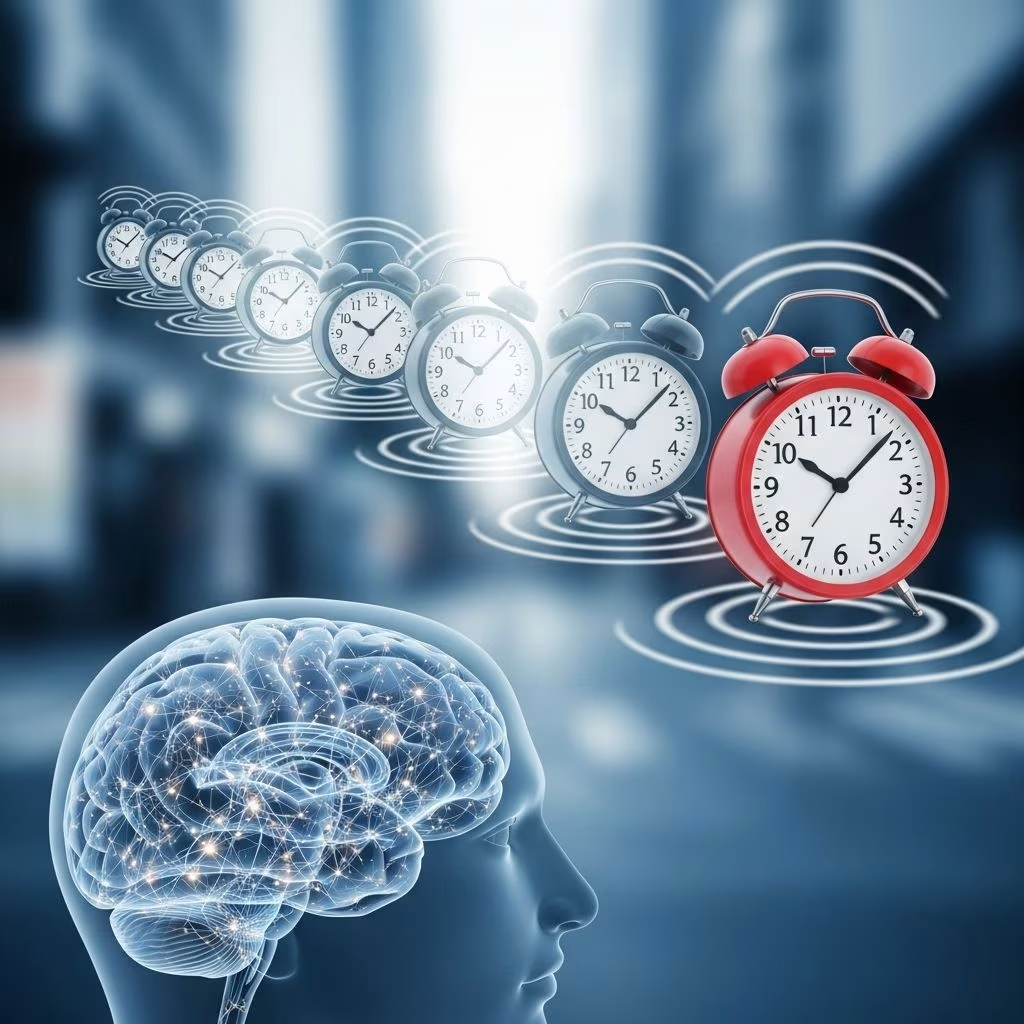
Have you ever noticed how a persistent background noise fades from your awareness after a while, or how a once-shocking smell eventually becomes barely noticeable? This fascinating decrease in response to a repeated, inconsequential stimulus is known as habituation. Habituation is a fundamental psychological process that underpins our ability to adapt and function in complex environments. This article explores what habituation is, how it works, real-world examples, and its relevance to psychology and daily life.
What Is Habituation?
Habituation is a type of non-associative learning where repeated or continuous exposure to a particular stimulus leads to a gradual decrease in the behavioral or emotional response to that stimulus. Unlike other forms of learning, habituation does not involve making connections between stimuli (as in associative learning), but rather reflects a reduction in responsiveness that helps focus an organism’s attention and energy on new or significant events.
- It is among the simplest and most universal forms of learning, observed in humans, animals, and even some invertebrates.
- Habituation allows individuals to filter out irrelevant or harmless background information to better attend to important stimuli.
- This process is not just behavioral; it can include physiological changes as well.
Basic Definition and Psychological Importance
Various definitions exist, but a broad consensus describes habituation as a decline in response to a repeated, unchanging stimulus. In psychological terms, habituation is a kind of adaptation that aids in managing sensory overload and optimizes an individual’s interaction with their surroundings.
“Habituation is the decreased response that occurs as a result of repeated exposure to a stimulus.” — Helpful Professor
Characteristics of Habituation
Research over decades has outlined several key characteristics that define true habituation and distinguish it from related phenomena like sensory adaptation or fatigue.
- Behavioral response decrement: A measurable decrease in the behavioral response occurs with repeated exposure to the same stimulus.
- Stimulus specificity: Habituation is often specific to the stimulus presented; a significantly different stimulus can restore the original response (dishabituation).
- Spontaneous recovery: If the stimulus is withheld for a period, the original response may return, showing that habituation is not permanent.
- Rate and frequency dependence: The speed of habituation depends on the frequency and intensity of the stimulus. More frequent or intense exposure typically accelerates habituation.
- Potentiation of habituation: Habituation tends to happen more quickly after repeated cycles of habituation and recovery.
| Feature | Description |
|---|---|
| Response Decrement | Behavioral/emotional response decreases over time with repetition. |
| Stimulus Specificity | Response reduction is specific; a new stimulus can reverse it. |
| Spontaneous Recovery | Removal of the stimulus can lead to the response returning after time. |
| Frequency & Intensity | Higher rates and intensities often lead to faster habituation. |
| Potentiation | Subsequent habituation occurs more rapidly after multiple cycles. |
How Does Habituation Work?
The mechanism behind habituation involves both psychological and neurological factors. When a benign stimulus is encountered repeatedly, our brain registers it as unimportant, leading to a reduction in neural or behavioral responses. This is a way for the nervous system to conserve energy and resources, allowing more attention to be given to novel or threatening changes in the environment.
- Initial response: The first exposure to a new stimulus usually causes an alert or orienting reaction.
- Repeated exposure: Continued presence of the same stimulus leads to the response diminishing over time.
- Neural adaptation: Brain pathways involved in threat or novelty detection show less activation with each presentation of the same innocuous stimulus.
Habituation vs. Sensory Adaptation
While habituation and sensory adaptation both involve decreased responses to repeated stimuli, they are distinct phenomena.
| Aspect | Habituation | Sensory Adaptation |
|---|---|---|
| Process Type | Behavioral/Psychological | Physiological |
| Conscious Control | Can be conscious or unconscious | Always unconscious |
| Involves Learning? | Yes | No |
| Reversibility | Rapid recovery after stimulus removal | Gradual reversibility as receptors reset |
In short, habituation is a matter of learning and behavior, while sensory adaptation is a reduction in sensation due to fatigue or changes at the sensory receptor level.
Examples of Habituation in Everyday Life
Habituation is a universal experience. Here are several real-world examples across different settings:
- Urban noise: People living in cities often stop noticing the sound of traffic, horns, or sirens after a while.
- Scents: When you first enter a bakery, the smell is potent, but it soon fades as you spend more time inside.
- Children and toys: Babies become less interested in a toy after repeated exposure, seeking more novel playthings.
- Startle reflex: After repeated, harmless loud noises, animals (and humans) startle less.
- Daily routines: Repetitive workplace alarms or notifications often fade into the background and are no longer disruptive.
Habituation in Child Development
Children, in particular, display obvious signs of habituation. When a new sound or sight enters their world, they direct full attention to it. Over time, as the experience is repeated and shown to be safe or inconsequential, attention diminishes and they shift focus to other things.
Dishabituation: When Habituation Is Interrupted
Dishabituation refers to the restoration of a response that has been decreased by habituation, typically following the introduction of a new or different stimulus. For example, someone who no longer notices the sound of a ticking clock might instantly notice when a distinctly different sound, like a loud crash, occurs, temporarily increasing awareness of all sounds.
- Dishabituation demonstrates that the original learning through habituation can be quickly reversed or modified.
- This phenomenon is important for alertness and helps reintegrate focus when changes or threats occur in the environment.
Why Does Habituation Matter?
Habituation has crucial implications in daily living, mental health, developmental psychology, and clinical therapy.
- Prevents sensory overload: By tuning out repetitive, harmless stimuli, people can focus on what’s new or important in their environment.
- Promotes efficient attention: Resources are reserved for processing new, meaningful information or threats.
- Aids behavioral therapy: Habituation is harnessed in therapies such as exposure therapy for anxiety or phobias, where gradual, repeated exposure to a feared object leads to a reduced emotional reaction.
- Autism, schizophrenia, and neurodevelopment: Research shows that individuals with certain psychiatric or developmental disorders display differences or deficits in habituation. This has implications for understanding and supporting these populations.
Applications of Habituation in Psychology and Therapy
Habituation principles are routinely used in psychological treatment, especially for conditions involving maladaptive or excessive responses to stimuli.
- Exposure therapy: Individuals with phobias, anxiety, or PTSD are gradually and repeatedly exposed to anxiety-provoking stimuli in a controlled environment, eventually leading to diminished anxiety responses.
- Cognitive-behavioral therapy (CBT): CBT may include habituation-based strategies to help reframe and diminish problematic emotional reactions through repeated, safe exposure.
- Autism and attention: Understanding habituation deficits helps create supportive interventions in neurodevelopmental therapy.
Factors That Influence Habituation
The process of habituation can be affected by several variables:
- Stimulus intensity: Stronger or more intense stimuli may take longer to habituate to, or may never fully habituate if they are perceived as threatening.
- Frequency of exposure: More frequent exposure usually leads to faster habituation.
- Duration and predictability: The length and predictability of exposure also impact the rate of habituation.
- Individual differences: Age, neural development, underlying mental health conditions, and previous experiences can all play a role.
Common Misconceptions About Habituation
There are several myths and misunderstandings about habituation:
- It is not just “getting bored”: Habituation is a learned decrease in response, not a subjective feeling of boredom.
- It’s not always conscious: While sometimes people notice themselves “getting used to” something, often habituation happens below conscious awareness.
- It is not permanent: Given a break from the stimulus, responses usually recover quickly.
Frequently Asked Questions (FAQs)
Q: How is habituation different from adaptation or fatigue?
A: Habituation is a learned or behavioral process of decreased response to a repeated stimulus, while sensory adaptation is a physiological reduction in sensitivity at the receptor level. Fatigue, in contrast, is a reduction in response due to depletion of resources, not learning or adaptation.
Q: Why is habituation important in daily life?
A: Habituation helps filter out unimportant background noise or distractions so you can focus on new and meaningful events, conserving cognitive and neurological resources for more pressing stimuli.
Q: Can habituation be reversed?
A: Yes. Through a process called dishabituation, presenting a new or significantly different stimulus can restore or increase the diminished response to the original stimulus.
Q: Does habituation happen in children?
A: Absolutely. Habituation is a key part of cognitive and sensory development. Babies and children show obvious signs of habituation as they get used to repeated sights, sounds, and experiences.
Q: Are there situations where habituation is a problem?
A: Yes. In certain psychological or neurological conditions (like autism or schizophrenia), people may habituate too slowly or not at all, leading to sensory overload or persistent negative reactions to harmless stimuli.
Summing Up: The Significance of Habituation
Habituation is an essential process that allows humans and animals to navigate complex environments, focus attention, and regulate emotional responses. By learning when to tune out and when to refocus, habituation supports learning, mental health, and daily functioning. Its role in therapy, especially in treating anxiety-related disorders, is a powerful testament to its foundational place in psychology.
References
- https://www.betterhelp.com/advice/psychologists/what-is-habituation-psychology-and-why-does-it-matter/
- https://en.wikipedia.org/wiki/Habituation
- https://helpfulprofessor.com/habituation-examples/
- https://study.com/academy/lesson/methods-of-studying.html
- https://dictionary.apa.org/habituation
- https://www.youtube.com/watch?v=D6Sbgi-gKhU
- https://www.gustavodefelice.com/p/what-is-habituation-and-how-it-impacts
- https://pmc.ncbi.nlm.nih.gov/articles/PMC2754195/


