


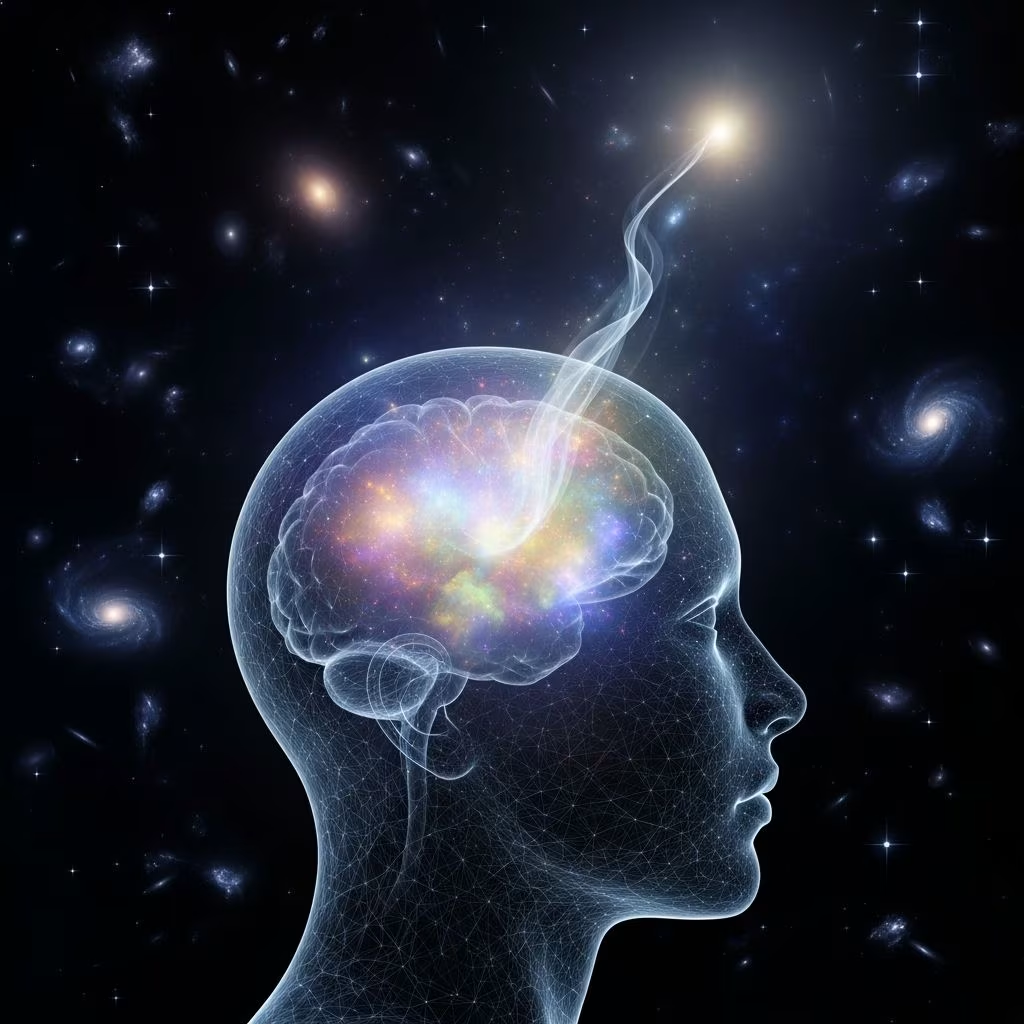
Consciousness has perplexed philosophers, scientists, and ordinary thinkers for centuries. Despite advances in neuroscience and psychology, the fundamental question—what is consciousness?—remains persistently challenging. This article delves deeply into the definition of consciousness, its qualities, history of inquiry, scientific research into its origins, leading theoretical frameworks, and why the study of conscious experience continues to baffle experts.
Defining Consciousness
Consciousness is commonly defined as the state of being aware of and able to think about oneself, one’s surroundings, and one’s experiences. Essentially, it is the subjective experience of internal and external existence. Consciousness includes:
- Awareness — The ability to perceive, feel, or be cognizant of events, objects, thoughts, emotions, or sensory experiences.
- Wakefulness — Differentiating between states of being awake, asleep, or unconscious.
- Self-awareness — The capacity to reflect on oneself as a distinct, thinking entity.
- Intentionality — The mind’s ability to direct attention and thought towards objects or ideas.
John Locke, an influential English philosopher, defined consciousness as “the perception of what passes in a man’s own mind”. This classical framing endures, though modern neuroscience and psychology reveal greater complexity.
Key Aspects of Consciousness
- Phenomenal consciousness (subjective experience): Sensory perceptions like seeing red, feeling pain, or hearing music.
- Access consciousness: Information available for reasoning, speech, and action.
- Self-consciousness: Awareness of oneself as an individual apart from others.
Consciousness in Psychology
In psychology, consciousness has been described as a collection of mental phenomena including:
- The waking state and experience of reality.
- Mental states such as perceptions, emotions, and thoughts.
- Self-consciousness, including embarrassment, self-reflection, and self-recognition.
The concept of consciousness was once central to early psychological inquiry, but in the early twentieth century, it became less prominent as behaviorism—which focused on observable behavior—rose to dominance. Renewed interest emerged from the mid-twentieth century onwards, fueled by breakthroughs in neuroscience, cognitive science, and the philosophy of mind.
The History and Philosophy of Consciousness Studies
Questions about consciousness—what it is, what it does, and how it arises—have occupied thinkers throughout history:
- Ancient Philosophies: Greek philosophers like Plato and Aristotle speculated about the soul, mind, and perception.
- Descartes’ Dualism: René Descartes (17th century) argued that the mind and body are fundamentally distinct—an idea with enduring influence.
- Empiricism: John Locke and later David Hume described consciousness as the perception of internal experience.
- Modern Philosophy: Debates continue around whether consciousness is a physical process, an emergent property, or something fundamentally distinct from matter.
A persistent theme is the mind-body problem: Is consciousness purely a byproduct of brain activity, or does it transcend the physical body? Recent work suggests much public fascination with consciousness stems from our intuitive “dualism”—the tendency to think of mind and body as separate.
Neuroscience: The Brain and Consciousness
Scientific research into consciousness has grown rapidly with advances in brain imaging and cognitive science. Researchers study the neural correlates of consciousness—the specific brain systems and activity patterns that align with conscious experience.
Major Findings
- Consciousness involves multiple brain regions, including the cerebral cortex and thalamus.
- Brain activity in certain frequency bands (e.g., gamma rhythms) increases during conscious attention and focus.
- States like sleep, anesthesia, and coma reveal how consciousness can wax and wane with physiological changes.
Awareness, Wakefulness, and the Brain
Consciousness is often divided into two components:
- Awareness: Content of consciousness (internal thoughts, sensory inputs).
- Arousal (Wakefulness): Level of consciousness (alertness, sleep, coma).
These components can be measured clinically using tools like the Glasgow Coma Scale, and neuroscientists monitor transitions between different states using brain scans.
Altered and Modified States of Consciousness
Consciousness is not static; it can be modulated through both natural and artificial means. Examples include:
- Dreams and deep sleep.
- Hypnosis, meditation, and mindfulness.
- Psychoactive drugs (such as hallucinogens) altering perceptions and thought processes.
Practices like meditation can produce measurable changes in brain structure and function, enhancing certain types of awareness and even increasing white matter integrity.
Philosophical Puzzles: Dualism and the “Hard Problem”
Modern philosophy acknowledges several enduring mysteries around consciousness:
- The “Hard Problem”: Coined by philosopher David Chalmers, refers to the difficulty of explaining how subjective experiences arise from objective brain processes.
- Dualism: The intuitive tendency to think of mind and body as separate, reinforced by thought experiments about zombies (creatures without consciousness) and the neuroscientist Mary who knows everything about color except for the experience of seeing it.
- Physicalism vs. Non-physicalism: Are mental states entirely explainable in physical terms, or is consciousness outside the reach of science?
Some researchers suggest our sense of consciousness as distinct from the body may itself be a trick of the mind, a consequence of how brains evolved to navigate a social and physical world.
Theories of Consciousness
While no single theory dominates, several important frameworks attempt to explain the emergence, function, and structure of conscious experience:
| Theory | Core Idea | Strengths | Limitations |
|---|---|---|---|
| Global Workspace Theory | Consciousness arises when information is globally broadcasted to many cognitive systems. | Explains attention, working memory, and subjective report. | May not explain the full richness of conscious experience. |
| Integrated Information Theory | Consciousness corresponds to the capacity of a system to integrate information in a unified way. | Allows quantitative study; links consciousness to brain complexity. | Controversial; difficult to test empirically. |
| Higher-Order Theory | Consciousness involves having higher-order thoughts about one’s own mental states. | Accounts for self-reflection, introspection. | Struggles to explain non-verbal or non-reflective conscious states. |
| Biological Theories | Emphasize the physical structures and neural mechanisms giving rise to awareness. | Rooted in neuroscience; testable with brain imaging. | Often miss subjective aspects; descriptive more than explanatory. |
Consciousness versus Conscience
Though the words “consciousness” and “conscience” are sometimes confused, they refer to distinct concepts:
- Consciousness is about awareness and subjective experience.
- Conscience deals with moral judgment—our ability to discern right from wrong and act according to inner ethical standards.
Whereas consciousness is rooted in perception and cognition, conscience reflects values and decision-making, influenced by individual, cultural, and societal factors.
What Does Consciousness Do?
Debate continues about the function of consciousness. Proposed functions include:
- Integrating sensory input to guide adaptive action.
- Enabling learning, creativity, and flexible thinking.
- Allowing social communication and empathy by modeling other minds.
- Facilitating planning, introspection, and self-control.
Notably, many actions (from driving to speaking) can be performed automatically, without conscious awareness, raising the question of what advantages consciousness confers.
Why Is Consciousness So Difficult to Understand?
The persistent mystery of consciousness stems from several factors:
- It is inherently subjective, known foremost by personal experience.
- There are no external, objective criteria to directly measure consciousness.
- Intuitive dualism—the sense that consciousness is separate from the body—may bias our understanding.
- Complexity of neural mechanisms and the lack of simple, complete explanations.
Despite clear progress in understanding brain function, explaining how the brain produces subjective experience remains a formidable challenge.
Research Approaches and Interdisciplinary Study
Today, study of consciousness brings together diverse fields, including:
- Neuroscience and neurobiology
- Philosophy of mind
- Psychology and cognitive science
- Computer science and artificial intelligence (examining the possibility of machine consciousness)
The interplay between these disciplines pushes research forward, though consensus on the fundamental nature of consciousness remains elusive.
Frequently Asked Questions (FAQs)
What is the difference between consciousness and unconsciousness?
Consciousness implies an awareness of oneself and one’s surroundings, while unconsciousness describes a state where that awareness is lost—such as in deep sleep, coma, or under anesthesia.
Can animals be conscious?
Many researchers believe animals experience at least basic forms of consciousness, including sensory awareness and emotions, though the depth and nature of non-human consciousness remains subject to debate.
Is it possible to measure consciousness?
Researchers use behavioral criteria, self-report, and brain imaging techniques to assess the presence and degree of consciousness, but there remains no universally accepted objective measure.
What are altered states of consciousness?
These are mental states different from baseline wakefulness, including dreams, meditative and hypnotic states, and those induced by psychoactive substances. They reveal the flexibility and range of conscious experience.
Why is the “hard problem” of consciousness so challenging?
The “hard problem”—explaining how and why brain activity gives rise to subjective experience—remains difficult because it bridges physical processes and private awareness, realms that are hard to reconcile scientifically.
Conclusion
Consciousness is the foundation of human experience and identity, yet it is also among science’s and philosophy’s greatest enigmas. As scientific tools grow ever more precise, and interdisciplinary perspectives deepen, experts hope gradually to reveal the intricacies of awareness. Still, the question “what is it like to be conscious?” continues to inspire wonder—which may be part of the very nature of consciousness itself.


