


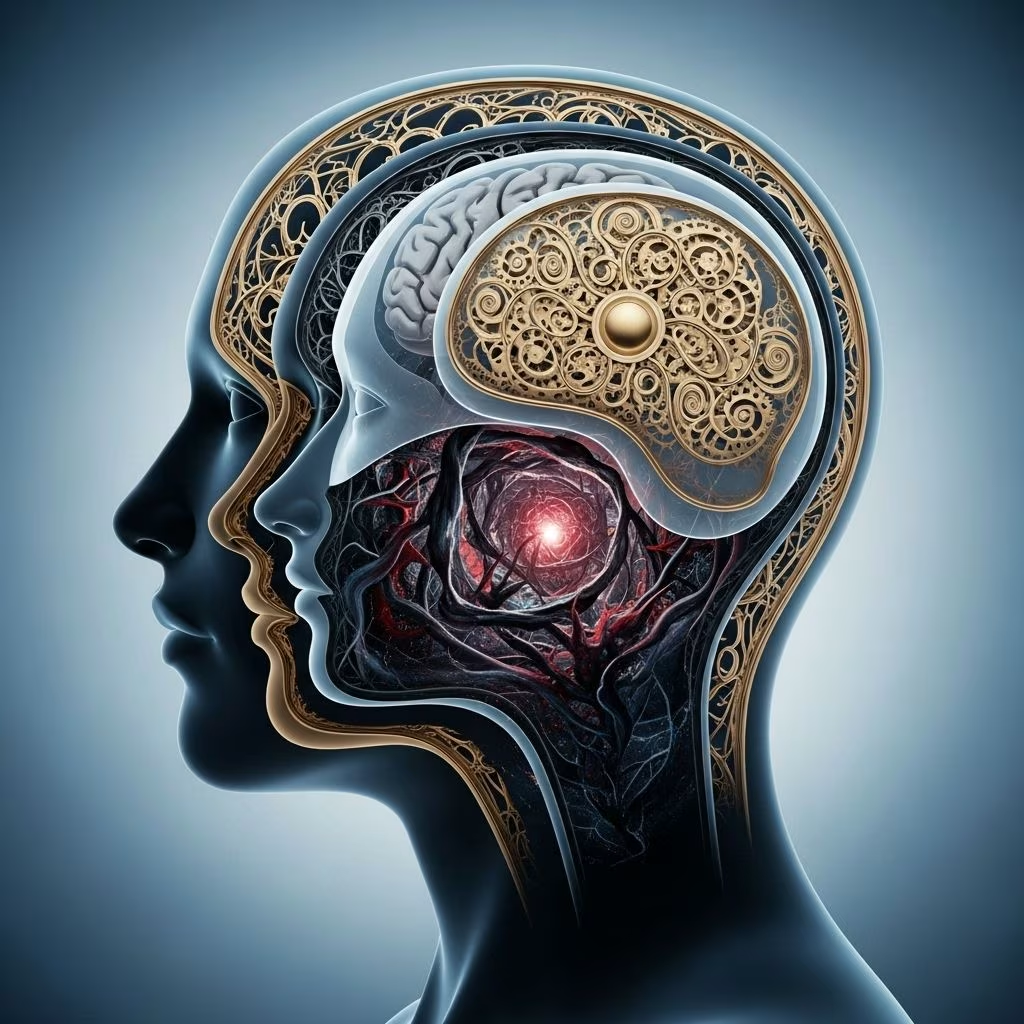
Introduction to Freud’s Structural Model of the Psyche
Sigmund Freud’s theory of the id, ego, and superego is one of the most influential models in the field of psychology. Developed in the early twentieth century, Freud’s structural model describes three core elements of the human psyche and explains the complex ways in which they interact to shape behavior, thought processes, and personality. By understanding the unique role and function of the id, ego, and superego, we gain insight into inner conflicts, motivations, and mental well-being.
Freud intended this model not only to clarify personality structure but also to illustrate how unconscious desires and moral ideals conflict and cooperate within each individual. This foundational idea remains central to psychoanalytic thought today.
The Origins of Freud’s Theory
Freud began developing his model in the early twentieth century, formalizing the concepts in works such as Beyond the Pleasure Principle (1920) and The Ego and the Id (1923). He believed that mental life is dynamic, involving constant tension and negotiation between internal drives, external reality, and internalized social norms. As a result, he proposed the structural model as a way to better understand how mental conflict arises and impacts health and behavior.
The three components Freud described are:
- Id – the instinctual and primitive part of the mind.
- Ego – the realistic and rational mediator.
- Superego – the moral and ethical compass.
The Id: The Unconscious Instinctual Drives
The id is the most primitive part of the personality. Present from birth, it is an entirely unconscious force that houses innate biological instincts and drives, including hunger, thirst, aggression, and sexual desire. The id operates on what Freud called the pleasure principle: seeking immediate gratification of desires and avoiding pain, regardless of reality or social norms.
The id is:
- Instinctive and impulsive
- Immune to logic, reality, or morality
- Oriented toward instant satisfaction
- Unchanging throughout life
- Unconscious and inaccessible to direct introspection
- Child-like and fantasy-driven
- Unconcerned with consequences or societal demands
Because the id knows no boundaries or codes, it can be likened to a “cauldron” of basic desires and emotions. For example, when an infant cries for food, the id demands satisfaction with no regard for time or circumstance. The id continues to influence a person throughout life, forming the raw energy behind much of our thought and action.
The Ego: Mediator and Reality Principle
As the individual grows, a new, more sophisticated structure emerges: the ego. Unlike the fully unconscious id, the ego includes conscious awareness and some unconscious processes. The ego’s main purpose is to mediate between the unreasonable demands of the id, the lofty standards of the superego, and the realities of the social world.
The ego is governed by the reality principle. This means it searches for practical and socially acceptable ways to fulfill the id’s desires, sometimes delaying gratification or finding alternatives that do not conflict with societal norms or lead to negative consequences. In Freud’s analogy, the ego is like a rider guiding a powerful horse (the id): it cannot suppress the horse completely but directs its energy in appropriate ways.
- Rational and practical
- Operates in both conscious and unconscious layers
- Balances inner drives with external demands
- Responsible for decision-making and problem-solving
- Develops defense mechanisms to manage anxiety and internal conflict
A well-functioning ego fosters mental health by productively resolving conflicts between instinct, morality, and reality. Poor ego strength, in contrast, can result in inflexible or unhealthy behavior patterns.
The Superego: Internalized Morality and Ideals
The superego emerges as the individual internalizes social and parental values, norms, and prohibitions. It acts as a critical and moralizing role, vigilantly judging the ego’s actions. The superego operates by the morality principle: compelling us to act according to what is right, just, and socially approved, even if this conflicts with personal desires.
The superego comprises two key subcomponents:
- The conscience: punishes the ego through feelings of guilt, shame, or anxiety when behavior falls short of moral ideals.
- The ego ideal: rewards the ego with feelings of pride or self-esteem when it lives up to internalized standards.
Unique characteristics of the superego:
- Represents societal rules, ethical codes, and cultural values
- Functions consciously and unconsciously
- Imposes strict guidelines and expectations
- Can be critical, rigid, or perfectionistic
The superego brings both benefits and challenges: it helps maintain social order and personal integrity but, if overly harsh, can lead to chronic guilt or unrealistic self-demands.
Interactions and Conflicts: How the Id, Ego, and Superego Shape Personality
The three structures of the psyche are interdependent and frequently in conflict. The id seeks immediate pleasure, the superego demands adherence to ideals, and the ego is caught in the middle, trying to negotiate a workable solution. This tension is at the heart of Freud’s view of psychological functioning.
- Id vs. Ego: The id’s demands are moderated by the ego, resulting in actions that are more acceptable or delayed until circumstances allow.
- Superego vs. Ego: The superego imposes guilt or pride, shaping the ego’s choices and internal state. Conflict with the superego can lead to repression or anxiety.
- Id vs. Superego: When instinctual urges clash with moral ideals, internal conflict and psychological distress are often the result.
Table: Comparison of Id, Ego, and Superego
| Aspect | Id | Ego | Superego |
|---|---|---|---|
| Principle | Pleasure | Reality | Morality |
| Consciousness | Unconscious | Conscious & Unconscious | Both |
| Main Function | Immediate gratification, instinct | Mediation, decision-making | Moral judgment, ideal self |
| Influence | Drives and impulses | Balancing forces | Ethical standards, guilt/pride |
| Development | Present at birth | Develops in infancy | Develops in early childhood |
Personality Development and Psychoanalytic Implications
According to Freud, a healthy personality depends on the ability of the ego to effectively balance the often competing demands of the id and the superego. Problems arise when one component dominates:
- Id-dominated personalities: impulsive, self-centered, potentially criminal or antisocial behavior; little concern for consequence or morality.
- Superego-dominated personalities: excessively moralistic, rigid, prone to guilt, self-denial, or anxiety about not meeting high standards.
- Weak ego: inability to balance demands, possibly leading to anxiety, neurosis, or dysfunctional coping mechanisms such as repression, denial, or projection.
- Well-balanced ego: flexible, rational, capable of finding realistic and ethical solutions to internal and external conflicts.
Freud saw these internal conflicts as crucial to understanding not only everyday behavior but also psychological disorders. Therapy, in Freud’s view, helps patients strengthen the ego and better manage the demands of both id and superego.
Examples Illustrating the Id, Ego, and Superego in Action
The dynamic interplay between the id, ego, and superego can be illustrated in common decision-making scenarios:
- Hunger at Work: The id demands immediate food. The superego insists it’s rude to eat during a meeting. The ego decides to wait until an appropriate time.
- Cheating on a Test: The id wants to cheat for instant success. The superego knows cheating is wrong and would produce guilt. The ego weighs the risks and comes to a practical decision.
- Impulsive Shopping: The id urges buying something expensive for pleasure. The superego warns about responsibility and saving. The ego mediates, perhaps opting for a compromise.
Assessment: The Contemporary View and Criticisms
While Freud’s structural model is an important historical milestone, contemporary psychology sees several limitations:
- Lack of empirical evidence: The concepts are not directly testable using scientific methods.
- Overemphasis on sexuality and aggression: Freud prioritized these drives, whereas modern psychologists recognize a broader set of motivations.
- Deterministic view: The theory underplays individual agency and overemphasizes unconscious forces.
- Cultural and gender biases: Critics note Freud’s views reflected Victorian-era values and may not generalize.
Despite these criticisms, Freud’s framework remains influential in therapy, literature, and popular culture. Its value lies in highlighting inner conflict and the complexity of human motivation.
Frequently Asked Questions (FAQs)
Q: What is the main function of the ego?
A: The ego acts as the rational mediator, balancing the primitive urges of the id and the moral demands of the superego while taking reality into account.
Q: Can the id, ego, and superego change over time?
A: While the id remains mostly unchanged from birth, the ego and superego continue to develop and adjust based on experience, learning, and socialization.
Q: How do the id, ego, and superego contribute to mental health problems?
A: Imbalances—such as a dominating id or superego, or a weak ego—can lead to issues like anxiety, compulsions, guilt, or impulsivity. Effective therapy often targets strengthening the ego’s ability to manage internal conflicts.
Q: Are Freud’s concepts still used in modern psychology?
A: While research methods and models have evolved, Freud’s ideas about unconscious processes, internal conflict, and defense mechanisms still influence therapeutic approaches and the understanding of personality.
Q: What’s a quick way to remember the difference between id, ego, and superego?
A: Think of the id as “I want,” the superego as “I should,” and the ego as “How can I make both work in the real world?”
Key Takeaways
- The id, ego, and superego form the foundation of Freud’s model of personality.
- The id is responsible for basic, instinctive drives and demands immediate satisfaction.
- The ego mediates between the desires of the id, the constraints of reality, and the moral standards of the superego.
- The superego internalizes societal rules and strives for moral perfection.
- Balanced interplay among the three leads to healthy personality functioning; imbalances can contribute to psychological distress.
- Although elements of Freud’s ideas are now considered dated, the concepts remain valuable for understanding internal conflict and personality.
References
- https://www.youtube.com/watch?v=bo_AXAqiK0E
- https://www.youtube.com/watch?v=kDO1B5NtrUM
- https://en.wikipedia.org/wiki/Id,_ego_and_superego
- https://study.com/learn/lesson/id-ego-and-superego-freud.html
- https://iastate.pressbooks.pub/individualfamilydevelopment/chapter/freuds-psychodynamic-theory/
- https://www.medschoolcoach.com/freud-psychoanalytic-theory-mcat-psychology/


