


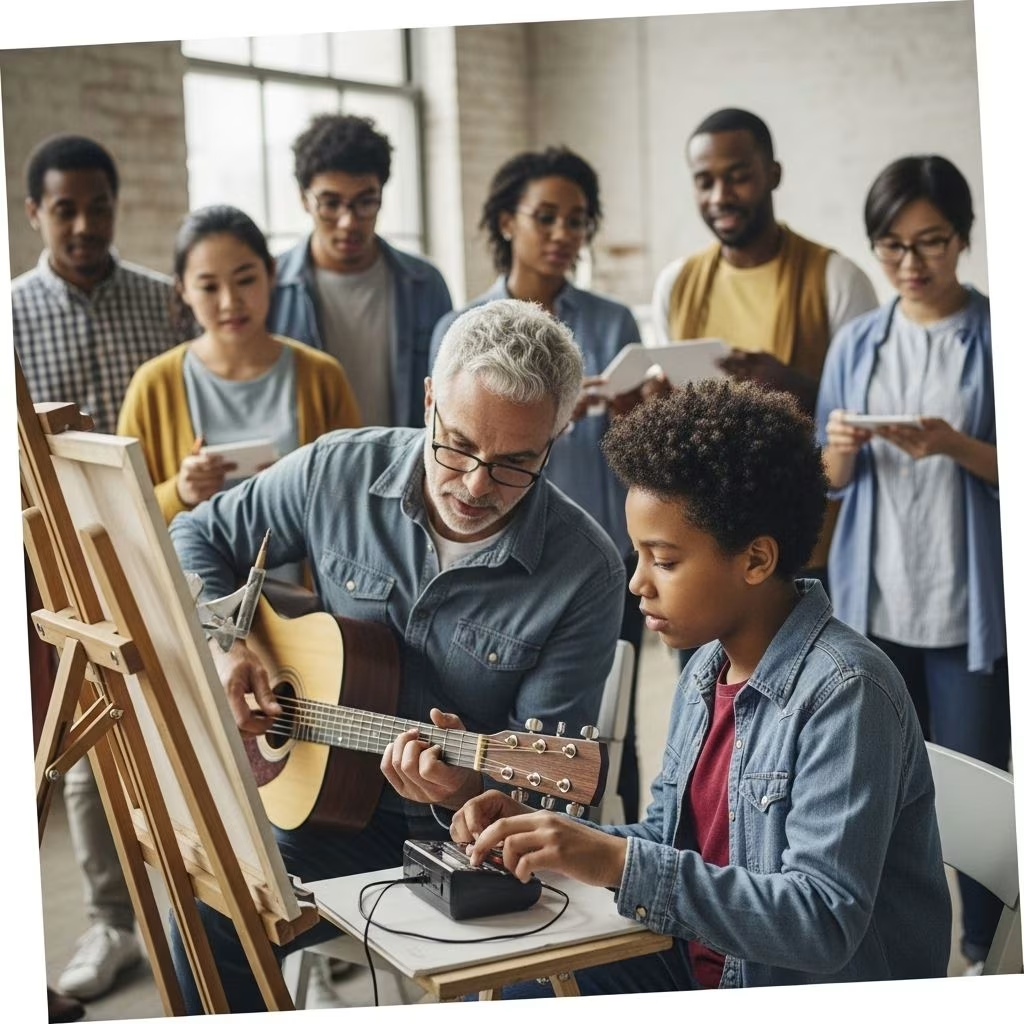
Observational learning is a fundamental psychological process by which individuals acquire new behaviors, skills, and attitudes simply by observing others. Central to human and animal development, this form of learning extends beyond direct experience or formal instruction, enabling us to adapt, innovate, and socialize effectively. At the heart of observational learning is not just imitation, but a deeper cognitive engagement with the actions, consequences, and successes or failures of those around us.
What Is Observational Learning?
Observational learning, also known as social learning or modeling, refers to the process of acquiring new knowledge and behaviors by watching and emulating others. Unlike learning through direct reinforcement or punishment, observational learning allows individuals to absorb information by seeing behavioral examples—whether in person or through various media—then storing and potentially reproducing what has been observed.
- Humans often learn from parents, peers, teachers, or admired figures.
- Animals also display observational learning; for example, birds learning songs or primates mastering tool use from watching others.
- The process is crucial in childhood—children mimic language, habits, and attitudes observed in their surroundings.
Observational learning does not require direct reinforcement; learning can occur simply by witnessing another’s experiences, including their rewards or punishments.
Albert Bandura and Social Learning Theory
The foundation of modern observational learning theory was established by psychologist Albert Bandura through his pioneering work in the 1960s. Bandura introduced the idea that humans could acquire complex behaviors through observation, independent of direct reinforcement. His influential Bobo Doll Experiment demonstrated that children who watched adults behave aggressively toward a doll were more likely to imitate those aggressive actions themselves.
- Bandura challenged traditional behaviorism, which emphasized conditioning through direct interaction.
- He highlighted observation, imitation, and modeling as central to how we learn, leading to the formulation of Social Learning Theory.
Bandura’s work established that learning involves not only direct experience but also the mental processes involved in observing and encoding the behaviors of others.
Main Elements of Social Learning Theory
- Observational learning (modeling): Acquiring new responses by watching the behaviors and outcomes experienced by others.
- Vicarious reinforcement/punishment: Learning about the desirability or undesirability of behaviors based on the consequences others receive.
- Symbolic representation: The ability to mentally represent and later recall the observed actions.
- Reciprocal determinism: Behavior, personal factors, and environmental influences all interact to shape learning.
Core Processes of Observational Learning
Bandura identified four essential processes that enable observational learning to occur. Each stage involves distinct mental operations:
| Process | Description | Key Influences |
|---|---|---|
| Attention | The observer must first notice and focus on the relevant behaviors displayed by a model. |
|
| Retention | The observer must be able to mentally retain or remember what has been observed. |
|
| Reproduction | The observer must be capable of retrieving and reproducing the observed behavior when needed. |
|
| Motivation | The observer must have sufficient motivation or reason to replicate the learned behavior. |
|
Each stage is critical; a lapse at any point can disrupt observational learning. For instance, the observer may notice a behavior (attention), remember it (retention), but lack either the physical skill (reproduction) or the reason (motivation) to perform it.
Factors Affecting Observational Learning
- Model Characteristics: People pay more attention to models who are perceived as attractive, competent, powerful, similar to themselves, or held in high regard.
- Observer’s State: Alertness, interest, and cognitive abilities impact how well the observer can attend to and remember what is seen.
- Consequences of Model’s Behavior: Behaviors that are rewarded are more likely to be imitated; punished behaviors are less likely to be copied (vicarious reinforcement/punishment).
- Social Context: The presence of peers, group norms, and cultural values can strengthen or weaken the likelihood of imitation.
- Self-efficacy: An individual’s belief in their own ability to perform the observed behavior greatly influences whether they attempt to replicate it.
Examples of Observational Learning in Everyday Life
Observational learning is ever-present, shaping behaviors in both children and adults. Below are some familiar contexts illustrating its broad influence:
- Children learning social skills: Kids often learn language, manners, and emotional regulation by observing parents, teachers, and peers.
- Sports and physical skills: Young athletes improve by watching expert coaches or players demonstrate proper techniques.
- Workplace behaviors: New employees absorb workplace etiquette, technical skills, and problem-solving strategies by shadowing more experienced colleagues.
- Media influence: Television and internet personalities shape fashion trends, attitudes, and consumer behaviors through widespread exposure.
- Learning from mistakes: Observing the errors and setbacks of others provides a valuable means of avoiding similar outcomes oneself.
Observational Learning in Animals
While research often centers on human learning, observational learning is also documented in the animal kingdom. Some examples include:
- Birds: Observing individuals to learn new song patterns or predator avoidance techniques.
- Primates: Learning to use tools or access food resources by copying group members.
- Dolphins: Imitating the hunting strategies of experienced pod members.
Real-World Applications and Benefits
- Education: Teachers and mentors integrate modeling into instruction, using demonstrations, role-playing, or peer observation to facilitate skill acquisition.
- Parenting: Parents provide powerful behavioral models, intentionally or not, shaping children’s norms, language, and values.
- Therapy and Counseling: Therapists demonstrate coping skills, social interactions, or problem-solving strategies for clients to observe and rehearse.
- Corporate Training: Organizations promote job shadowing and mentorship programs to help new employees learn from seasoned professionals.
- Media and Communication: Public health campaigns harness modeling (such as displaying seatbelt use or healthy eating) to encourage widespread behavioral change.
Potential Drawbacks and Risks
While observational learning offers substantial benefits, it also carries risks—particularly when negative or harmful behaviors are modeled or glamorized.
- Learning maladaptive behaviors: Exposure to aggressive, prejudiced, or unsafe conduct may encourage imitation, especially among impressionable children.
- Stereotypes and biases: Repeatedly observing social or media stereotypes can reinforce distorted perceptions and discriminatory behavior.
- Lack of critical thinking: Blind imitation, rather than thoughtful evaluation, sometimes leads to poor decision-making or unethical choices.
Tips for Facilitating Effective Observational Learning
- Choose appropriate models: Seek credible, skilled, or relatable individuals whose actions you wish to emulate.
- Increase engagement: Actively focus attention on demonstrations; ask questions or take notes to enhance retention.
- Practice reproduction: Break down observed behaviors into steps and try them out personally.
- Reflect on outcomes: Consider the consequences of observed actions—both positive and negative—before imitating.
- Encourage feedback: Ask for input or correction when attempting to reproduce new behaviors.
Observational Learning vs. Other Forms of Learning
| Method | Description | Key Feature |
|---|---|---|
| Observational Learning | Learning occurs by observing and modeling others’ behaviors. | Requires a model; does not need direct reinforcement. |
| Classical Conditioning | Learning via association of a neutral stimulus with a meaningful one. | Involves involuntary responses. |
| Operant Conditioning | Learning by consequences—reinforcement or punishment after behavior. | Relies directly on rewards or punishments. |
| Direct Instruction | Learning through explicit teaching and practice. | Requires active engagement and guidance from an instructor. |
Frequently Asked Questions (FAQ) About Observational Learning
What is the definition of observational learning?
Observational learning is a form of learning that takes place by watching others (models)—their actions, attitudes, and the outcomes of their actions—then potentially replicating what is observed, either immediately or later.
Who first described observational learning?
Psychologist Albert Bandura is primarily credited with formally describing observational learning and developing Social Learning Theory, particularly through his work with the Bobo Doll experiments.
What are the four processes of observational learning?
The core stages are: Attention (noticing the behavior), Retention (remembering it), Reproduction (physically replicating it), and Motivation (having the desire or incentive to imitate).
Does observational learning require reinforcement?
No, direct reinforcement is not required. However, seeing the model experience rewards or punishments (vicarious reinforcement/punishment) influences motivation to imitate.
Can observational learning be used to unlearn unwanted behaviors?
Yes. Observing others successfully coping with a problem or replacing problematic behaviors with positive alternatives can aid in extinguishing or reshaping undesirable patterns.
How does observational learning influence media and society?
Media often acts as a model, transmitting behaviors, attitudes, and cultural norms to large audiences. Observational learning explains how repeated exposure to certain actions or ideals in media can shape viewers’ choices, attitudes, and beliefs.
Key Takeaways
- Observational learning is a fundamental way humans and animals acquire new knowledge and skills, especially during development.
- Albert Bandura’s research established it as a central component of social learning theory.
- Attention, retention, reproduction, and motivation are the key stages ensuring effective observational learning.
- The process explains both the spread of positive behaviors and the risks of imitating negative models.
- Practical applications span education, therapy, work, parenting, and media.
References
- https://www.britannica.com/science/observational-learning
- https://www.easy-lms.com/knowledge-center/learning-training/observational-learning/item13048
- https://thedecisionlab.com/reference-guide/psychology/observational-learning
- https://www.simplypsychology.org/what-is-observational-learning.html
- https://waterbearlearning.com/observational-learning/
- https://en.wikipedia.org/wiki/Observational_learning
- https://pmc.ncbi.nlm.nih.gov/articles/PMC3139552/
- https://fiveable.me/key-terms/ap-psych/observational-learning
- https://openstax.org/books/psychology-2e/pages/6-4-observational-learning-modeling


