


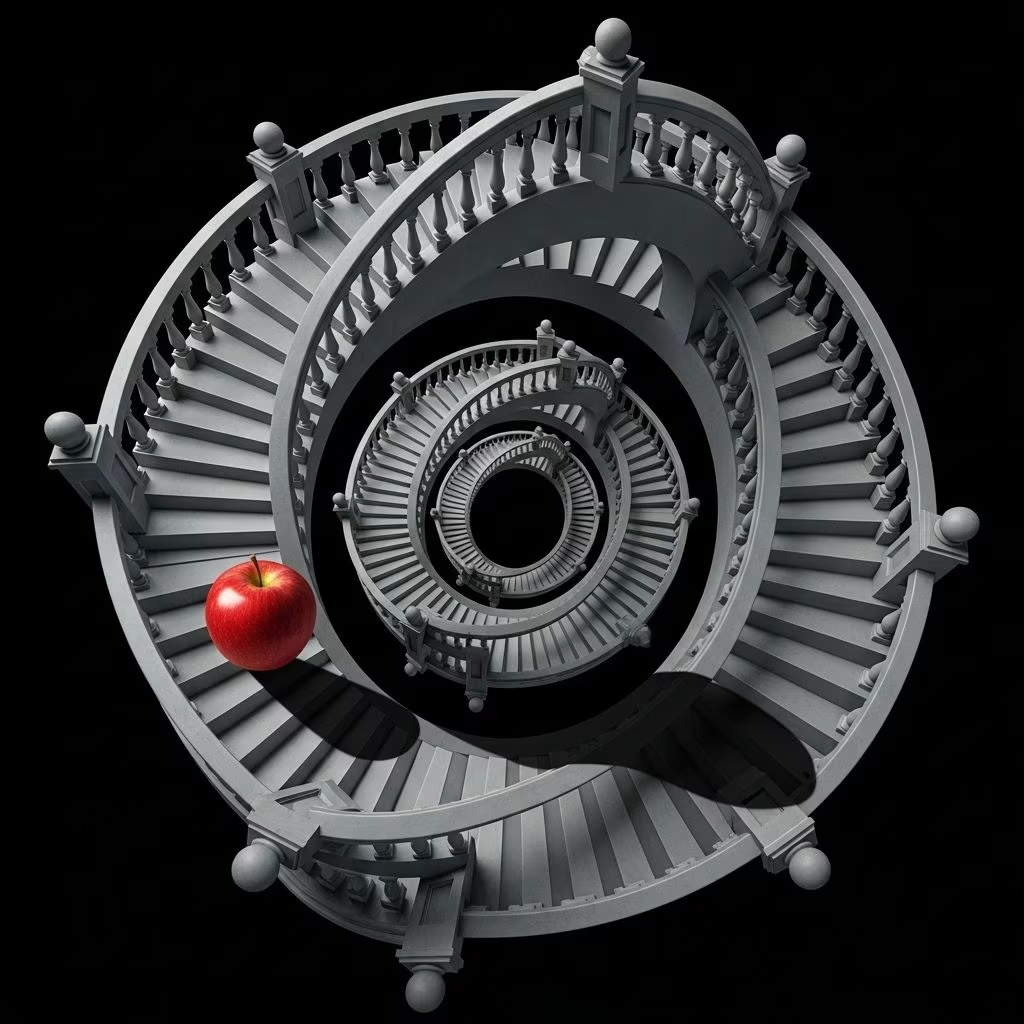
Optical illusions are fascinating visual phenomena that manipulate our brains into seeing things that aren’t as they seem. For centuries, artists and scientists have explored these clever tricks of perception, revealing just how easily our minds can be deceived by simple shapes, colors, and patterns. In this article, you’ll discover the science behind some of the world’s most famous optical illusions, the psychological principles that make them work, and why they’re not just entertaining curiosities but valuable tools for understanding how we see and interpret the world.
What Are Optical Illusions?
Optical illusions are images or visuals that cause our brains to misinterpret what our eyes are seeing. Instead of accurately representing reality, they present stimuli that the brain processes in ways that can produce strange, contradictory, or impossible perceptions.
- They can exploit color, shape, pattern, lightness, or context.
- Some illusions make us see motion in still images, others make objects appear bigger, smaller, or entirely different from what they are.
- Optical illusions are often used in psychology to study visual perception and the brain’s interpretation of sensory information.
While illusions are entertaining, they also highlight the limitations and quirks of the human visual system. Our eyes and brain work together to create our conscious visual experience, but many “shortcuts” that make perception fast and efficient can also leave us susceptible to being tricked by illusions.
Types of Optical Illusions
Optical illusions come in many forms, but most can be categorized into three main types:
- Literal Illusions: Images that are different from the objects that compose them.
- Physiological Illusions: Visual effects that arise from the eyes or brain being overstimulated by certain elements such as color, brightness, or movement.
- Cognitive Illusions: Errors in visual judgment that result from unconscious inferences made by the brain—often involving ambiguous or impossible figures.
The Science Behind How Optical Illusions Work
Optical illusions rely on the processing “shortcuts” used by the brain to quickly interpret complex visual information. Rather than analyze every detail of what we see, the brain makes educated guesses and fills in gaps based on past experience, context, and expectations.
According to Gestalt psychology, one way the brain processes visual information is by grouping elements into a “whole” that is easier to interpret than a collection of parts. This principle explains why we can readily recognize shapes and patterns, even if parts of the image are missing or ambiguous.
- The brain simplifies images by emphasizing contrasts, grouping similar features, and filling in missing information.
- Visual perception is influenced by context, background, and even the expectations or focus of the viewer.
- Some illusions exploit the way our brain distinguishes between “figure” and “ground,” making it harder to determine which part of an image should be in the foreground.
Classic Optical Illusions Explained
The Boring Figure: “My Wife and My Mother-in-Law”
This famous ambiguous image, analyzed by psychologist Edwin Boring, lets viewers see one of two women:
- A young woman, turning away with a choker around her neck.
- An old woman, with the young woman’s choker now interpreted as the old woman’s mouth and chin.
Why it works: Your brain can flip between two equally valid interpretations, but can’t see both simultaneously. This demonstrates the role of perspective, figure-ground discrimination, and the brain’s tendency to impose meaning onto ambiguous images.
The Kanizsa Triangle and Gestalt Effect
The Kanizsa Triangle is a classic example of Gestalt psychology. Although no triangle is drawn, three “Pac-Man” shapes and three V-shaped angles are positioned to suggest the contours of a white triangle atop three black circles.
- Your brain “fills in” the triangle, demonstrating how it perceives shapes as wholes—even when the lines aren’t there.
- The suggested triangle often appears brighter than the background, despite being the same color.
Rubin’s Vase (Figure-Ground Illusion)
The Rubin Vase is an image that can be interpreted in two ways: as a vase (white central area) or as two faces in profile (black areas on either side).
- An example of the figure-ground effect, where the viewer’s perception switches between seeing the vase as the “figure” or the faces as the “figure” against a background.
Café Wall Illusion
This illusion features staggered rows of black and white squares, separated by alternating gray mortar lines. Despite appearances, the horizontal lines between rows are perfectly straight and parallel.
- The illusion occurs because of the way our visual system processes contrasts and boundaries, leading to a perception of sloped lines where none exist.
Escher’s Waterfall
Escher’s Waterfall is a well-known “impossible object” in which water appears to flow perpetually uphill before dropping in a waterfall, creating a physically impossible scenario.
- Uses perspective tricks and cleverly connected paths to confuse the viewer’s sense of gravity, movement, and space.
Lilac Chaser (Pac-Man Illusion)
The Lilac Chaser illusion features lilac-colored disks arranged in a circle with a gap. When viewers stare at a central cross, a “hole” appears to chase around the circle. After 10–20 seconds:
- Viewers see a green disk moving around the circle (an afterimage effect).
- Eventually, the lilac disks fade and only the green disk remains (due to Troxler fading).
This phenomenon combines perceptual adaptation, afterimages, and the fading of constant stimuli from peripheral vision.
Illusory Motion
Some images appear to move even though they are completely static. Concentric circles, swirling lines, or repeating patterns can create the impression of motion as the brain’s processing of edges and contrasts is “overstimulated.” Researchers have linked this effect to small involuntary eye movements and blinking.
Ames Room
The Ames Room is a distorted room designed to create an optical illusion of dramatic differences in size between people or objects on opposite sides of the space.
- In reality, the room is trapezoidal, but it appears cubic from a fixed viewpoint.
- People standing in different corners appear to grow or shrink as they move due to the slanted walls, ceiling, and floor.
Ebbinghaus Illusion
Two identically-sized central circles are each surrounded by either smaller or larger circles. The circle surrounded by smaller circles appears larger than the one surrounded by larger circles, even though both are the same size.
- This illusion demonstrates how comparative context shapes our perception of size.
- Recent research suggests retinal image size plays a significant role over perceived size of surrounding objects.
Shepard’s Tables
Proposed by psychologist Roger Shepard, this illusion features two tabletops of identical size and shape oriented at different angles within a drawing. One appears long and narrow, the other short and wide—even though they are the same.
- The effect arises from the brain’s attempt to extrapolate three-dimensional information from a two-dimensional image.
- Shading and perspective cues mislead our size judgments.
Other Fascinating Illusions and Visual Phenomena
- Ponzo Illusion: Two identical lines appear different in length when placed over converging lines (like railroad tracks), because the brain interprets the context as depth cues.
- Hermann Grid: Viewing a grid of black squares separated by white lines makes gray “ghost” spots appear at the intersections.
- Müller-Lyer Illusion: Lines with arrowheads or fins at the ends seem to be different lengths due to misinterpretation of depth and perspective.
- Impossible Trident (Blivet): A drawing that appears to have three cylindrical prongs at one end, which become two at the other—an object that cannot exist in three dimensions.
Why Do Optical Illusions Fool Us?
Optical illusions reveal a lot about the complex processes involved in visual sensation and perception. Here are the major factors at work:
- Context and Expectation: The brain uses context and cues from the surrounding environment to interpret ambiguous information.
- Gestalt Principles: The mind seeks patterns and organizes elements into groups, often “filling in” missing details.
- Figure-Ground Organization: The brain distinguishes objects (figures) from their background (ground), but ambiguous images can confuse this process.
- Processing Shortcuts: To save time and energy, the visual system uses heuristics—rules of thumb that work most of the time but can occasionally be fooled.
Because of these tendencies, certain patterns, colors, contrasts, and arrangements can consistently deceive us all, regardless of age or experience.
Optical Illusions and the Brain: What Science Reveals
Researchers study optical illusions to understand how the brain processes vision.
- Different illusions tap into various parts of the visual pathway (e.g., retina, visual cortex, higher-level cognitive areas).
- Some illusions reveal how we process color, lightness, and motion; others show the limits of depth perception or meaning-making systems in the brain.
- Not all illusions have a single known explanation—some remain mysteries even to neuroscientists.
| Illusion Name | Main Effect | Scientific Principle |
|---|---|---|
| Boring Figure | Ambiguous image, two interpretations | Figure-Ground, Cognitive Perception |
| Kanizsa Triangle | Perception of a non-existent shape | Gestalt Closure |
| Café Wall | Parallel lines appear slanted | Contrast Interactions |
| Lilac Chaser | Afterimages and motion illusion | Troxler Fading, Color Adaptation |
| Shepard’s Tables | Identically shaped tables look different | Perspective & Depth Cues |
Applications of Optical Illusions
- Psychology and Neuroscience: Used to explore perception, brain function, and cognitive processes.
- Medical Diagnostics: Some illusions help identify vision or neurological issues.
- Art and Design: Artists and architects use them to create intriguing or deceptive visuals that evoke emotion, surprise, or wonder.
- Education: Teachers use illusions to demonstrate the brain’s complex relationship with reality and perception.
How to Experience and Create Optical Illusions
- Stare long enough at a high-contrast or ambiguous image to see how your perception can change.
- Use simple shapes and patterns—contrasting lines, repetitive forms, or figure-ground flips—to construct your own illusions.
- Observe how changing background color, perspective, or context dramatically alters what the brain “believes” it is seeing.
Frequently Asked Questions (FAQs) About Optical Illusions
Q: Why do some people see certain illusions faster than others?
A: Individual differences in focus, experience, and how the brain processes visual information can make certain illusions more striking or easier to decipher for some people.
Q: Are optical illusions evidence that our brain makes mistakes?
A: Not exactly. Illusions demonstrate the brain’s efficiency in interpreting limited data quickly—it usually gets things right, but illusions exploit those rare situations where shortcuts lead us astray.
Q: Can optical illusions affect everyone?
A: Yes. Optical illusions work for all ages and backgrounds because they exploit universal neural processing mechanisms common to most humans.
Q: Is there a limit to how much an illusion can fool the brain?
A: Most illusions rely on the basic principles of vision, so as long as those systems are intact, illusions will continue to deceive. However, familiarity and focus can reduce susceptibility).
Q: Are there practical uses for optical illusions?
A: Beyond entertainment, illusions are used in neuroscience and psychology research, clinical testing, and the creative arts to study and demonstrate the nature of perception.
Summary
Optical illusions are a powerful reminder that what we see isn’t always the truth. By understanding the science—and artistry—behind these amazing phenomena, we gain deeper insight into the marvels and mysteries of the human mind.
References
- https://coopervision.com/blog/how-optical-illusions-work
- https://www.findlight.net/blog/optical-illusions/
- https://ojs.library.illinois.edu/index.php/brainmatters/article/view/994
- https://www.dmei.org/how-does-an-optical-illusion-work/
- https://3sixtyinsights.com/understanding-perception-and-how-perception-is-reality/


