


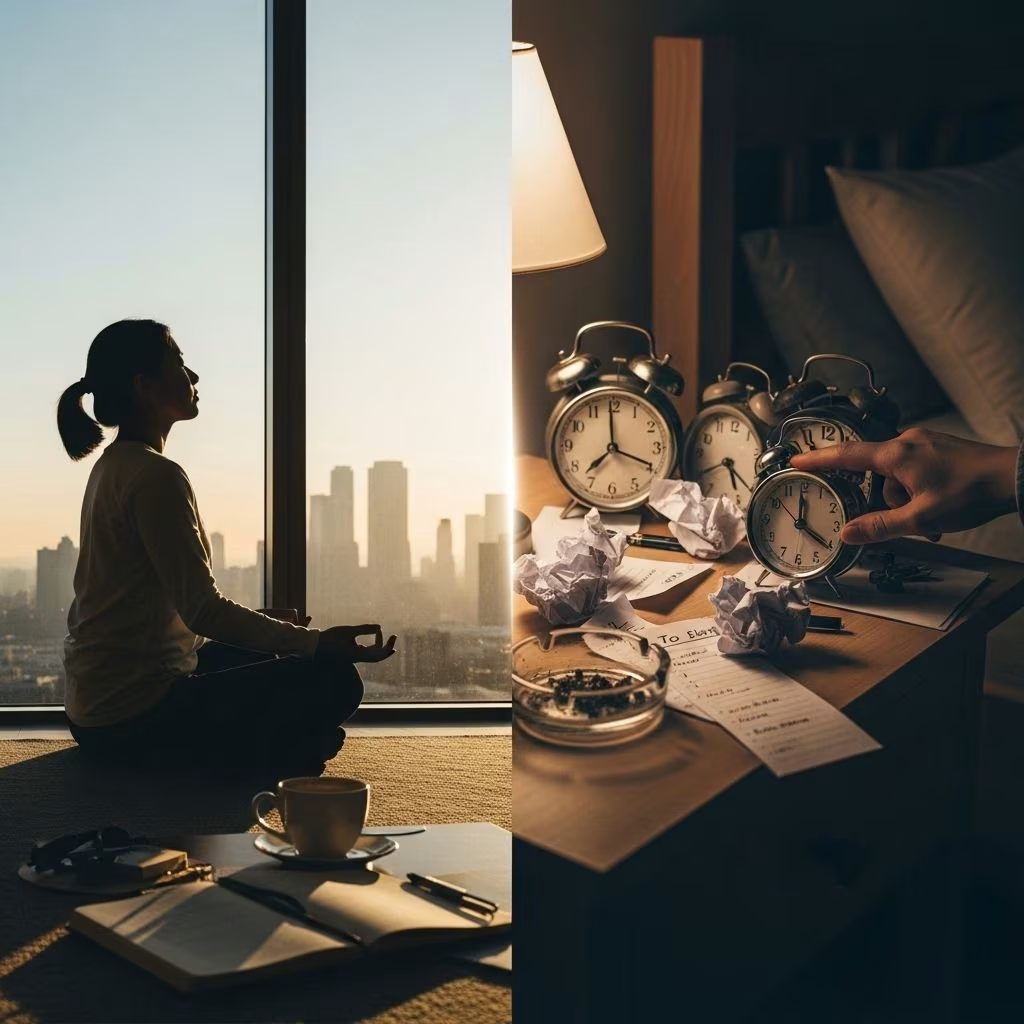
Morning routines have become a widely discussed topic in personal development circles, with countless articles, interviews, and books touting the early rituals of world-renowned performers, entrepreneurs, and leaders. But are these routines truly the secret to their success, or are we falling prey to survivorship bias—mistaking correlation for causation and overlooking those with similar habits who did not reach extraordinary heights?
Introduction: The Allure of Morning Routines
Across media, stories abound about how waking at dawn, meditating, journaling, or exercising transformed ordinary people into extraordinary achievers. The appeal is simple: if you could just copy the habits of the successful, you too might unlock similar achievement. Social media platforms amplify these narratives, often with attractive visuals and bold promises. Yet, this framing can be misleading and may oversimplify the pursuit of success, centering attention on methods that may not be universally effective.
Famous Morning Routines: Patterns & Highlights
Examining morning routines of well-known figures reveals both diversity and recurring themes. Here are select examples and the habits they highlight:
| Name & Occupation | Wake Time | Core Rituals |
|---|---|---|
| Leo Babauta (Author) | 4:30 AM | Hydration, setting daily priorities, breakfast, exercise, meditation (6:30 AM family wake up, then work) |
| Steve Jobs (Entrepreneur) | Early | Mirror self-reflection: “Would I want to do what I am about to do today?” |
| Barack Obama (Former US President) | 6:45 AM | Workout, reading newspapers, breakfast and family time |
| Jack Dorsey (Twitter Co-founder) | 6:15 AM | One hour of meditation |
| Jeff Bezos (Amazon Founder) | Early (no alarm) | Breakfast with family, reading, “puttering” before no meetings until 10 AM |
| Sara Blakely (Spanx Founder) | Early | Yoga, family breakfast, long drives for idea generation |
| Janine Allis (Boost Juice Founder) | 6:30 AM | Smoothie, shower, dressing for comfort/exercise, brainstorming |
| Arianna Huffington (Media Executive) | Around 7:00 AM (no alarm) | Meditation, bulletproof coffee, journaling, stationary bike, yoga, email |
| Anulekha Venkatram (Product Manager) | 5:20 AM | Multiple alarms, breakfast, packing snacks, train commute with reading/study |
Common patterns among these routines include:
- Waking up early, often between 4:30 and 7:00 AM
- Exercise or physical movement (workouts, yoga, walking)
- Meditation or mindfulness practices
- Setting priorities or self-reflection activities
- Healthy breakfast or hydration
- Family or quiet personal time
These habits are frequently presented as non-negotiable anchors for success. However, not everyone who exercises early, meditates, or journals ends up leading a global corporation or revolutionizing an industry.
What Actually Drives Success?
While morning routines can support well-being and productivity, research consistently shows that no single habit guarantees success. Personal achievement is usually the result of many factors, including:
- Opportunity and environment: Access to resources, support networks, education, and timing play significant roles.
- Deliberate practice: Long-term effort focused on skill improvement is a key factor, as seen in studies of experts across fields.
- Mindset and resilience: A growth mindset and the ability to adapt to setbacks are commonly observed among high performers.
- Socioeconomic background: Family support, financial stability, and geographic location can all have outsized influence.
- Luck and random events: Chance encounters, cultural movements, and even accidents can shape careers.
A morning routine may foster discipline, clarity, or health, but it nearly always operates within a larger constellation of influences—some controllable, others not.
Understanding Survivorship Bias
Survivorship bias is a logical error that focuses on individuals or things that have “survived” some selection process, overlooking those that did not. In the context of morning routines, it leads us to:
- Observe only the subset of successful individuals who share and promote their routines.
- Ignore the potentially vast number of people with similar habits who did not achieve notable success.
- Draw faulty conclusions about causality, e.g., if all these CEOs meditate at dawn, then meditation at dawn causes success.
This thinking is not new. In World War II, analysts inspecting returned bomber planes initially recommended reinforcing the spots riddled with bullet holes. Statistician Abraham Wald argued otherwise: those planes survived—attention should go to the areas with no bullet holes, representing planes that did not return. This is the core logic of survivorship bias.
How Survivorship Bias Shapes Routine Advice
The promotion of morning routines in best-selling books, podcasts, and articles (such as “What the Most Successful People Do Before Breakfast”) takes an anecdotal approach—highlighting the morning activities of high-achievers, but failing to present a control group. Thus:
- Advice becomes universalized: Routines that fit one person’s context are portrayed as universally transformative.
- Exceptions are ignored: Famous night owls or those with unconventional schedules are rarely profiled, creating a distorted stereotype of success.
- Overemphasis on ritual over substance: The complex interplay of talent, opportunity, and effort is boiled down to routines, turning nuanced stories into formulaic checklists.
For example, Jeff Bezos’s preference for “puttering” and no meetings before 10 AM may be feasible for an Amazon founder but impossible for a shift worker, new parent, or student on a tight schedule. Similarly, meditating for an hour as Jack Dorsey does may work for some but is not a prerequisite for creative or professional achievement.
A Critical Approach to Crafting Your Own Routine
Given the limitations of anecdotal routine advice, how should one approach morning rituals?
- Assess your context: Consider your biological rhythms, family obligations, work requirements, and physical needs. There is no one-size-fits-all.
- Experiment with intention: Use routines to focus on what matters most to you—prioritization, health, learning—rather than blindly mimicking celebrities.
- Aim for sustainability: The best routines are those you can sustain and adapt through different life phases.
- Value outcomes over rituals: If a routine increases your well-being, focus, or energy, keep it. If it feels forced or stressful, refine or discard it.
- Remain skeptical: Question advice that claims certainty without caveats or context. Look for evidence and diversity of experience.
Most importantly, understand that routines are means, not ends. They can support your goals but are not, by themselves, magical formulas for success.
Frequently Asked Questions (FAQs)
Q: Do all successful people have a rigorous morning routine?
No. While many successful people share details of their mornings, there are numerous examples of high achievers with irregular schedules, unconventional habits, or no routine at all. The routines promoted in media represent a selective, non-representative sample.
Q: Can adopting a famous routine guarantee similar success?
Adopting another person’s routine does not guarantee the same outcome. While you might experience benefits such as increased productivity or clarity, success depends on broader factors than daily rituals alone.
Q: Is waking up early necessary for productivity?
No. Chronotype research shows people have natural preferences for waking and sleeping times. Some are morning larks, others are night owls. Productivity can be optimized by understanding and working with your own energy cycles.
Q: Are there scientifically proven best morning routines?
No definitive best routine exists. Common elements such as exercise, hydrating, journaling, or meditating can benefit health and focus, but these effects vary by individual. Experimentation is key.
Q: How can I avoid survivorship bias when reading about routines?
Look for balanced stories, consider a diversity of examples (including failures, counterexamples, and people with unorthodox routines), and remember that media often highlight extremes over the average.
Conclusion
Famous morning routines can inspire and provide useful frameworks for personal growth, but embracing them uncritically risks confusing correlation with causation. Survivorship bias encourages us to focus on visible successes while ignoring unreported failures, distorting our understanding of which habits truly matter. The most effective routine is not necessarily the one most replicated by icons of industry or politics, but the one deliberately crafted, adapted, and sustained for your unique life circumstances.
Instead of striving to copy heroes, use their stories as inspiration, then run your own experiments—remaining flexible, skeptical, and compassionate towards yourself as you build rituals that serve your authentic goals and priorities.
References
- https://letsreachsuccess.com/morning-routines-of-successful-people/
- https://rize.io/blog/morning-routines-of-successful-people
- https://balancethegrind.co/collections/morning-routines-of-15-successful-people/
- https://www.groovnow.com/blog/morning-routines-of-highly-successful-people
- https://scottjeffrey.com/morning-routine-list/
- https://salesman.com/7-morning-routine-habits-of-successful-people/


