


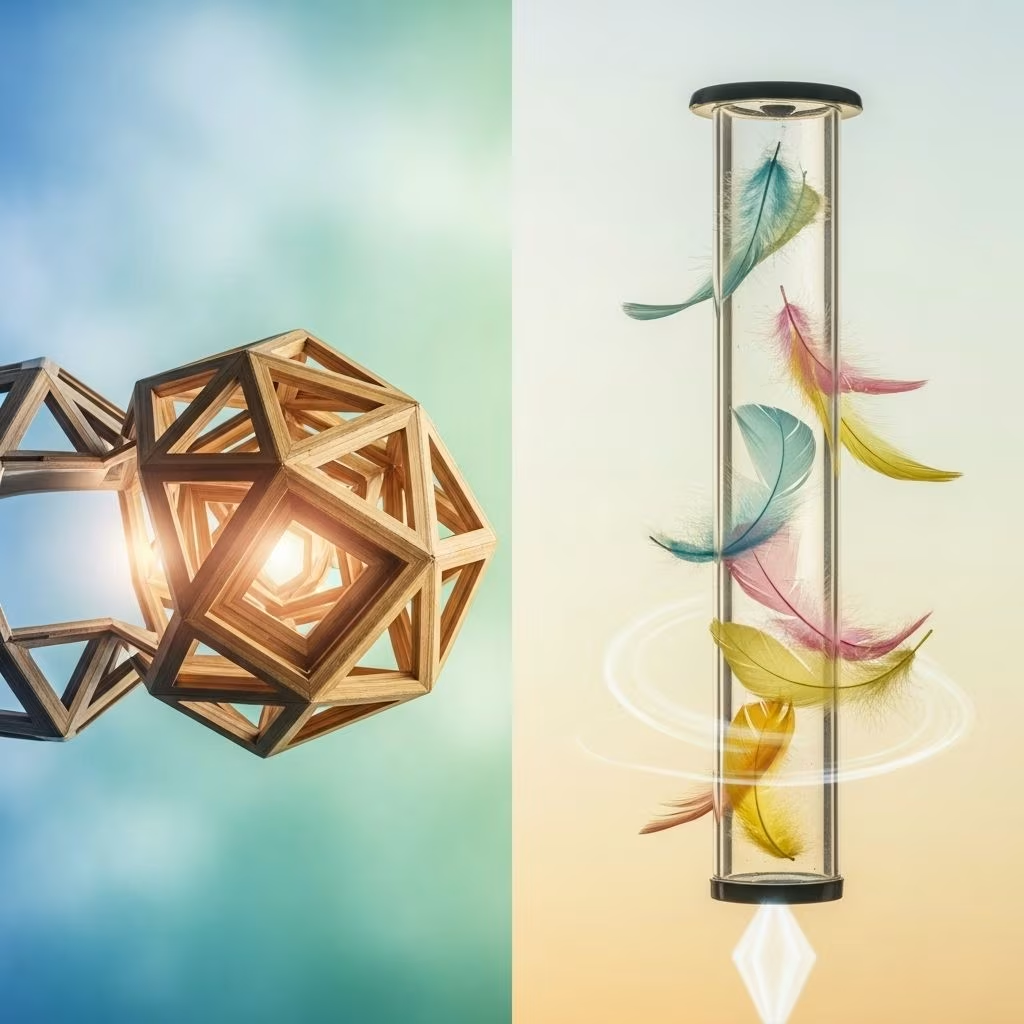
Children thrive on sensory-rich experiences and engaging activities that stimulate curiosity, calm the mind, and build foundation skills for learning. Breathing balls (such as the Hoberman sphere) and feather floaters (using feathers in imaginative exercises) have emerged as two widely adopted tools among educators, therapists, and parents for mindfulness, stress reduction, and STEM education. This article offers a comprehensive comparison of these tools, exploring their mechanisms, psychological and scientific benefits, and practical applications in child development.
Introduction: Sensory Tools for Modern Kids
Modern childhood is often filled with overstimulation and stress, making calming techniques and focused activities ever more essential. Tools that engage both mind and body—like breathing balls and feather floaters—play a dual role:
- They foster self-regulation and emotional awareness
- They create powerful, hands-on learning experiences for early STEM education
Let’s explore what each tool is, how it works, and why it matters in children’s development.
What Are Breathing Balls?
Breathing balls—most commonly Hoberman spheres—are collapsible, geometric toys that expand and contract, mimicking the rhythm of breathing. When used as a mindful activity, the ball is expanded for inhalation and contracted for exhalation in sync with a child’s breath.
Features:
- Collapsible, brightly colored sphere
- Visual cue for inhaling (expand) and exhaling (contract)
- Hand-held, tactile, and easy to manipulate
Common Uses:
- Mindful breathing exercises in classrooms and therapy
- Transition tool to guide children from high energy to calm
- Demonstrating the mechanics of lung expansion and contraction
How to Use a Breathing Ball
- Hold the ball in your hands.
- As you slowly breathe in, expand the ball outward.
- As you slowly breathe out, contract the ball inward.
- Repeat several cycles, matching breath to movement.
This synchronized breathing activity is easy to follow and visually reinforces the inhale/exhale cycle, making it especially suitable for younger children and those who benefit from multimodal learning.
What Are Feather Floaters?
Feather floaters refer to using real feathers as a playful and tactile prop for mindfulness, breath control, and scientific exploration. In its simplest form, a child is invited to blow a feather and watch it float gently to the ground. However, feather floaters activities can be much more creative and varied:
Features:
- Lightweight natural or synthetic feathers
- Interactive exercises: blowing, catching, observing, balancing
- Offers gentle, slow motion as feather dances on air currents
Common Uses:
- Calming breath games in mindfulness practice
- Teaching about air resistance, gravity, and other forces in nature
- Sensory play to heighten awareness and focus
How to Use Feather Floaters
- Place a feather on your open palm or a flat surface.
- Breathe in slowly, then blow gently to set the feather in motion.
- Observe the feather’s slow, graceful descent or try to keep it afloat in the air by blowing underneath.
- Experiment: Can you move the feather with breath alone? What happens when you change the force or the direction of your breath?
The soft, floating motion of the feather provides not only visual relaxation but also a powerful anchor for mindful attention and scientific inquiry.
The Science Behind the Tools
Breathing Balls: Biofeedback for Calm
The rhythmic expansion and contraction of the breathing ball visually models diaphragmatic breathing—a technique proven to lower heart rate, stabilize mood, and enhance focus. By holding and moving the ball, children receive immediate, concrete feedback on their breath cycle, aiding body awareness and emotional regulation.
Feather Floaters: Demonstrating Forces and Mindfulness
Feather floating activities introduce basic physics concepts, notably air resistance and gravity. When a child blows a feather, it floats and drifts slowly, offering a tangible way to observe how lighter objects are affected by air drag more than heavier ones, such as balls. This phenomenon is famously used in science demonstrations (like the classic ball vs. feather drop in a vacuum) to illustrate the effect of air resistance on falling objects.
In mindfulness contexts, focusing on the feather’s gentle movement encourages slower breathing, which physiologically induces calm and grounds attention in the present moment.
Psychological and Mindfulness Benefits
Both breathing balls and feather floaters are effective for teaching children to calm their bodies and quiet their minds, but they do so in subtly different ways:
- Breathing balls offer a structured, predictable visual anchor. Their repetitive motion can quickly induce a rhythm in breathing, helpful for anxious or hyperactive kids.
- Feather floaters invite open-ended play and creativity. Watching the feather’s unpredictable path encourages longer out-breaths and gives children gentle sensory cues to slow down.
Research and practical observations show these benefits:
- Activation of the parasympathetic nervous system (the body’s rest-and-digest mode)
- Lowering heart rate and blood pressure
- Reducing acute stress or sensory overload
For many children, these strategies are as effective as traditional verbal instructions—but with far greater engagement.
Developmental and Learning Outcomes
Cognitive and STEM Connections
- Feather floaters provide a playful entryway into scientific reasoning and early physics:
- Gravity vs. air resistance: Why does the feather fall slower than the ball?
- Cause and effect: How does changing my breath’s speed, angle, or direction change the feather’s motion?
- Breathing balls support body awareness and simple biology:
- Understanding the mechanics of lung movement
- Linking breath control to mood and attention
Social-Emotional Learning (SEL)
Both tools are widely used to teach impulse control, emotional literacy, and self-regulation—a core set of skills in social-emotional learning curricula. Group activities with breathing balls or feather floaters promote cooperation, turn-taking, and shared calmness, helping build empathy and emotional resilience in early education settings.
Sensory Processing Skills
Feather play is especially helpful for improving:
- Tactile discrimination (how light touch feels on skin)
- Oral-motor coordination (blowing in specific directions or at different intensities)
- Body mapping and proprioception (awareness of where the feather lands on the body or in space)
Practical Uses in Homes, Schools, and Therapy
In Home Settings
- Settle high-energy children after school or before bedtime
- Offer a quick reset after meltdowns or overstimulation
- Engage in family mindfulness sessions with simple, accessible props
In Classrooms
- Use breathing balls as a group activity to transition between lessons
- Facilitate science lessons on forces using feathers
- Create calm corners or sensory spaces featuring both tools for self-regulation breaks
In Therapeutic Environments
- Occupational therapists use feather blowing games to build oral-motor skills needed for speech therapy
- Child psychologists use breathing balls for anxiety reduction and emotional regulation training
- Autism specialists include both tools in sensory diets to balance stimulation and regulate arousal
Side-by-Side Comparison Table
| Feature | Breathing Balls | Feather Floaters |
|---|---|---|
| Primary Use | Guided mindful breathing, visualization, calming | Sensory play, breath control, scientific exploration |
| Physical Action | Expand/contract to model inhale/exhale | Blow gently, float or catch feather, observe descent |
| Main Benefits | Visual cue for breath, structured self-regulation | Open-ended exploration, sensory integration, science learning |
| Age Suitability | 3 years and up (with supervision) | 2 years and up (with supervision) |
| Cost/Accessibility | Moderate (purchased toys/tool) | Low (can use any clean feather) |
| Typical Duration | 1-5 minutes per session | 1-10 minutes, encourages longer creative play |
| STEM Value | Demonstrates body systems, breath mechanics | Teaches gravity, air resistance, observation skills |
Choosing the Right Tool for Your Child
Both breathing balls and feather floaters offer diverse, evidence-based benefits for kids. The choice depends on your goals and your child’s preferences:
- For predictable, guided calm: Breathing balls may be better, providing simple rhythm and stronger biofeedback for mindful breathing.
- For imaginative, sensory play and science learning: Feather floaters shine, as they prompt curiosity, exploration, and the joy of discovery.
Many parents and educators find that using both tools in tandem yields the greatest benefit, as children can switch between structured and open-ended activities according to their needs and moods.
Frequently Asked Questions (FAQs)
Q: Are breathing balls safe for toddlers and younger children?
A: Yes, breathing balls are generally safe for children ages 3 and up, with adult supervision. The expandable parts can pinch small fingers if mishandled, so always guide young children in using the ball correctly.
Q: Can any type of feather be used for feather floater activities?
A: Most clean, washed feathers (such as craft feathers or naturally-shed bird feathers) are safe, but avoid feathers from unknown or wild sources to reduce risk of allergens or contaminants. Synthetic feathers work just as well for breath games.
Q: How long should children practice these activities?
A: Short sessions of 1-5 minutes are effective for most children. For feather play, longer periods may be natural, as the activity encourages curiosity and creative variations. Let your child’s attention guide the timing.
Q: Do feather floaters and breathing balls help with anxiety and meltdowns?
A: When used consistently, both tools are supported by research as effective techniques for calming, reducing anxiety, and managing meltdowns in children. They can be particularly helpful for kids who benefit from visual and sensory cues.
Q: How do these tools support special needs children?
A: Children with ADHD, autism, and sensory processing differences often benefit from the tactile, visual, and predictable feedback provided by breathing balls and feather floater exercises. Adapt the activities as needed to fit individual needs and sensitivities.
References and Further Reading
- “A Yoga Breath Activity to Calm, Feed and Organise Young Minds!” childreninspiredbyyoga.com
- “8 Calming and Breathing Activities for Children,” The Montessori Family
- “Ball vs. Feather – UCSB Physics Demonstration,” UCSB Physics Department
- “Deep Breathing Exercises for Kids,” Coping Skills for Kids
- “Brian Cox visits the world’s biggest vacuum | Human Universe – BBC”
References
- https://web.physics.ucsb.edu/~lecturedemonstrations/Composer/Pages/08.12.html
- https://lancasterarchery.com/blogs/product-info/feathers-vs-vanes-heres-what-you-need-to-know
- https://childreninspiredbyyoga.com/blog/2020/01/yoga-breath-activity-calm/
- https://themontessorifamily.com/8-calming-and-breathing-activities-for-children/
- https://www.youtube.com/watch?v=E43-CfukEgs
- https://dlnr.hawaii.gov/dar/files/2016/03/Fishing_in_Hawaii.pdf
- https://copingskillsforkids.com/deep-breathing-exercises-for-kids
- https://ymaa.com/articles/daoist-breathing-techniques


