


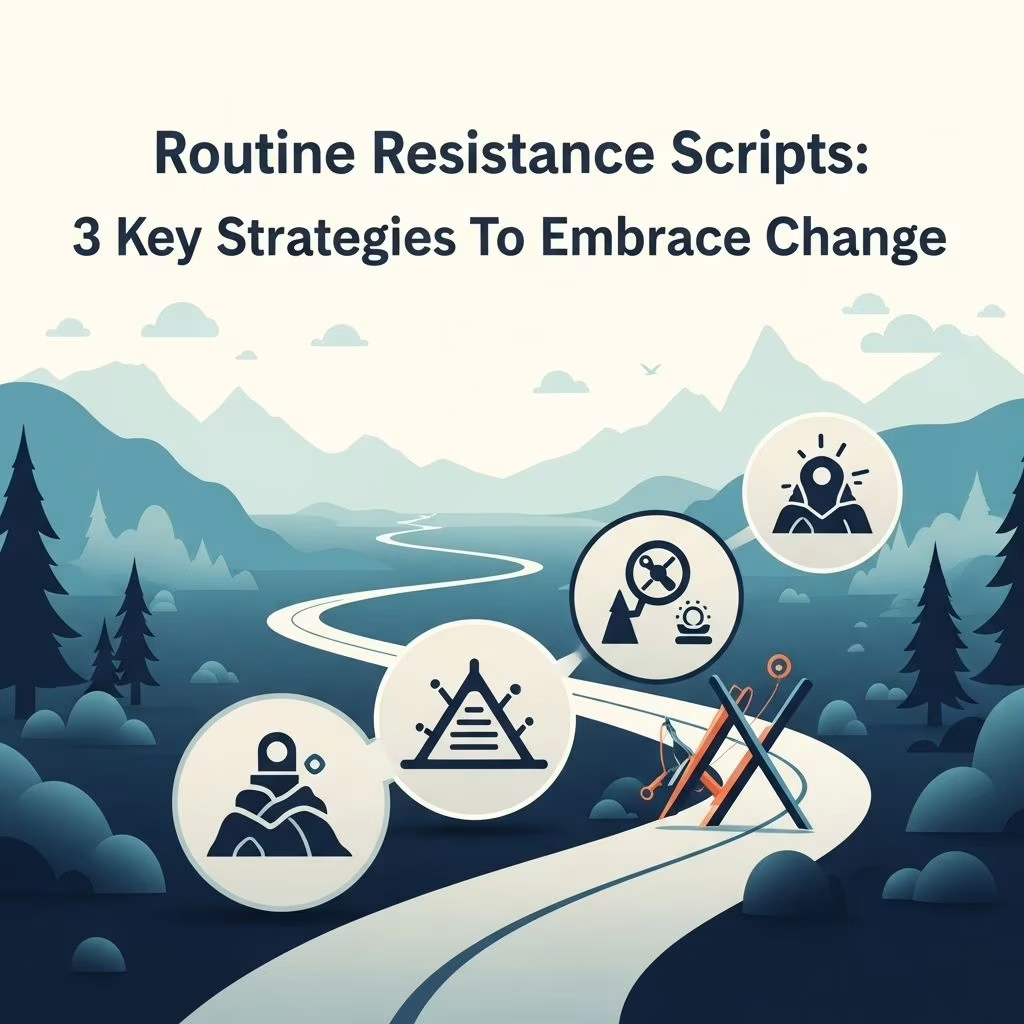
Introduction to Routine Resistance Scripts
Routine resistance scripts refer to the mental templates or patterns that guide our behavior in familiar situations but can hinder our ability to adapt to new or challenging transitions. These scripts are deeply ingrained in our minds and often influence our decisions without us realizing it. Understanding these scripts is crucial for personal growth and overcoming difficult transitions.
Understanding Cognitive Scripts
Cognitive scripts are mental blueprints that help us navigate various social and personal situations by providing a structured sequence of actions. They are learned through repetition and societal norms, making interactions predictable and reducing cognitive load. However, reliance on these scripts can lead to stagnation and resistance to change.
Types of Cognitive Scripts
- Sequel Script: Often experienced in professional settings, this script dictates a linear progression in career and life stages, sometimes limiting innovation and personal satisfaction.
- Crowdpleaser Script: Driven by social approval, individuals conform to societal expectations even when they conflict with personal aspirations.
- Epic Script: Pursuit of grand narratives or achievements that can both inspire and constrain personal growth.
Impact of Routine Resistance Scripts on Transitions
Difficult transitions, such as career changes or moving to a new city, can be daunting due to the disruption of familiar scripts. These scripts provide comfort but also limit our ability to adapt to new situations, leading to resistance and stress during transitions.
Strategies for Overcoming Routine Resistance Scripts
- Questioning Assumptions: Regularly challenging the origins of our assumptions can help identify and break free from restrictive scripts.
- Experimentation and Exploration: Engaging in small, low-risk experiments allows individuals to explore new possibilities without fully committing to them.
- Seeking Support: Building a network of supportive peers can provide the encouragement needed to challenge existing scripts and embrace change.
Embracing Change and Personal Growth
Embracing change requires a willingness to disrupt existing scripts and forge new paths. By recognizing and challenging our routine resistance scripts, we can overcome latent fears and biases that hold us back, leading to more fulfilling and dynamic transitions in life.
Factors in Script Disruption
Script disruption often involves a combination of personal willpower, social support, and environmental cues that challenge existing behaviors. For instance, witnessing others adopt sustainable practices can influence our own behavior, illustrating the power of social proof in changing scripts.
Frequently Asked Questions (FAQs)
Q: What are routine resistance scripts?
A: Routine resistance scripts are mental patterns that guide our behavior in familiar situations and can hinder our ability to adapt to new or challenging situations.
Q: How do cognitive scripts affect personal growth?
A: Cognitive scripts can limit personal growth by constraining our ability to adapt to new situations and pursue different paths in life.
Q: How can I overcome routine resistance scripts?
A: Overcoming routine resistance scripts involves questioning assumptions, engaging in experimentation, and seeking support from others.
Conclusion
Understanding routine resistance scripts offers a powerful tool for navigating difficult transitions. By challenging these scripts and embracing change, individuals can break free from limiting patterns and unlock new paths for personal growth and fulfillment.
References
- https://bigthink.com/smart-skills/the-3-cognitive-scripts-that-subtly-rule-our-lives/
- https://thedecisionlab.com/reference-guide/psychology/script-theory
- https://lifestyle.sustainability-directory.com/term/social-scripts/
- https://www.ebsco.com/research-starters/social-sciences-and-humanities/script-theory
- https://study.com/academy/lesson/scripts-psychology-overview-analysis.html
- https://journals.publishing.umich.edu/ergo/article/id/5191/
- https://en.wikipedia.org/wiki/Behavioral_script
- https://pmc.ncbi.nlm.nih.gov/articles/PMC8329037/


