


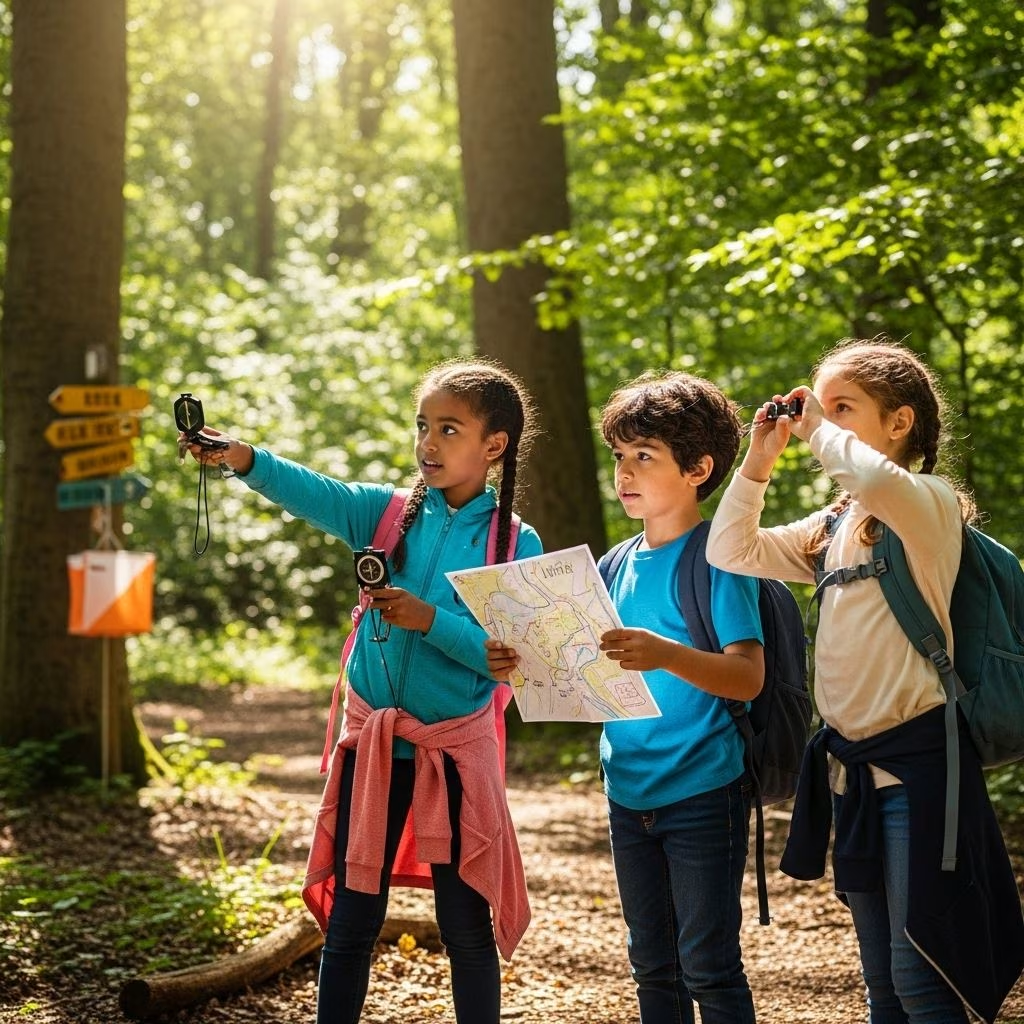
Outdoor play is more than just a form of recreation for children—it is a powerful educational and developmental experience that directly supports the cultivation of a sense of direction, orientation, and spatial awareness. In today’s world, where structured environments and screen time often outweigh time spent outdoors, it is crucial to understand how exposure to nature and unstructured physical activity fosters essential cognitive, sensory, and motor skills in young learners. This article provides an in-depth look at the link between outdoor play and the development of navigational abilities in children, supported by research and practical strategies for parents, educators, and therapists.
Introduction: Why Sense of Direction Matters
A child’s sense of direction and orientation—the ability to navigate from place to place, recall locations, and understand spatial relationships—lays the groundwork for both academic learning and day-to-day independence. Children with well-developed navigational skills show improved abilities in reading maps, mathematics, and problem-solving, and adapt better to new environments. Lack of spatial awareness can hinder classroom performance and increase risks during physical play, underscoring the importance of fostering these foundational abilities early in life.
Outdoor Play and Spatial Awareness
The natural world presents endless opportunities for children to test and refine their spatial reasoning. Unlike indoor environments, outdoor settings are varied and ever-changing. When climbing hills, navigating trails, chasing peers, or playing hide and seek, children are constantly making judgments about distance, speed, direction, and obstacles. Research highlights several core benefits of outdoor play for spatial and orientation skills, including:
- Developing spatial awareness: Children learn to judge where they are relative to people, landmarks, and boundaries, which improves their ability to orient themselves in a complex world.
- Practicing movement planning: Running, hopping, balancing, and jumping all require awareness of body position and the environment, laying down neural pathways for spatial processing.
- Encouraging problem-solving and decision-making: Negotiating playground features, finding hidden objects, or figuring out the fastest route back to base in a game activates cognitive processes related to orientation.
- Enhancing observational skills: Outdoor play increases sensitivity and attention to sensory cues such as sounds, visual landmarks, and tactile feedback from ground surfaces.
The Role of the Vestibular System
A pivotal but often overlooked benefit of outdoor play is the stimulation and development of the vestibular system—the sensory system responsible for balance, spatial orientation, and movement control. Located in the inner ear, this system helps children:
- Understand where their body is in space
- Coordinate head and eye movement, which is vital for reading, writing, and safe navigation
- Maintain balance and move from point A to point B effectively
- Regulate attention and emotional responses
Outdoor play uniquely challenges and supports the vestibular system by offering:
- Opportunities to roll, spin, swing, jump, and climb (e.g., on hills, trees, playground equipment)
- Experiences with changes in body position, such as going upside down or sliding
- Chances to move in multidirectional ways, which is seldom possible indoors
This physical activity moves fluid within the inner ear, which stimulates hair cells crucial to the vestibular system’s development and calibration. Sufficient vestibular input translates to improved sense of direction, orientation, and even academic skills through better attention and visual-motor integration.
Physical Development and Navigation
Gross and fine motor development are deeply linked to children’s orientation skills. Outdoor play facilitates both through:
- Gross Motor Skills: Running, balancing, skipping, hopping, climbing, and directional movement build core strength and stability, essential for confident navigation.
- Fine Motor Skills: Manipulating natural objects, digging, building structures, and investigating textures improve manual dexterity and hand-eye coordination.
- Coordination & Balance: Navigating uneven surfaces, jumping between rocks, or dodging obstacles requires constant adjustment and adaption, refining proprioception—the awareness of body position and movement.
Children develop these abilities most effectively through regular and unstructured outdoor play. Studies show that children exposed to natural play environments demonstrate higher levels of coordination, balance, and strength compared to those with limited outdoor experiences.
Outdoor Activities to Build Navigation Skills
There are myriad ways to intentionally use outdoor play to cultivate children’s spatial awareness and directional sense. The following activities—popular both in natural settings and at playgrounds—provide rich sensory, motor, and cognitive stimulation:
- Treasure Hunts and Orienteering: Using maps or verbal directions to find objects encourages children to interpret spatial information and apply route planning.
- Obstacle Courses: Courses made from natural or artificial materials require children to navigate, judge distances, and make quick decisions about movement and balance.
- Free Play in Varied Terrains: Hill rolling, tree climbing, hopping across stones, and exploring uneven ground develop both vestibular and proprioceptive senses.
- Group Games (e.g., ‘Capture the Flag’, ‘Hide and Seek’): These types of play involve memorizing landmarks, strategizing safe paths, and tracking moving targets, all of which require sharp orientation skills.
- Building Structures: Creating forts, dens, or bridges from branches or loose materials demands spatial reasoning and collaborative planning.
- Bicycle or Scooter Routes: Navigating set paths, respecting rules, and adapting to the dynamic environment foster environmental awareness and real-world navigation ability.
Active encouragement and involvement—whether from parents, siblings, or peers—can intensify the learning involved in these outdoor experiences.
Cognitive Benefits of Orientation Skills
Cognitive advantages derived from outdoor play are extensive. Developing a strong sense of direction and spatial awareness supports:
- Mathematical reasoning: Concepts like distance, measurement, speed, and location gain meaning through embodied experiences outdoors.
- Decision-making and problem-solving: Children continually assess options, predict outcomes, and choose routes during outdoor play, simulating real-world navigation challenges.
- Concentration and attention: Physical movement turns on the brain’s reticular activating system, helping children maintain alertness and focus, which transfers to classroom learning.
- Memory and observation: Remembering landmarks and recalling routes sharpens working memory and powers later academic tasks.
- Imagination and creativity: Open-ended play encourages children to invent games and strategies, fostering flexible and creative thinking.
Outdoor play is thus not only recreational but facilitates the neural development required for success in a variety of academic and daily life tasks.
Social and Emotional Benefits
Outdoor play environments are inherently social and emotionally rich. The development of sense of direction and orientation also supports:
- Self-efficacy: Successfully navigating an unfamiliar environment boosts children’s confidence and autonomy.
- Social cooperation: Group play often requires children to collaborate, negotiate, and communicate, essential for healthy social development.
- Stress reduction: Natural settings and physical activity have proven benefits for emotional regulation, reducing anxiety, and increasing overall well-being.
- Emotional resilience: Overcoming small risks (e.g., navigating uneven ground or climbing trees) in a supervised setting builds courage and the ability to manage setbacks.
Regular, purposeful outdoor play thus supports the underlying emotional and interpersonal skills required for navigating both physical and social spaces in life.
Designing Outdoor Spaces for Orientation
Intentional design of outdoor spaces can drastically increase their potential for supporting navigational and orientation skills. Key principles include:
- Diverse environments: Natural features such as hills, rocks, trees, and water offer rich sensory and spatial opportunities for exploration.
- Landmarks and navigational cues: Incorporating distinctive plants, sculptures, or paths makes orientation activities both intuitive and challenging.
- Unstructured and varied zones: Areas with loose materials, open spaces, and movable objects support self-directed learning and experimentation.
- Safe risk-taking opportunities: Features like climbing walls, log bridges, or uneven surfaces allow children to test and extend their boundaries under supervision.
Such environments encourage not just free play, but also inquiry-based learning and cooperative exploration, maximizing developmental benefits.
Tips for Parents and Educators
- Encourage children to spend time outdoors daily, regardless of weather, to maximize vestibular and spatial development.
- Allow unstructured play: Let children choose their own paths, create games, and solve navigation challenges independently.
- Model and verbalize spatial language (e.g., “Let’s walk around the big tree and climb over those rocks to reach the pond”), as this reinforces concepts of direction and position.
- Provide safe opportunities for risk-taking, including climbing, balancing, and exploring.
- Join in play: Participate in treasure hunts, hide and seek, or movement games to further bond and facilitate learning.
- Observe children’s play for signs of improvement or difficulty in spatial awareness, and gently scaffold when necessary.
Frequently Asked Questions (FAQs)
Q: How much outdoor play is needed to support spatial development?
A: Experts recommend that children have opportunities for physical activity outdoors every day. Unstructured play of at least one hour per day is ideal for supporting spatial awareness and orientation skills.
Q: What if my child has difficulty finding their way or gets easily lost outdoors?
A: Some children need more time and support to develop these skills. Use joint activities such as map-reading, orienteering, and repetitive visits to the same environments to build confidence. Seek guidance from occupational therapists if concerns persist.
Q: What types of outdoor environments are best for orientation learning?
A: Both natural environments (with trees, rocks, water) and well-designed playgrounds with distinct landmarks and varied zones are excellent. Space diversity and opportunities for exploration are key.
Q: Are there risks to encouraging children to take physical challenges outdoors?
A: While outdoor play involves manageable risks, these are valuable for development. Safe supervision and encouragement to take calculated risks contribute to both physical and emotional growth.
Q: Does outdoor play benefit children with sensory or motor challenges?
A: Yes, outdoor play can be especially beneficial for children with challenges in sensory integration, balance, or coordination, as it provides multisensory opportunities for growth. Adapt the environment as needed for safety and inclusion.
References
- https://www.occupationaltherapy.com/articles/therapeutic-benefits-outdoor-play-5303
- https://files.eric.ed.gov/fulltext/EJ1417743.pdf
- https://seswps.umkc.edu/docs/berkley-items/the-importance-of-outdoor-play-and-its-impact-on-brain-development-in-children.pdf
- https://pmc.ncbi.nlm.nih.gov/articles/PMC11660033/
- https://www.tandfonline.com/doi/full/10.1080/00131881.2023.2285762
- https://princetonperspectives.com/purposeful-outdoor-open-ended-play-provides-benefits-that-last-a-lifetime/
- https://www.tc.columbia.edu/articles/2024/may/why-outdoor-experiential-learning-is-key-for-young-learners/
- https://www.naeyc.org/resources/pubs/yc/may2019/outdoor-play-is-essential
- https://pmc.ncbi.nlm.nih.gov/articles/PMC9579527/


