


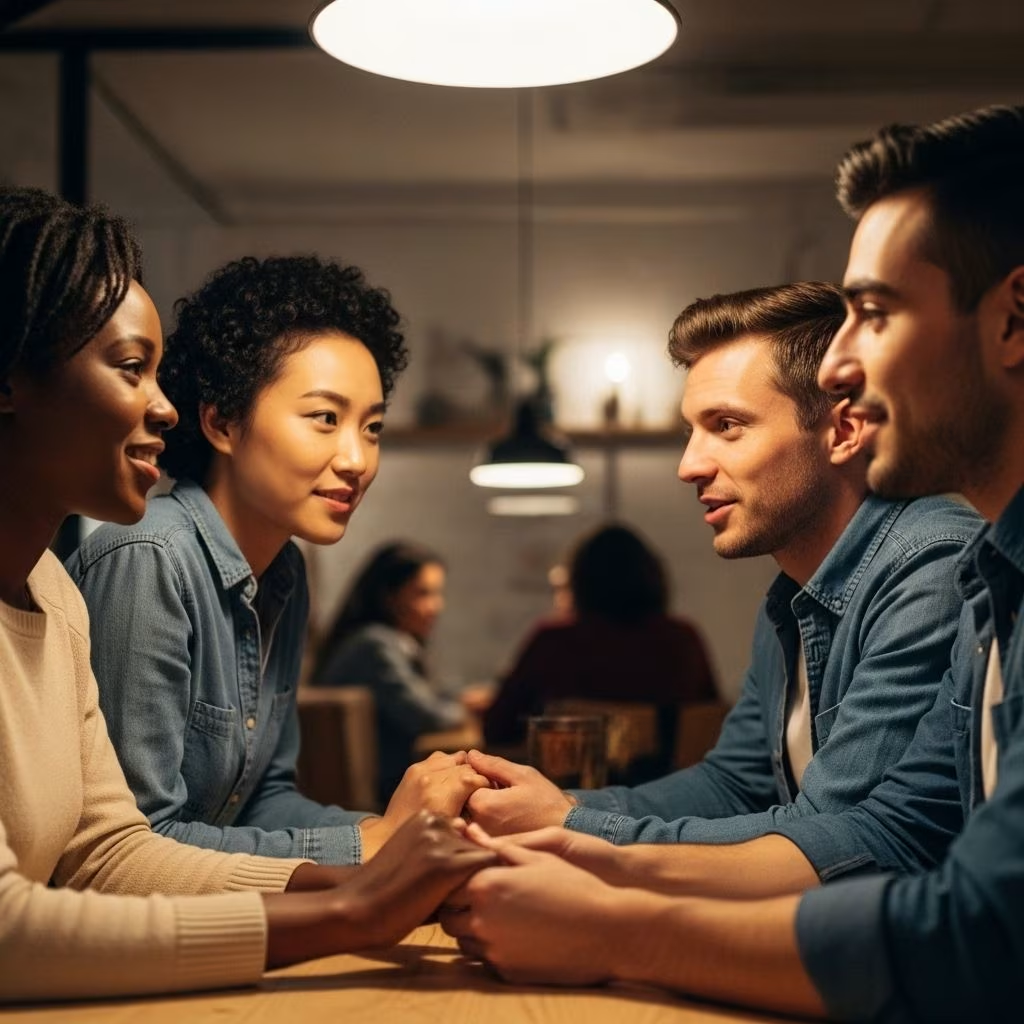
I Had My Friends Get Brutally Honest About My Interracial Relationship
Few things shape our view of love like the expectations of those closest to us. While dating can be filled with joy, anxiety, and self-discovery, entering an interracial relationship brings an entirely new layer of scrutiny—a dynamic where the voices of friends and family often echo loudest. In my own journey as a Black woman dating a white man, I invited my friends to lay their rawest, most honest thoughts on the table. What follows is a revealing look at the challenges, stereotypes, and ultimately the lessons that emerged from these conversations.
Why Do We Care About Friends’ Approval?
Before jumping into the unique obstacles of interracial love, it’s worth asking: why do we seek validation from friends and family in our romantic lives?
- Our loved ones know us best—their input feels like a reflection of our core selves.
- Community and culture shape our understanding of what is normal, desirable, or taboo in romantic relationships.
- For marginalized groups, such as Black women, external approval can feel like both a shield and a source of inherited pressure.
But when race and romance intersect, the stakes feel higher. Suddenly, every glance, every comment, and every friend’s hesitation acquires new weight.
The Specter of “Showing Your Work” in Love
Falling in love should be simple, but being in a relationship between two people of different backgrounds often feels like solving an equation out loud—with each step, you’re compelled to prove your reasons and justify your choices. It’s as if being Black and dating a white partner means you have to «show your work» for others’ understanding.
When I first broached the topic of my relationship with my friends and family, I was immediately confronted by the tacit demand to explain my decision.
Frequently Asked Questions from Friends
- Why him?—A common refrain, not always asked rudely but as pure curiosity, stemming from perceived “opposites” at play.
- What do you have in common?—People often underestimate the shared experiences and values that transcend race.
- Are you sure this is real?—Underlying doubts that make interracial love feel perpetually under trial.
I Was Accused of ‘Experimenting’
One of the first and most jarring reactions from some friends was the notion that I must be “experimenting”—that my relationship was little more than a phase to “get something out of my system.”
- This stemmed from the idea that Black and white relationships are inherently novel—and not to be taken as seriously as same-race relationships.
- There was a subtle, and at times overt, implication that I was dabbling—that my choice stemmed from a desire for the exotic or forbidden, rather than something genuine.
This accusation ignored both my feelings and the real connection I shared with my partner, reducing our relationship to a passing curiosity.
I Was Told I Should Feel ‘Lucky’ to Be the Exception
Perhaps even more discomforting was the “compliment” that I was an exception—the Black woman who had somehow gained entry into uncharted territory. Some friends framed my relationship as though I were a rare explorer, “privileged” to have been chosen by, or allowed into, white social circles.
- Such attitudes reeked of backhanded admiration, suggesting that interracial dating was an unusual feat few could achieve.
- This “exceptionalism” narrative underscores the lingering idea that love across racial lines is something rare, challenging, or even socially subversive.
It made me feel less like a woman in love and more like an anomaly on display—a feeling that many in interracial relationships will recognize.
My Partner’s Intentions Were Questioned
It’s common to worry about a loved one’s intentions, but in my case, friends took it further: Was I being fetishized?
- Friends feared I might simply be checking a box on someone else’s racial “to-do list.”
- As a Black woman, I was aware of the “exotic” stereotype, so their concerns, though pointed, weren’t unfounded.
- This scrutiny forced me to examine whether my partner truly saw me as an equal, full person.
I sought reassurance that I was more than an object of curiosity or a token in someone’s dating history—an anxiety that sometimes became my own internal doubt, as well.
Self-Doubt and the Weight of ‘Forbidden’ Love
All this questioning from friends made me examine my own feelings. Was my love genuine? Was I being gullible, or blinded by the excitement of something new?
Sometimes, the sense that I was breaking an unspoken rule led to doubt, guilt, and second-guessing. I questioned if my choices were “forbidden,” replaying conversations and comments from friends who wondered if I was betraying some invisible standard.
The Challenges of Protecting Yourself
One of my closest friends, herself a Black woman who had mainly dated outside her race, was incredibly frank. She explained that everyone keeps their guard up—not because of the partner’s race, but because protecting oneself from emotional harm is human nature.
- There’s a tendency to assume interracial partners are more likely to cause hurt, but pain can come from anyone, regardless of race.
- Choosing to avoid “rankings” of who is safer to love is an act of self-love and progress.
No one wants to experience segregation within themselves. It’s a protective instinct, not a moral failing, and owning that can help dismantle unconscious prejudices.
The Lessons Learned: Owning Your Path to Love
Being in an interracial relationship forced me to look long and hard at my own insecurities and the prejudices of those around me. I realized:
- The world has changed, but old prejudices linger. Progress in society doesn’t erase the subtle undercurrents of history and inherited attitudes.
- People will always judge. Their opinions—whether voiced or merely perceived—will follow you in any unconventional relationship.
- You control your narrative. Letting others’ skepticism dictate your self-confidence is a recipe for perpetual doubt.
- Conviction attracts respect. When you believe unapologetically in your relationship, those around you are more likely to accept it.
Eventually, I understood that it’s up to each of us to navigate our journey with pride and purpose. When you own your choices, you give less space for doubt—yours or anyone else’s—to sink your happiness.
Common Myths and Stereotypes About Interracial Relationships
| Stereotype | Reality |
|---|---|
| “You’re just experimenting” | While some explore, many interracial relationships are built on deep, lasting connection. |
| “You should feel lucky to be accepted” | No one is an ‘exception’. Love is not a prize for being exotic; it’s about partnership. |
| “One person is being fetishized” | Open dialogue about intentions is key; generalizations harm everyone involved. |
| “You must have nothing in common” | Shared values, interests, and humor transcend race. |
Practical Advice for Navigating Friends’ Reactions
- Expect questions. Curiosity doesn’t always equate to criticism.
- Communicate openly. Talk to your friends and partner about your feelings and experiences.
- Draw boundaries. Decide how much influence friends’ opinions will have on your relationship.
- Stay self-aware. If you internalize every doubt, you’ll suffocate your own happiness.
- Lead with confidence. Asserting the reality and importance of your relationship sets the tone for others.
Frequently Asked Questions (FAQs)
Q: Do interracial couples really face more scrutiny from friends and family?
A: Yes. Interracial couples often experience extra questioning, doubt, and unsolicited opinions from friends and family, rooted in cultural differences, biases, and lingering social prejudices.
Q: How should you respond to friends doubting your partner’s intentions?
A: Respond with honesty and clarity. Share your trust in your partner and communicate how their doubts make you feel. If needed, set boundaries about what commentary you’ll accept.
Q: Is it normal to second-guess your relationship because of others’ opinions?
A: It’s common. Others’ doubts can create internal pressure, but evaluating your relationship on your own terms is crucial for sustained happiness.
Q: What’s the biggest lesson from dating outside your race?
A: The journey reveals as much about yourself as about society. Owning your story—and your joy—matters more than anyone’s judgment.
Final Thoughts: Set Sail on Your Own Journey
In the end, no relationship—interracial or otherwise—should be defined by outside opinions. Friends care deeply, but their honesty reflects their own fears, hopes, and limitations as much as your reality. Let your own sense of rightness anchor you. Doubt and judgment are as inevitable as the tides—but so are growth and the freedom to love on your own terms. Set sail confidently, and let happiness be your compass.
References
- https://www.elitedaily.com/dating/friends-get-brutally-honest-interracial-relationship/1811234
- https://yaf.org/news/yale-course-seeks-to-determine-if-friendship-between-black-white-women-possible/
- https://www.youtube.com/watch?v=EVePcsklEjM
- https://jimcrowmuseum.ferris.edu/collect.htm
- https://aas.princeton.edu/news/she-changed-black-literature-forever-then-she-disappeared
- https://www.elitedaily.com/dating/borderline-personality-disorder-ghosting/1630016


