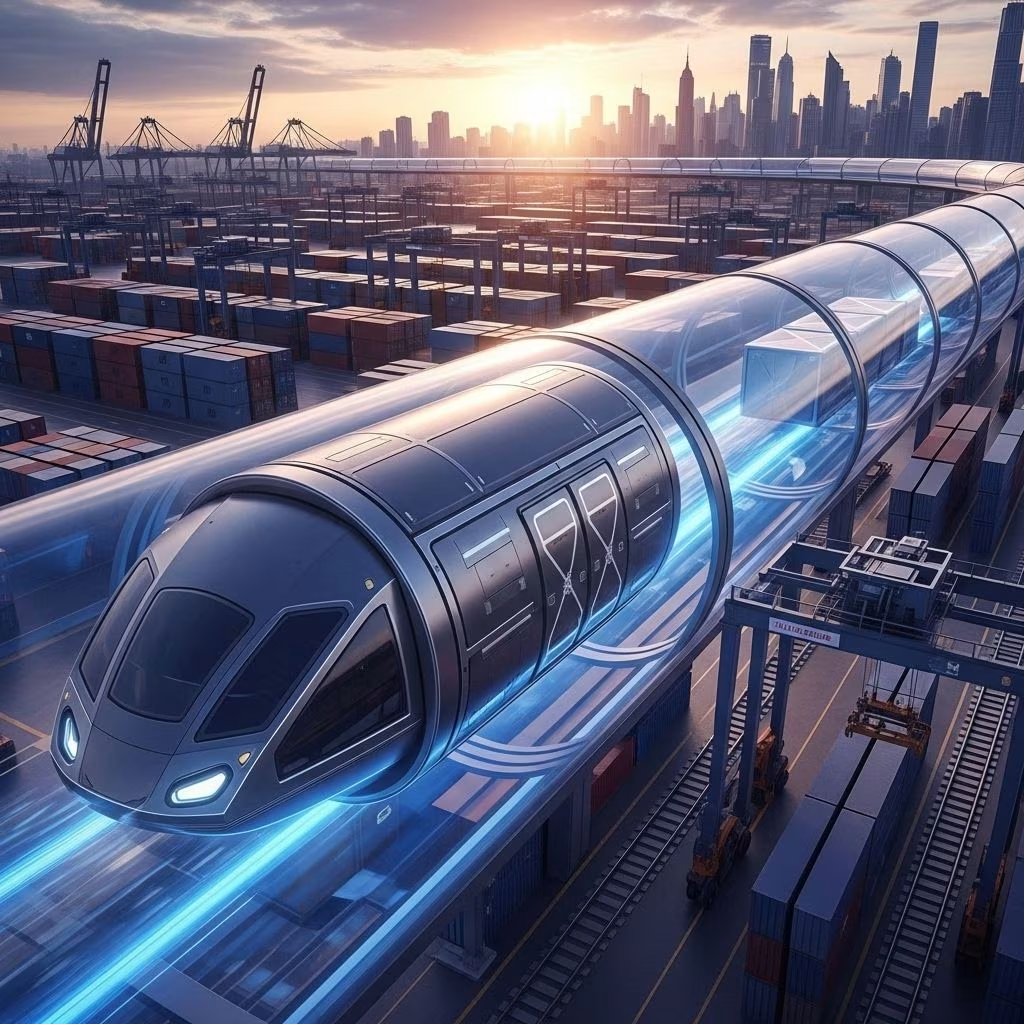
Virgin Hyperloop’s Strategic Pivot: Redefining High-Speed Cargo Movement
Virgin Hyperloop, long regarded as a leading innovator in high-speed, near-vacuum tube transportation, has fundamentally shifted its business focus. Once synonymous with the vision of whisking passengers between cities at the speed of sound, the company now centers its ambitions on freight and cargo transport. This bold realignment is not just a tactical maneuver but signals a deep recalibration of what hyperloop technology can viably deliver amidst complex commercial, regulatory, and technical realities.
From Passenger Dreams to Freight Pragmatism
For years, the promise of hyperloop as a passenger system inspired headlines, investment, and public fascination. The company achieved milestones such as the world’s first human trials in a trial pod, but these accomplishments were ultimately overshadowed by persistent barriers:
- Regulatory uncertainty about certifying passenger safety and comfort at ultra-high speeds
- High capital demands and lengthy infrastructure timelines for human transit
- Technical challenges in scaling human-rated pods for mass adoption
These hurdles fostered mounting skepticism among investors and policymakers. In February 2022, Virgin Hyperloop announced a dramatic downsizing, laying off over 100 employees and shelving plans for passenger travel. This strategic reorientation reflected both the immense challenges of mass transit and the relative commercial readiness of freight-focused systems.
The Case for Freight: Why Hyperloop’s Future is Cargo
Several key trends explain Virgin Hyperloop’s pivot to freight:
- Explosive growth in global e-commerce demands faster, more reliable logistics across vast distances.
- Ports and shipping companies seek to move high-value, perishable, and just-in-time cargo with unprecedented speed and reduced environmental impact.
- Freight systems face fewer regulatory obstacles than passenger models, accelerating the path from demonstration to deployment.
- Infrastructure investment is potentially less risky when moving cargo rather than humans, as operational safety requirements—while still stringent—are less complex.
Companies such as DP World Cargospeed, in partnership with Virgin Hyperloop, have spearheaded pilot programs aiming to deliver cargo at speeds of up to 620 mph. These advancements promise to revolutionize time-sensitive freight, such as medical supplies and fresh produce, enabling same-day cross-continental delivery that outpaces even air freight.
Market Realities: Logistics, Not Human Transport, Drives Hyperloop Growth
Market analysis reveals why freight is rising to dominance in the hyperloop sector. As of 2023:
- The passenger segment still leads in market share, owning about 55% thanks to city and intercity travel demand, but momentum for fast, cost-effective freight is growing at the fastest rate.
- The global hyperloop technology market reached $2.1 billion in 2023 and is projected to surge to $46.6 billion by 2032—a testament to growing institutional interest, especially from logistics giants.
- North America remains a key player, but Asia Pacific is outpacing others in growth due to urgent needs for resilient, rapid infrastructure in disaster-prone regions.
Advantages of Hyperloop Freight Systems
Hyperloop offers a suite of benefits uniquely suited to the needs of modern logistics:
- Ultra-high speeds (sub-700 km/h initially, with future systems aiming higher), enabling near-instantaneous delivery of goods over medium to long distances.
- Reduced congestion on traditional road and rail networks, shifting high-value freight to dedicated, weatherproof tube systems.
- Substantial reductions in carbon emissions thanks to electric propulsion, near-zero friction, and potential for renewable energy integration (like solar arrays along the tube).
- Minimized supply chain vulnerabilities and improved reliability for time-sensitive and perishable cargo.
| Feature | Traditional Freight | Hyperloop Freight |
|---|---|---|
| Speed (long-haul) | Average 60–100 km/h (truck/rail) | Up to 700+ km/h (initial); 1000+ km/h (future) |
| Carbon Emissions | High (diesel trucks, air freight) | Low-to-zero (electric and solar potential) |
| Congestion Impact | Major road/rail bottlenecks | Dedicated tubes bypass surface networks |
| Weather Resilience | Moderate/Low; delays common | High; enclosed tube mitigates weather risks |
| Regulatory Burden | Long-established, some flexibility | Simpler criteria for cargo systems |
Technical and Commercial Challenges
Despite these advantages, hyperloop faces formidable barriers before commercial freight deployment can become standard practice:
- Engineering Obstacles: Maintaining the integrity of near-vacuum tubes, managing energy consumption, and ensuring robust, reliable operation over large-scale distances.
- Cost Considerations: Hyperloop demands high up-front investment for bespoke infrastructure—far higher than already-established alternatives.
- Land and Rights-of-Way: Securing, permitting, and building dedicated tubes across urban, suburban, and rural territories pose significant negotiation challenges.
- Institutional Uncertainty: Limited operational history, shifting investor confidence, and competition from other emerging rail and transit solutions.
For Virgin Hyperloop, the shift from ambitious passenger plans to a focused freight strategy was as much a reflection of pragmatic survival as it was of technology’s current maturity. The closure of passenger-facing projects—including the much-publicized West Virginia certification center—highlighted the practical difficulties in scaling human-rated pods compared to cargo modules.
The Broader Hyperloop Landscape: Evolving Competitors and Innovations
Virgin Hyperloop’s pivot is emblematic of a wider reckoning in the field. Other hyperloop developers, including Hyperloop Transportation Technologies (HyperloopTT), Hardt Hyperloop, TransPod, and Zeleros, maintain mixed approaches—still developing passenger systems but increasingly giving weight to freight applications.
Recent breakthroughs across the sector include:
- Construction of 10 km freight demonstration tracks in Europe
- Development of large-scale, safety-critical components (like 35-tonne valves for rapid isolation)
- Introduction of hybrid levitation systems, using AI for pod stability at high speeds
- Collaboration between industrial giants (e.g., TransPod’s $550 million investment and POSCO’s partnership with Hardt Hyperloop)
- Debut of prototype freight pods and capsules (e.g., DP World Cargospeed’s solutions)
However, commercial viability remains elusive; Hyperloop One (formerly Virgin Hyperloop) ceased operations in December 2023, illustrating the tough realities of pioneering new infrastructure paradigms, despite foundational technology proving robust in early-stage tests.
Market Growth and the Next Decade
Despite the setbacks, the hyperloop freight market is poised for significant expansion:
- A global market projected to grow at a CAGR of up to 40% through the 2030s, fueled by logistics and sustainability mandates.
- Freight applications expected to reach operational demonstration between 2028 and 2030, with commercial corridors launching soon after.
- Governments and public-private partnerships increasingly evaluate hyperloop as a pillar of future supply chain resilience and decarbonization policies.
Yet, widespread rollout will require multi-billion dollar investments, regulatory harmonization, and continued technical validation on real-world routes.
Frequently Asked Questions (FAQs)
Q: Why did Virgin Hyperloop stop pursuing passenger travel?
A: Virgin Hyperloop shifted away from passenger travel due to high regulatory hurdles, immense costs, and slower-than-anticipated technical and public adoption. Freight systems allow for a faster, less risky commercial pathway.
Q: What are the main benefits of hyperloop for logistics?
A: Hyperloop dramatically shortens delivery times for long-distance cargo, cuts carbon emissions, is resilient to weather delays, and can ease congestion on surface-based freight networks.
Q: How fast can freight pods travel on a hyperloop?
A: Initial cargo pods are projected to reach speeds of up to 700 km/h, while future systems could surpass 1000 km/h as technologies mature.
Q: When will commercial hyperloop freight lines be operational?
A: The first demonstration corridors for freight are likely to be operational before 2030, with full-scale networks following later, depending on successful trials, regulatory progress, and continued investment.
Q: What is the long-term outlook for hyperloop technology?
A: While setbacks have led to company closures and re-focus, ongoing R&D by multiple players and support from logistics giants ensure that hyperloop remains a prominent contender for 21st-century freight transportation.
Conclusion: Hyperloop’s Reinvented Promise
Virgin Hyperloop’s pivot underscores the iterative nature of disruptive technology: grand visions must often be retooled to align with market realities and technological constraints. For now, the era of high-speed hyperloop cargo—not passenger pods—looks set to shape global supply chains in the coming decade. Whether this new focus will allow hyperloop to transcend its hype and deliver lasting societal and environmental benefits remains a challenge for innovators and policymakers alike.
References
- https://idstch.com/technology/energy/the-hyperloop-revolution-market-surge-technological-leaps-and-the-global-push-for-ultra-high-speed-transport-2025-update/
- https://www.globenewswire.com/news-release/2025/05/30/3091125/0/en/Hyperloop-Technology-Market-to-Reach-USD-46-6-Billion-by-2032-Driven-by-Demand-for-High-Speed-Sustainable-Transit-Solutions-SNS-Insider.html
- https://papers.ssrn.com/sol3/Delivery.cfm/5132204.pdf?abstractid=5132204&mirid=1
- https://en.wikipedia.org/wiki/Hyperloop_One
- https://www.zionmarketresearch.com/report/hyperloop-technology-market
- https://www.wealthformula.com/blog/hyperloop-revolutionizing-the-future-of-high-speed-travel/
- https://en.wikipedia.org/wiki/Hyperloop
- https://www.borntoengineer.com/hyperloop-technologies-shuts-down-after-failing-to-achieve-commercial-viability
- https://www.maximizemarketresearch.com/market-report/hyperloop-market/27018/