


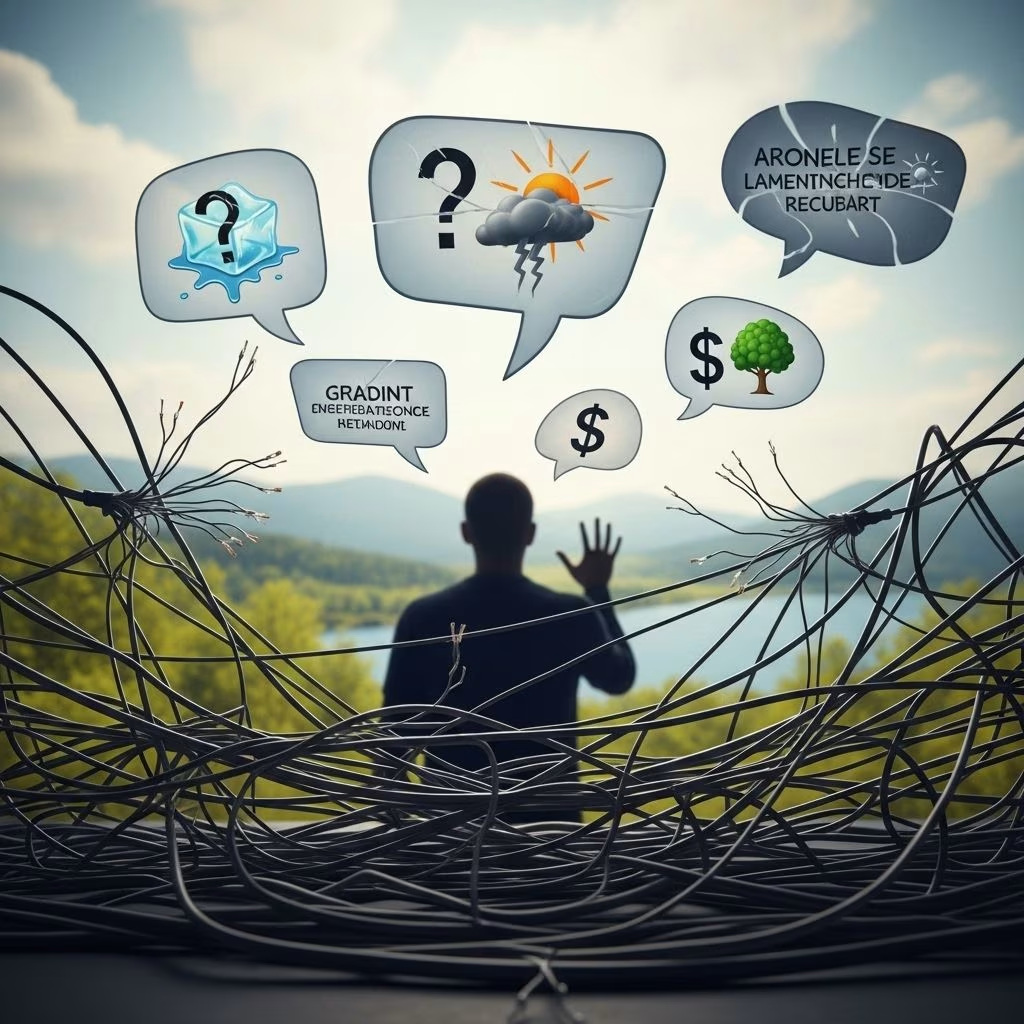
How Climate Communication Language Confuses, Misleads, and Shapes Public Response
Effective communication is the backbone of public engagement with complex issues like climate change. Yet studies consistently reveal that scientific language used to describe climate change often baffles, misleads, or disengages the public, hampering the shift from awareness to action. This article explores where communication breaks down, which terms create confusion, how misunderstandings shape perceptions and political divides, and what can be done to create clearer, more impactful messaging.
Why Climate Language Matters
The language scientists and communicators use to discuss climate change directly affects how the public understands, worries about, and acts on the issue. The stakes are high: poor communication of risks and scientific consensus has allowed skepticism and misinformation to flourish, creating gaps between scientific reality and public belief. For climate action to succeed, people need to grasp the urgency, scale, and clarity behind scientific statements—but that clarity is often missing.
- Technical terms and abstract concepts can alienate non-experts, fueling misunderstandings about climate risks.
- Language emphasizing uncertainty rather than risk can reduce perceived urgency and willingness to act.
- Public perception of scientific consensus remains lower than the actual near-universal agreement among experts.
The Study: How Scientific Terms Confound the Public
A high-profile study highlighted in Treehugger reveals that many scientific terms central to climate science—such as ‘mitigation,’ ‘carbon neutral,’ and ‘adaptation’—are not understood by much of the general public. The confusion isn’t benign; it leads to misinformed discussions, policy resistance, and political gridlock.
- Terms like mitigation (reducing emissions) and adaptation (responding to impacts) were frequently misinterpreted or confused.
- The phrase net zero often led people to falsely believe emissions had stopped entirely, not balanced out by removals.
- Carbon neutral was mistaken by many as meaning completely emission-free, undermining understanding of offsetting methods.
Commonly Misunderstood Terms
| Term | Intended Meaning (Scientist) | Common Public Misunderstanding |
|---|---|---|
| Mitigation | Efforts to reduce greenhouse gas emissions | General lessening of climate effects or fixing problems; not necessarily reduction of emissions |
| Adaptation | Changes made to cope with climate impacts | Simply adjusting lifestyles or continuing as normal |
| Net Zero | Balancing emissions by removal or offsets | No emissions produced at all |
| Carbon Neutral | Achieving net-zero emissions (offsetting what’s emitted) | Completely emission-free behavior |
| 2°C Target | Limit warming to under 2°C above pre-industrial levels | Confusion about baseline or impact of temperature change |
How the Public Reacts to Scientific Language
Research shows that the gap between climate science consensus and public perception is wide. Although over 97% of climate scientists agree that climate change is human-caused, surveys find the public consistently underestimates this consensus. This gap is maintained and exacerbated by confusing language, politicization, and continual misinformation.
The Gateway-Belief Model
The Gateway-Belief Model proposes that emphasizing the extent of expert agreement on climate change strengthens belief in its reality and seriousness. This model asserts that communicating consensus acts as a ‘gateway’ to changing attitudes and supporting climate policy. Studies confirm that as the public is made aware of scientific agreement, their concern grows, cascading into support for action.
- Accurate messaging on consensus can counteract political divides and doubt.
- Clear, compelling language about scientific findings increases support for climate policies and increases trust in science.
Why ‘Uncertainty’ Is a Problem Word
Communicating uncertainty is an essential part of scientific honesty—but it’s also routinely misunderstood or misrepresented by the media and policymakers. Instead of conveying degrees of risk, the term often feeds skepticism and the false notion that scientists lack concrete understanding.
- Audiences interpret uncertainty in vastly different ways; sometimes as ignorance rather than calculated risk.
- Some climate scientists worry the media exaggerate, misstate, or oversell uncertainties, diminishing the urgency of action.
- Newer research suggests shifting language toward risk rather than uncertainty can boost engagement and preparedness.
The Roles and Responsibilities of Key Stakeholders
Climate communication occurs in a dynamic triangle of scientists, journalists, and the public, each with unique duties, expectations, and expertise. Effective messaging demands cross-group collaboration and recognition of these roles:
- Scientists: Traditionally focused on academic circles, but increasingly expected to engage more with the public directly. Differences persist by country: US scientists more often see media as responsible; others expect scientists themselves to communicate findings.
- Journalists: Act as gatekeepers and interpreters, with a mandate to make science relevant, verify information, and facilitate understanding for lay audiences.
- Public: Expect themselves and others to be sufficiently informed before engaging in policy debates. Citizens often perceive climate change threats as distant, while scientists view them as immediate.
Interactive Communication Channels
With the rise of social media, scientists and journalists now have more direct channels with the public. This two-way communication allows for timely, responsive engagement but raises the stakes for clarity and transparency. Democratic societies especially rely upon informed citizens playing an active role in policy formation.
Why Scientific Consensus Messaging Matters
The success of climate communication hinges on public recognition of scientific consensus. When the public understands that climate experts overwhelmingly agree on the reality and dangers of climate change, they are more likely to accept the science and support solutions. But if technical jargon or vague messaging prevails, consensus is obscured, and skepticism grows.
- Surveys show a persistent gap between scientists’ agreement and public belief due largely to confusing or politicized language.
- Misleading terminology can fuel fatalism, apathy, or outright denial, especially in polarized environments.
- Clarity about consensus and risks is a gateway to constructive dialogue and policy support.
Strategies for Effective Climate Communication
Creating impactful climate messaging demands attention to language, audience, and context. Experts recommend several practical strategies for bridging the divide between scientific complexity and public understanding:
- Use clear, everyday language: Translate scientific terms into familiar concepts. For example, ‘cutting emissions’ is more accessible than ‘mitigation’.
- Shift focus from uncertainty to risk: Highlight real-world threats and opportunities rather than abstract probabilities.
- Emphasize consensus: Reinforce the broad agreement among scientists to combat misinformation and political division.
- Humanize climate impacts: Share relatable stories and consequences to move climate change from a distant issue to a personal concern.
- Encourage dialogue and participation: Foster two-way conversation, allowing the public to ask questions and voice concerns.
Table: Recommended vs. Confusing Climate Terms
| Confusing Term | Recommended Alternative |
|---|---|
| Mitigation | Cutting pollution / reducing harmful emissions |
| Adaptation | Adjusting to new climate realities |
| Carbon Neutral | Balancing out carbon footprint |
| Net Zero | No more pollution overall / all pollution is removed or offset |
| 2°C Target | Keeping global warming under dangerous levels |
Consequences of Confusing Communication
The fundamental risks of poor climate communication go beyond mere misunderstanding. They extend to policy inertia, political polarization, and a diminished sense of personal agency. When language fails to connect, the public underestimates the urgency and scale of solutions needed.
- Misinterpretation of key terms results in confusion about what actions are needed and who should take them.
- Scientific vagueness undermines political will, giving space for special interests or misinformation to dominate talks.
- Poor communication reduces trust in experts, lowering engagement with climate solutions and policies.
Moving Forward: Solutions for Clearer Climate Conversations
Research points to a way forward: make climate communication audience-centered, accessible, and engaging. The following practical changes hold promise for shifting public understanding and action:
- Test messages with real audiences and adjust based on feedback.
- Choose words carefully and clarify their meanings, even at risk of repetition.
- Use stories and local examples to create emotional engagement.
- Acknowledge uncertainties but frame them as manageable risks rather than debilitating unknowns.
Frequently Asked Questions (FAQs) About Climate Language
Q: Why do scientists use such complicated climate terms?
A: Many scientific terms capture precise meanings vital in research, but they are not always selected with lay audiences in mind. Efforts are underway to train scientists and communicators to explain climate issues using everyday language.
Q: Does misunderstanding climate terms really affect action?
A: Yes. When people misunderstand what needs to be done or doubt the urgency, they are less likely to advocate for or support meaningful policies.
Q: What should communicators do to fix the problem?
A: Use clear, tested language. Emphasize consensus and explain risk, not just uncertainty. Encourage dialogue, answer questions transparently, and relate scientific facts to personal and community impacts.
Q: What is the most misunderstood climate term?
A: Terms like ‘mitigation,’ ‘carbon neutral,’ and ‘net zero’ are among the most commonly misunderstood, often mistaken for complete elimination of emissions when they actually refer to balancing or reducing them.
Q: How can I get reliable information about climate change?
A: Seek out reputable sources that prioritize clear communication—such as the Yale Program on Climate Change Communication or mainstream science journalism outlets—and ask questions when you see confusing terms.
Key Takeaways for Scientists, Journalists, and the Public
- Recognize the gap between scientific language and public understanding—and actively work to close it.
- Test and revise climate messaging frequently, using audience feedback to guide improvements.
- Frame scientific uncertainties as risk management, not ignorance.
- Make climate impacts personal and immediate, not distant and vague.
- Continue building trust by demonstrating honesty, transparency, and responsiveness in communication.
Conclusion: A Call for Clarity and Collaboration
The challenge of climate communication is not only translating science, but also motivating action through clarity. Confusing terminology and messaging must be replaced by direct, thoughtful language tailored for public understanding. Only then can science, journalism, and citizenship converge toward real solutions for climate threats.
References
- https://faculty.wcas.northwestern.edu/jnd260/pub/Bayes%20et%20al%20Research%20Agenda%20for%20Climate%20Change.pdf
- https://pmc.ncbi.nlm.nih.gov/articles/PMC10631269/
- https://www.nature.com/articles/s41599-025-04585-6
- https://climatecommunication.yale.edu/publications/ccam-explorer-2023/
- https://climatecommunication.gmu.edu/all/public-understanding-of-climate-change-has-grown-in-the-us/
- https://unfoundation.org/media/climate-change-communications-study-finds-that-common-scientific-terminology-confounds-public/
- https://hsph.harvard.edu/research/health-communication/resources/climate-communication-tips/
- https://www.tandfonline.com/doi/full/10.1080/10810730.2024.2360021
- https://coast.noaa.gov/data/digitalcoast/pdf/psychology-climate-change-communication.pdf
- https://climatecommunication.yale.edu


