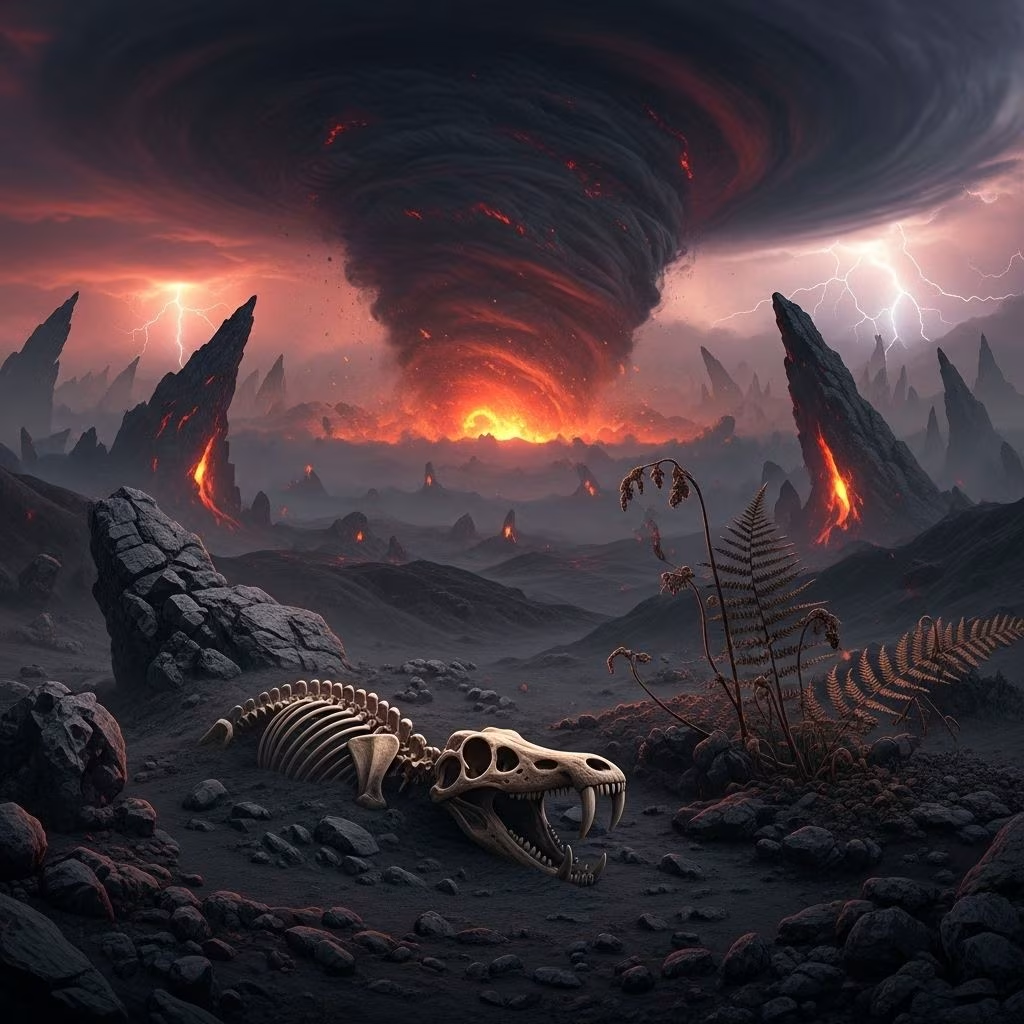
The Permian-Triassic extinction event, often referred to as the Great Dying, stands as the most severe biological crisis in the planet’s history. Around 252 million years ago, this mass extinction dramatically reshaped life on Earth, eradicating the majority of marine and terrestrial species and paving the way for the next era of evolution. Scientists continue to investigate the causes behind this unparalleled event, applying cutting-edge research to illuminate the series of catastrophic events that transpired at the close of the Permian period. This article examines the latest scientific insights and debates, exploring the factors that triggered the Great Dying and its lasting legacy.
Understanding the Permian Extinction: An Overview
The Permian extinction marks the boundary between the Permian and Triassic geologic periods, as well as the end of the Paleozoic Era and the dawn of the Mesozoic. Occurring approximately 251.9 million years ago, this event surpassed all other known mass extinctions in its scale and intensity.
- Estimated 90% of marine species and about 70% of terrestrial vertebrate species disappeared from the Earth.
- 57% of biological families and 62% of genera went extinct, including the greatest loss of insects in the fossil record.
- Some evidence suggests the extinction was not a single event but unfolded in multiple pulses across several million years, with one or more sharp peaks of massive biological loss.
This die-off was a global phenomenon, drastically reducing ecosystems on both land and in the sea. It fundamentally reset the evolutionary trajectory of life, enabling the rise of mammals and, eventually, dinosaurs.
Pinpointing the Main Culprit: Siberian Traps Volcanism
The leading scientific consensus attributes the primary cause of the Permian extinction to massive volcanic eruptions in what is now Siberia. These eruptions produced the vast Siberian Traps—one of the Earth’s largest regions of volcanic rock.
- These eruptions lasted for over a million years, releasing an estimated 100,000 billion metric tons of carbon dioxide into the atmosphere.
- Other volcanic gases, including sulfur dioxide, contributed further to environmental changes, initiating acid rain and atmospheric cooling in the short term, followed by long-term warming due to greenhouse gas accumulation.
- Geochemical evidence, such as spikes in mercury and other volcanic markers, links these Siberian Traps eruptions in timing and scale with the extinction event.
How did these volcanic eruptions trigger extinctions?
- Massive influxes of greenhouse gases led to extreme global warming, destabilizing the climate and ecosystem structures worldwide.
- Oceans became acidified and deoxygenated, leading to anoxia (loss of oxygen)—fatal for marine species.
- Terrestrial environments suffered from acid rain, habitat destruction, and rapid climate swings.
Evidence for a Multi-Phase Extinction Event
While the Siberian Traps eruptions are closely associated with the peak of the extinction, fossil and geological records indicate that the event itself may have unfolded in several distinct phases or pulses.
- Some marine and terrestrial species began to disappear thousands of years before the principal extinction peak.
- Paleontological and geochemical data suggest at least two significant pulses: one targeting primarily surface-dwelling species, and another severely affecting deep-sea and benthic organisms.
- Surviving species endured further climate and ecosystem instability for millions of years after the initial crisis.
Climate Crisis: Global Warming and Oceanic Upheaval
The vast quantities of CO2 emitted by Siberian volcanism had profound effects on global climate systems:
- Temperatures soared by an estimated 10°C, even reaching historically cold polar regions, transforming them into temperate zones.
- Oceans warmed, undermining the solubility of oxygen, and feeding a cycle of deoxygenation and further marine extinctions.
- The alteration of global weather patterns led to more intense storms, seasonality shifts, and long-lasting El Niño events.
Plant fossils and numerical climate simulations confirm this rise in global (and especially polar) temperatures, as well as the subsequent collapse of traditional biomes such as tundra habitats. Nevertheless, some plant species demonstrated relative resilience, even as animal life collapsed.
Ocean Anoxia, Acidification, and the Collapse of Marine Life
The sheer scale of CO2 and sulfur dioxide release fostered profound oceanic anoxia (complete loss of oxygen in large ocean regions) and led to acidification, both of which had catastrophic impacts on marine ecosystems.
- Anoxic and sulfurous ocean conditions (euxinia) developed, removing the possibility of survival for oxygen-dependent marine animals.
- Calcifying organisms—such as corals and some plankton—were among the most affected, with entire reefs disappearing from the fossil record for millions of years.
- Deeper-water life suffered especially in the later phases of the extinction, as oxygen loss became more widespread.
Some high-temperature-intolerant species had to migrate to cooler or more oxygen-rich waters, but many could not adapt quickly enough, resulting in further extinctions in the early Triassic.
Other Hypotheses and Contributing Factors
Though the Siberian Traps eruptions form the basis of the primary model, several other hypotheses and potential contributing factors have been proposed for the Permian extinction:
- Methane release: Heating of permafrost and gas hydrate deposits may have released large amounts of methane, a potent greenhouse gas, amplifying initial warming.
- Burning of coal and oil: Volcanic activity may have ignited vast carbon-rich deposits, adding further CO2 and toxic gases to the atmosphere.
- Methanogenic archaea: Some researchers suggest that specific microbes, fed by volcanic nutrients, could have rapidly released methane.
- Extraterrestrial impacts: While no definitive evidence has been found, some geological layers from this era contain markers such as shocked quartz indicative of possible asteroid or comet impacts.
- Ozone depletion: High atmospheric methane and increased volcanic activity might have damaged the ozone layer, exposing Earth’s surface to dangerous UV radiation and further disrupting ecosystems.
Evidence for these scenarios varies in strength and often overlaps, highlighting the complex, interconnected nature of mass extinction mechanisms.
Impacts of the Permian Extinction
The biological and ecological consequences of the Great Dying were profound:
- Marine Life: Up to 96% of all marine species vanished, including trilobites, many types of brachiopods, and most coral orders.
- Terrestrial Life: Some 70% of vertebrate species went extinct, along with large numbers of plant species, insects, and other land organisms.
- Ecosystem Collapse: Food webs were shattered, and ecosystems drastically simplified, leaving a world with far fewer species and greatly reduced diversity.
- Biogeography: Entire groups migrated, adapted to new niches, or disappeared entirely. Recovery and diversification took millions of years, leading to the eventual rise of dinosaurs and mammals.
Comparison Table: Major Mass Extinctions
| Extinction Event | Time (mya) | Estimated Species Loss | Main Suspected Cause |
|---|---|---|---|
| Permian-Triassic (Great Dying) | 251.9 | ~90% marine, 70% terrestrial | Siberian Traps volcanism, greenhouse gases |
| Cretaceous-Paleogene | 66 | ~75% of all species | Asteroid impact, Deccan volcanism |
| Triassic-Jurassic | 201 | ~70% of all species | Volcanism, climate change |
| Late Devonian | 372/359 | ~75% of all species | Multiple causes (anoxia, volcanism) |
| Ordovician-Silurian | 444 | ~85% of marine species | Glaciation, sea level fall |
Lessons for Today: The Relevance of Deep-Time Crises
Modern scientists often look to the Permian extinction as a powerful case study in how rapid environmental shifts—especially those triggered by massive carbon emissions—can drive life to the brink of annihilation. The parallels between then and now are sobering:
- Both events involve dramatic increases in atmospheric greenhouse gases and global warming.
- Rapid alterations to climate, ocean chemistry, and biospheres echo contemporary anthropogenic changes.
- Understanding Earth’s deep past mass extinctions provides critical insight into the risks and resilience of today’s biosphere.
Frequently Asked Questions (FAQs)
Q: What exactly caused the Permian extinction?
A: The dominant cause was massive volcanic eruptions in Siberia, which released colossal amounts of greenhouse gases and toxic compounds, destabilizing global climates and causing oceanic anoxia and acidification. Other factors, including methane release and possible asteroid impacts, may also have contributed.
Q: How long did the extinction event last?
A: The main phase of extinction appears to have occurred over a geologically short interval (possibly within 61,000 years), but environmental instability and repeated pulses extended the crisis over several million years.
Q: Were any organisms able to survive the event?
A: A small fraction of marine and terrestrial species survived, often by rapidly adapting, migrating to refuge areas, or possessing traits favorable to harsh, low-oxygen, and high-temperature environments. These survivors formed the basis of post-extinction evolutionary diversification.
Q: Is there any connection between the Permian extinction and today’s climate change?
A: While the triggers are different (volcanism versus fossil fuel burning), both events share the catastrophic injection of greenhouse gases into the atmosphere and associated climate and biogeochemical disruptions. The Permian extinction serves as a stark warning about the planetary consequences of destabilizing the global carbon cycle.
Q: Could another mass extinction on this scale happen again?
A: Earth’s history suggests that rapid, large-scale environmental changes can have devastating effects on life. While the exact circumstances of the Permian extinction are unlikely to repeat, ongoing biodiversity loss and climate change have led many scientists to warn that we may be entering a new mass extinction event.
References and Further Reading
- MIT News – “An Extinction without Warning”
- Nature Communications – “Evidence for a Prolonged Permian–Triassic Extinction Interval”
- Frontiers in Earth Science – “252 Million Year Old Climate Crisis”
- Wikipedia – “Permian–Triassic Extinction Event”
- UC Berkeley Evolution – “Gathering Evidence to Study Mass Extinctions”
References
- https://news.mit.edu/2018/permian-period-extinction-0919
- https://www.nature.com/articles/s41467-019-09620-0
- https://pmc.ncbi.nlm.nih.gov/articles/PMC10753410/
- https://www.frontiersin.org/news/2025/03/11/252-million-year-old-climate-crisis-permian-extinction-co2-frontiers-earth-sciences
- https://en.wikipedia.org/wiki/Permian%E2%80%93Triassic_extinction_event
- https://evolution.berkeley.edu/mass-extinction/gathering-evidence-to-study-mass-extinctions/