


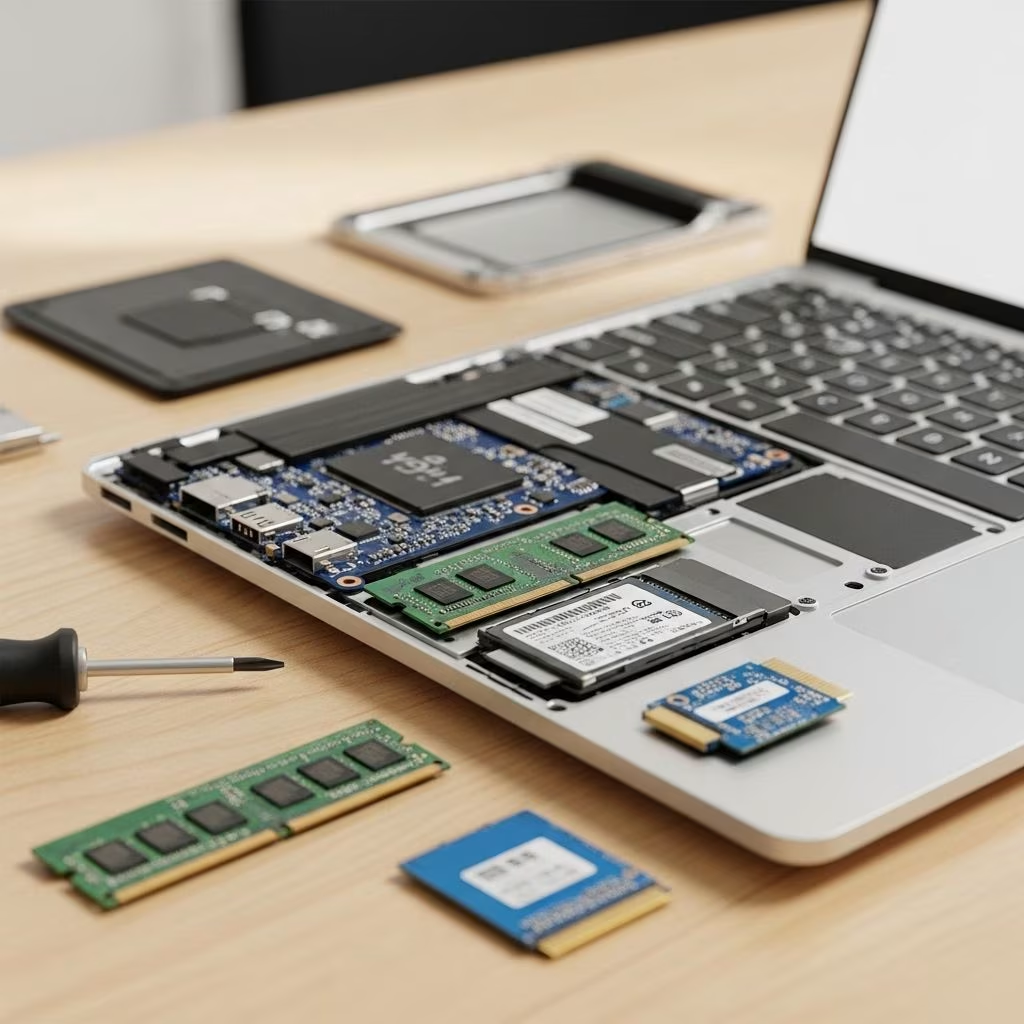
Framework Laptop: Pioneering Modular, Repairable, and Upgradable Technology
The rapid evolution of personal computing has given rise to countless device iterations, but very few have tackled the industry’s growing crisis of electronic waste and limits on consumer empowerment. Framework, an American technology company, is blazing a trail with its modular, repairable, and upgradeable laptops, aiming to transform not just the way people buy computers, but also how they maintain, adapt, and reuse them over time. From ease of repair to customizability and a commitment to sustainability, Framework’s design philosophy confronts some of the most pressing challenges in consumer tech today.
The Mounting Problem: Electronic Waste in Computing
In 2019, global electronic waste rose to a staggering 53.6 million tonnes, up from 44.4 million tonnes only five years earlier. Most laptops and smartphones are traditionally designed as “disposable one-offs,” offering little in terms of longevity or upgrade paths. As components break or become outdated, these devices are discarded, contributing to the mounting e-waste problem. Framework’s CEO, Nirav Patel, has made it the company’s mission to address this crisis by building products intended to last much longer, thereby reducing the stream of discarded electronics entering landfills each year.
Design Philosophy: Modularity, Repairability, and Longevity
- Modular Architecture: Framework laptops feature modular components that can be swapped, repaired, or upgraded, giving users unprecedented control and extending the life of the device.
- Customizability: The Expansion Card system allows users to choose their preferred ports and change them as their needs evolve—from USB to HDMI or Ethernet—with hot-swappable modules on either side of the chassis.
- Repairability: Every major component, from the screen and keyboard to the battery and motherboard, can be removed and replaced with basic tools supplied with the device. QR codes attached to components link users directly to detailed online repair guides and an official parts marketplace.
- Sustainability: Framework uses environmentally conscious materials, including 50% post-consumer recycled (PCR) aluminum for the chassis, supporting a circular economy approach and reducing virgin material demand.
How Easy Is It to Repair a Framework Laptop?
Unlike most consumer laptops, which discourage users from opening and repairing them, Framework’s approach is refreshingly open. DIY and preassembled versions are available, with both bundled with the necessary screwdriver and spudger tools for component access. Five small screws on the bottom panel allow users to quickly open the laptop and access internal parts.
- The keyboard section lifts to reveal replaceable internals.
- The battery is easily removable—no adhesive complications.
- The motherboard can be swapped out, repurposed, or upgraded.
- A QR code guides users to step-by-step online repair instructions and part ordering.
Users have reported that framework laptops meet and exceed the current right-to-repair expectations, supporting upgrades to the SSD, RAM, WiFi card, and even allowing for future processor upgrades by swapping motherboards into the same chassis.
Innovation Through Customization: The Expansion Card System
Framework’s Expansion Card system represents a leap in laptop configurability. Many devices today lock consumers into a fixed set of ports, but Framework’s design makes port selection dynamic, future-proofing the device as standards and user preferences shift.
- Choose and swap between USB-C, USB-A, HDMI, DisplayPort, microSD, and Ethernet modules.
- Each module can be rearranged or replaced at any time—even years after purchase.
- Future-proof design enables swapping as technologies or user needs evolve.
This means you don’t have to adapt your workflow to your laptop; your laptop adapts to you.
Motherboard Replacement and Reuse: Extending Life and Versatility
A key innovation is the reusable motherboard. If a processor upgrade is desired, users can replace the motherboard and continue using the same chassis, keyboard, and display. The replaced motherboard can be repurposed as a single-board computer (SBC) for DIY projects, significantly expanding its useful lifespan and reducing waste.
This approach solves a frequent pain point: the inability to upgrade CPUs in most laptops, forcing whole-device replacement. Framework’s model offers a much more sustainable and flexible solution—one that grows with your needs.
Right to Repair: Empowering Consumers and Shaping Policy
Framework positions itself as a champion of the right to repair, giving consumers the ability to maintain and upgrade their investments without being locked into manufacturer service monopolies. While regulatory progress has seen right-to-repair legislation passed in the EU and UK, it often excludes laptops and smartphones. Major tech companies have responded only with minimal compliance, like making some parts available, yet true device longevity requires comprehensive modularity.
Framework’s business model directly challenges this inertia, demonstrating that device longevity and profit can go hand in hand—if companies are willing to put the user, not planned obsolescence, first.
Framework Desktop: Applying Modular Principles Beyond Laptops
Framework recently expanded its innovation to desktops, with its first modular mini desktop system receiving glowing praise from iFixit. While desktop PCs are already known for their modularity, Framework’s design insists upon tool-free panels, standard connectors, and easy disassembly.
- Tool-free case panels: thumbscrews and magnets for rapid access.
- Cooling: Swappable Noctua fan, with support for any standard 120mm fan for upgrades or replacements.
- Storage: Easily accessible M.2 SSDs for quick upgrades or repair.
- Mainboard: Standard Mini-ITX form factor, with ATX headers and PCIe x4 slot, making it compatible with many off-the-shelf cases and components.
- Highly customizable rear I/O: USB4, DisplayPort, HDMI, and 5Gb Ethernet.
The only current criticism concerns memory—Framework chose to solder down the RAM, a move necessitated by a partnership with AMD’s Ryzen AI Max processor for performance reasons. Detachable RAM would have compromised memory bandwidth, so the design prioritizes high-performance AI and gaming capability over upgradability in this one aspect.
Performance vs. Repairability: Striking a Balance
| Feature | Framework Desktop | Standard PC |
|---|---|---|
| Memory | Soldered (LPDDR5x, for Ryzen AI Max) | Usually removable DIMMs |
| Repairability | Tool-free panels, modular expansion cards | Depends on case/design |
| Upgrade Options | Storage, case, I/O expansion, cooling | Memory, storage, GPU, most components |
| Performance | High memory bandwidth, great for AI/gaming | Varies by build, potentially lower AI bandwidth |
Despite the soldered RAM trade-off, the rest of the desktop’s design still exemplifies modularity and repairability. iFixit concluded that, as long as Framework maintains accessibility in production models, they expect high repairability scores.
Sustainability: Building a Circular Economy
Framework’s commitment goes beyond eco-friendly materials. Their business model promotes a circular economy by encouraging component reuse, upgrade, and recycling throughout the product’s life cycle.
- Chassis made from 50% PCR aluminum.
- Motherboards reused as SBCs for new DIY projects.
- Official marketplace for spare parts extends repair options.
- QR codes streamline access to repair guides and ordering.
By helping users “generate less waste and make products that last longer,” Framework sets a template for other hardware manufacturers to follow.
User Experience: Real-World Adaptability and Feedback
Framework laptops have attracted a dedicated community, with users praising how the machines adapt to evolving personal and professional needs. One user noted the seamless upgrade path—moving from an 11th Gen board to the 12th Gen in the same chassis, able to adjust I/O ports as USB standards and peripherals changed.
The device eliminates the pain of proprietary repairs and forced upgrades by allowing daily routines and workflows to dictate hardware configuration, not the other way around.
- Daily customization of ports for different work environments.
- Diverse use cases, from network management to creative work and engineering.
- Mature support community and forums for troubleshooting and upgrading.
Challenges and Considerations
No product is perfect. Framework’s approach does face some hurdles:
- Component ecosystem: Wide availability of expansion cards and spare parts depends on Framework’s ongoing support and community engagement.
- Performance trade-offs: Maintaining peak performance can sometimes require breaking modularity, as illustrated by soldered memory on the desktop model.
- Regulatory gaps: Right-to-repair laws still largely exclude laptops and smartphones, leaving most tech buyers dependent on manufacturer goodwill rather than legal protections.
- Market inertia: Large incumbents in consumer tech have little incentive to embrace true modularity, relying instead on sales of new devices rather than upgrades.
Still, the momentum from regulatory bodies and growing consumer demand is strengthening the trend toward repairable and sustainable electronics.
FAQs: Framework Laptops and Desktops
Q: Can I upgrade the processor on a Framework laptop?
A: Yes, you can upgrade the processor by swapping out the motherboard for a newer one compatible with your chassis and components.
Q: Are Framework laptops easily repairable?
A: Yes; nearly every core component, including keyboard, battery, display, and I/O ports, is replaceable with basic tools. QR codes link to detailed guides.
Q: Is the Framework desktop as modular as the laptop?
A: The Framework desktop emphasizes modular, tool-free panels and customizable components, but its memory is soldered for high performance, making it less upgradeable in that specific aspect.
Q: What makes Framework laptops sustainable?
A: Framework uses recycled materials, designs for longevity and upgradability, provides a marketplace for replacement parts, and encourages reuse and recycling of major components.
Q: How does the Expansion Card system work?
A: Users can select, swap, and rearrange modular I/O cards, configuring their laptops with the ports they need now and changing them later as needs evolve.
Conclusion: Framework’s Model—A Blueprint for the Future
Framework’s audacious push toward modularity, repairability, and sustainability is redefining expectations for consumer electronics. By empowering users, supporting the right to repair, and combating the massive issue of electronic waste, Framework laptops and desktops are more than just a technological innovation—they are a call to action and a blueprint for a future where products grow, adapt, and endure alongside their owners. If industry leaders follow suit, the days of disposable, non-repairable electronics may soon be over.
References
- https://www.theregister.com/2025/02/27/ifixit_framework_desktop/
- https://www.dezeen.com/2022/01/04/framework-modular-laptop-technology/
- https://community.frame.work/t/welcome-please-introduce-yourself-2nd-edition/18147?page=2
- https://www.youtube.com/watch?v=vQLws5KfntE
- https://www.projectgus.com/2024/09/18-months-with-framework-laptop/
- https://www.youtube.com/watch?v=hJjstBT0bpw


