


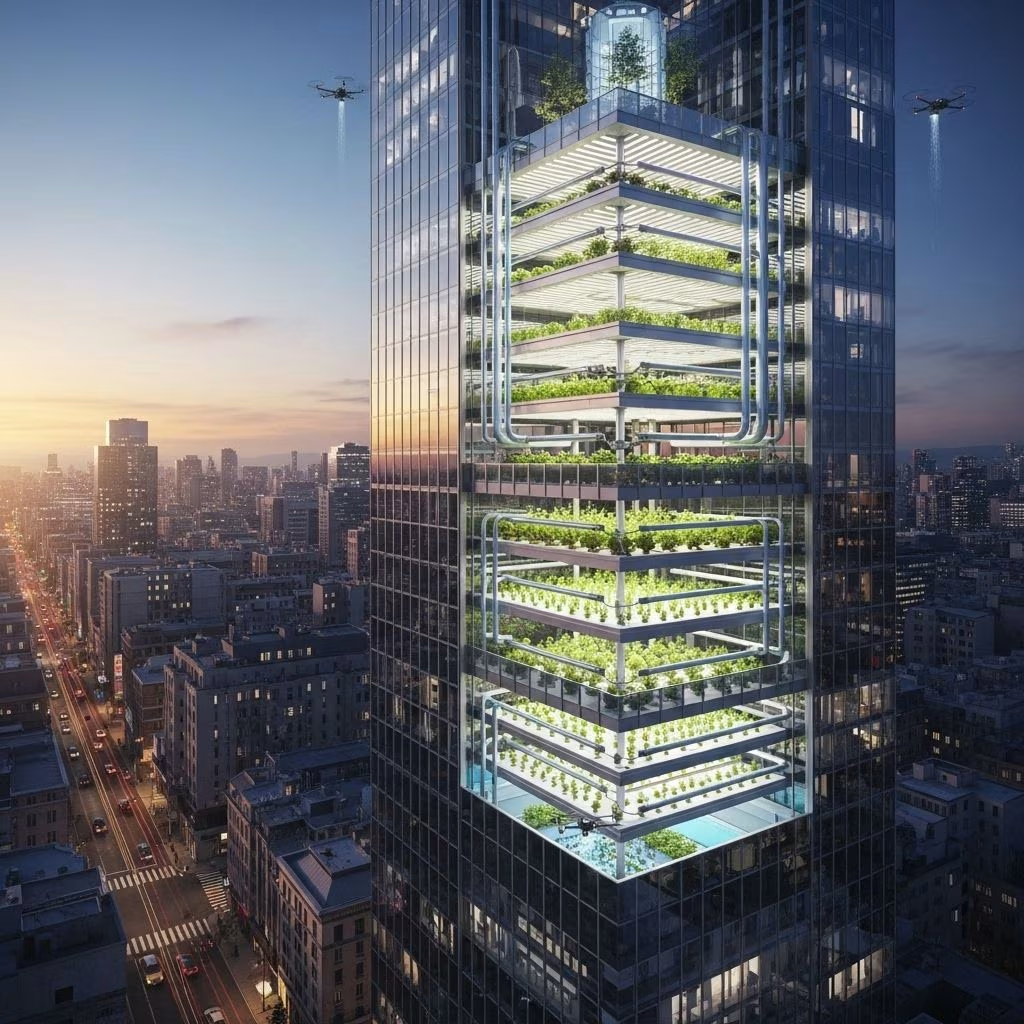
Are Vertical Farms Still a Thing? The State and Future of Urban Farming
Once hailed as the future of urban food production, vertical farming continues to spark debate about its viability, scalability, and long-term role in sustainable agriculture. As cities expand and climate pressures mount, supporters tout vertical farms as a high-tech solution to food insecurity and environmental degradation, while critics point to persistent economic and logistical challenges. This article explores the current landscape of vertical farming, examining both the realities facing the industry and the technological innovations shaping its future.
What is Vertical Farming?
Vertical farming is a method of cultivating crops in stacked layers—often within controlled indoor environments—using soilless technologies such as hydroponics, aeroponics, or aquaponics. This approach maximizes the use of space and can be integrated into urban environments, including warehouses, shipping containers, or purpose-built towers.
- Hydroponics: Plants are grown in a nutrient-rich water solution without soil. It is currently the dominant technology in vertical farming, holding over half the market share.
- Aeroponics: Roots are suspended in air and misted with nutrients, using even less water than hydroponics.
- Aquaponics: Combines hydroponics with fish farming, where fish waste provides nutrients for plants and plants help filter water for fish.
These systems allow for year-round production, independent of weather, and can dramatically reduce water and pesticide usage compared to traditional agriculture. Vertical farms are often located close to or inside population centers, reducing the distance food travels to consumers and potentially resulting in fresher produce.
Why Vertical Farming Still Matters
Despite skepticism in some quarters, vertical farming addresses several of the most pressing challenges facing global food production:
- Urbanization: With the majority of the world’s population now living in cities, vertical farms offer locally grown produce – reducing the need for long-haul transportation.
- Land Scarcity: By stacking production upwards, vertical farms require a fraction of the land compared to conventional farms – freeing up valuable space or repurposing underutilized urban infrastructure.
- Water Efficiency: Hydroponic and aeroponic systems can use up to 90% less water than field-grown crops, a crucial factor as water scarcity intensifies globally.
- Year-Round Consistency: Controlled environments protect crops from weather extremes, pests, and diseases, offering stable harvests regardless of external conditions.
- Food Security: Production closer to consumers can bolster resilience against supply chain disruptions, a lesson underscored by recent global crises.
Given these benefits, governments, investors, and urban planners continue to advocate for the integration of vertical farming into future food systems, even as the industry navigates growing pains and shifting market forces.
Recent Challenges Facing the Industry
Despite technological progress and glowing media coverage, vertical farming faces tough hurdles, especially regarding financial sustainability, energy use, and scalability:
- High Operating Costs: Vertical farms often rely on energy-intensive lighting and climate control, resulting in large electricity bills that undermine profitability, particularly where energy is expensive.
- Expensive Setup: The initial investment required for advanced equipment and facilities is substantial; this barrier has led to the closure or restructuring of some high-profile vertical farming startups.
- Labor and Technical Skills: Operating sophisticated indoor farms requires specialized skills in data analysis, system maintenance, and agronomy, which are not always widely available or affordable.
- Narrow Crop Focus: Most vertical farms today grow leafy greens and herbs, which have high value but limited market size. Expanding to staple crops remains a technical and economic challenge.
- Market Demand and Consumer Perception: Selling at price points that reflect true costs, while competing with conventionally grown produce, remains difficult without premium branding or supportive policies.
A Look at Major Players
Several pioneering companies have defined the vertical farming sector’s identity, ambitions, and risks. Although some earlier high-profile ventures have faltered or downsized, others continue to innovate and adapt. Notable names in vertical farming include:
- AeroFarms: Known for its large-scale aeroponic systems and sustainability initiatives. AeroFarms has experienced recent financial setbacks, with reports of restructuring and layoffs, yet continues operational research and partnerships.
- Plenty: Backed by significant venture capital, Plenty focuses on high-yield, tech-driven hydroponic solutions, often collaborating with retail giants for market presence.
- Bowery Farming: Based in the United States, Bowery Farming leverages advanced AI and data-driven techniques to optimize crop production, positioning itself as a leader in operational efficiency.
- Infarm: Based in Europe, Infarm deploys modular, distributed vertical farming systems in grocery stores and food markets to allow on-site production and reduce food miles.
| Company | Specialization | Notable Achievements |
|---|---|---|
| AeroFarms | Aeroponics, R&D | Large-scale facilities, sustainability focus, research collaborations |
| Plenty | Hydroponics, automation | High yields, strong VC backing, retail partnerships |
| Bowery Farming | AI, data analytics | Operational efficiency, urban farm deployments |
| Infarm | In-store modular farms | Europe-wide installations, on-demand urban farming |
Technology and Innovation
Technological innovation remains the backbone of modern vertical farming. The sector has made substantial strides in precision agriculture, automation, and control systems:
- LED Lighting: Customized spectra optimize growth, enabling efficient and rapid plant development with less energy use than traditional lighting,”3″].
- Automated Systems: Robots now sow, tend, and harvest crops, while AI-driven platforms monitor and control everything from nutrient dosing to light cycles.
- Data Analytics: Real-time sensing and analytics platforms allow for fine-tuned resource management, improved forecasting, and predictive maintenance.
- Modular Scalability: Advances in modular system design allow farms to expand (or contract) rapidly and adapt to diverse settings, facilitating easier entry for smaller producers.
- Renewable Energy Integration: Some operators now power facilities with solar, wind, or advanced battery storage to offset costs and improve sustainability profiles.
These advances not only enhance production efficiency and scale, but also help to address sustainability concerns associated with energy use—one of the industry’s most persistent criticisms.
Economics and Scaling Up
Vertical farming’s growth trajectory reflects a balance between the realities of operational costs and the pressures of urbanization and climate change. Market research reveals strong projected growth, despite recent turbulence:
- The global vertical farming market was valued at around $21.5 million in 2025 and is projected to reach $47 million by 2032, with a CAGR exceeding 11%.
- Hydroponics currently account for the largest segment, representing over 50% of all vertical farming market value, thanks to its flexibility and resource use.
- Key players continue to attract investment, especially where urban governments support sustainable food initiatives.
- Despite these figures, business failures remain common; profitability is often linked to the ability to scale efficiently, adopt energy-saving solutions, and diversify product offerings.
Emerging trends highlight a move towards more diversified crops (beyond leafy greens), greater use of automation to cut labor costs, and stronger integration with renewable energy sources to address environmental and economic concerns. However, long-term profitability and mass adoption hinge on continued technological advancement, effective market positioning, and policy support.
The Future of Vertical Farming
The notion that vertical farming is a ‘fading trend’ does not match the current reality. Instead, the sector remains dynamic, reacting to shifting pressures and opportunities by evolving its technology and business approaches. Looking ahead, several factors will shape the next era of vertical farming:
- Research and Development: Innovations in plant breeding, light recipes, and system design will expand the range of crops that can be economically produced indoors.
- Integration with Smart Cities: Urban planners are evaluating ways to embed vertical farms within residential and commercial developments as part of broader food security strategies.
- Policy and Incentives: Government support—be it through grants, tax breaks, or utility rate structures—could determine which operators thrive and help push the sector toward environmental benchmarks.
- Global Reach: The greatest growth may occur in Asia, the Middle East, and regions where food security and local supply are paramount—and where local investors are increasingly backing high-tech ag solutions.
The consensus is that vertical farming is not a panacea for all agricultural issues, but remains a promising and rapidly evolving contributor to the future of food production.
Frequently Asked Questions (FAQs)
Q: Can vertical farming replace traditional agriculture?
A: Vertical farming is best seen as a complementary technology rather than a replacement. It excels in producing leafy greens and herbs near urban centers but is not yet cost-effective for broad-acre staples like wheat or corn, nor does it replicate certain ecological services offered by traditional fields.
Q: Are vertical farms environmentally sustainable?
A: Vertical farms are highly water- and land-efficient, and can significantly reduce pesticide use. However, their environmental footprint depends on energy sources; reliance on fossil-fueled electricity can undermine climate gains, while pairing with renewables enhances sustainability.
Q: Why do some vertical farms struggle financially?
A: High up-front infrastructure costs, expensive energy requirements, the need for technical expertise, and narrow crop focus can squeeze margins. Market saturation for leafy greens in some regions and strong competition from conventional agriculture further complicate business models.
Q: What crops are best suited to vertical farming?
A: Fast-growing, compact, high-value crops like lettuces, microgreens, herbs, and—more recently—some berries and tomatoes are most common. Research continues to expand this list, but grains and root crops remain largely impractical indoors.
Q: Is vertical farming here to stay?
A: The fundamentals driving urban food innovation—resource scarcity, supply chain resilience, health concerns—ensure vertical farming remains part of the future food conversation. Its form, focus, and market share will continue to evolve as technology advances and urban needs shift.
References
- https://www.edengreen.com/blog-collection/future-of-vertical-farming
- https://www.marketreportanalytics.com/reports/indoor-vertical-farming-technology-115731
- https://www.coherentmarketinsights.com/market-insight/vertical-farming-market-5469
- https://www.ars.usda.gov/oc/utm/vertical-farming-no-longer-a-futuristic-concept/
- https://robovision.ai/blog/top-5-agtech-trends-in-2025
- https://www.tandfonline.com/doi/full/10.1080/14620316.2025.2513702?src=exp-la
- https://www.plugandplaytechcenter.com/insights/new-agriculture-technology-modern-farming
- https://www.indoorverticalfarm.com/p/us-indoor-farming-insights


