


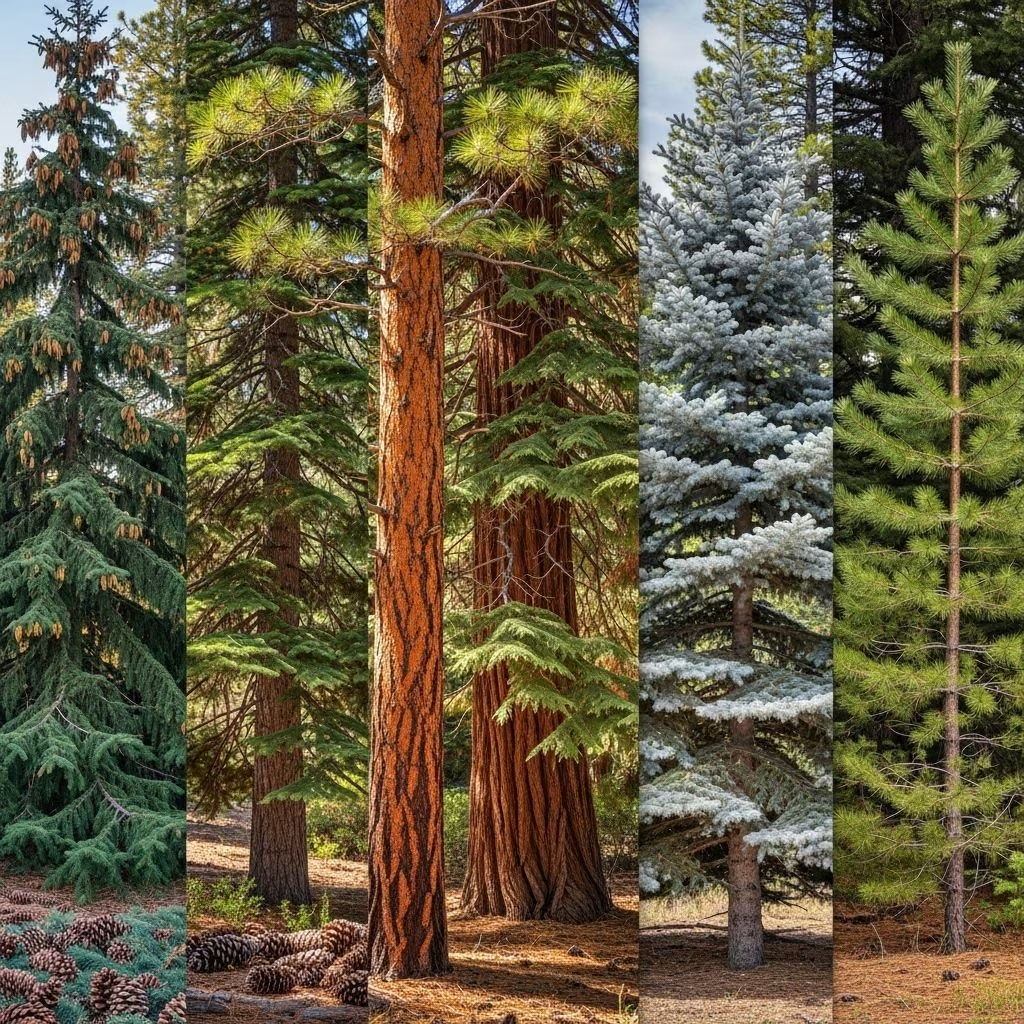
Major North American Conifers: Identification & Descriptions
Conifers are a defining element of North American landscapes, from the redwood forests of California to the pine woodlands of the Southeast. These evergreen, cone-bearing trees play vital ecological roles and provide the iconic look of many wild and cultivated spaces. This guide presents key North American conifers, with detailed descriptions, identification tips, and ecological notes.
What Are Conifers?
Conifers are gymnosperm trees and shrubs characterized by needle-like or scale-like foliage and their unique method of reproduction via cones instead of flowers. Most are evergreen, though some, like the Baldcypress, lose their needles in winter. Conifers dominate vast regions of Canada, the United States, and northern Mexico.
Main Types of North American Conifers
- Pines (Pinus)
- Spruces (Picea)
- Firs (Abies)
- Hemlocks (Tsuga)
- Cedars (Thuja, Chamaecyparis)
- Douglas-firs (Pseudotsuga)
- Larches (Larix)
- Redwoods (Sequoia, Sequoiadendron)
- Cypresses (Taxodium, Cupressus)
- Junipers (Juniperus)
Pines (Pinus)
Pines are the most widespread conifers in North America, adapted to diverse climates from the desert Southwest to northern Canada. Pines typically have long, slender needles grouped in bundles (fascicles) of 2-5.
Notable Species
- Eastern White Pine (Pinus strobus)
Features: Five soft, blue-green needles per bundle, tall straight form, long slender cones.
Range: Found from Newfoundland through the Great Lakes to the northern Appalachians and the southeastern U.S.
Ecology: Key lumber species; habitat for birds and mammals. - Ponderosa Pine (Pinus ponderosa)
Features: Three long, yellow-green needles per bundle, thick orange-brown bark.
Range: Dominant in western U.S. mountains, from British Columbia to Mexico.
Ecology: Fire-adapted; supports western forest ecosystems. - Lodgepole Pine (Pinus contorta)
Features: Short pairs of needles, slender trunk.
Range: Western North America, widespread from Alaska to California.
Ecology: Pioneer species after wildfire; habitat for small mammals. - Longleaf Pine (Pinus palustris)
Features: Exceptionally long, flexible needles in threes; large cones.
Range: Southeastern U.S., primarily Gulf Coastal Plains.
Ecology: Key element of fire-adapted ecosystems supporting biodiversity.
Spruces (Picea)
Spruces are tall, conical trees with sharp, stiff, four-sided needles that radiate around the twig. Their cones hang downward. Spruces are cold-adapted, often found in boreal forests and high mountains.
Notable Species
- White Spruce (Picea glauca)
Range: Canada, Northern U.S.
Notes: Blue-green, relatively short needles; adaptable, valued for windbreaks. - Black Spruce (Picea mariana)
Range: Boggy areas of northern North America.
Notes: Short, bluish needles; small cones, critical in taiga ecology. - Colorado Blue Spruce (Picea pungens)
Range: Central Rocky Mountains.
Notes: Striking silvery-blue foliage; popular ornamental tree.
Firs (Abies)
Members of the fir genus are recognized by their flat, soft needles attached individually to the branch; cones stand upright on the branches and disintegrate at maturity.
Notable Species
- Balsam Fir (Abies balsamea)
Range: Northeast U.S. and Canada.
Notes: Flat, aromatic needles; classic “Christmas tree” look. - Noble Fir (Abies procera)
Range: Pacific Northwest.
Notes: Tall stature, bluish needles, crucial for timber. - Subalpine Fir (Abies lasiocarpa)
Range: Rockies to the Pacific.
Notes: Narrow, spire-like profile; grows at high elevations.
Hemlocks (Tsuga)
Hemlocks are graceful conifers with flat, feathery needles arranged in two rows, small cones, and often nodding tree tops. They thrive in shady, moist environments in eastern and western North America.
Notable Species
- Eastern Hemlock (Tsuga canadensis)
Range: Northeastern U.S., eastern Canada, Great Lakes.
Notes: Soft, short needles; drooping branches and cones.
Conservation: Threatened by hemlock woolly adelgid pest. - Western Hemlock (Tsuga heterophylla)
Range: Pacific coast from California to Alaska.
Notes: Tolerant of heavy rainfall; forms lush forests.
Cedars & False Cedars
True cedars (Cedrus) are Old World natives, but North America features “false cedars” in the genera Thuja and Chamaecyparis. These trees are commonly called cedars due to aromatic wood and scale-like foliage.
- Northern White Cedar (Arborvitae, Thuja occidentalis)
Range: Northeastern U.S. and adjacent Canada.
Notes: Dense, fan-shaped sprays; small, woody cones. - Western Redcedar (Thuja plicata)
Range: Pacific Northwest.
Notes: Giant size possible; essential to indigenous cultures. - Atlantic White Cedar (Chamaecyparis thyoides)
Range: Atlantic and Gulf coastal swamps.
Notes: Tolerant of wet conditions; aromatic wood.
Douglas-firs (Pseudotsuga)
Douglas-fir is not a “true fir.” These towering trees have soft, flat needles with cones bearing distinctive three-pointed bracts.
- Coast Douglas-fir (Pseudotsuga menziesii)
Range: Pacific Northwest.
Notes: Valuable timber tree, exceeding 200 feet in ideal conditions.
Ecology: Dominant in western forests, supports birds, deer, and squirrels.
Redwoods & Sequoias
North America’s tallest and most massive trees belong to the redwood family. These trees feature soft, needle-like leaves and thick, fire-resistant bark.
- Coast Redwood (Sequoia sempervirens)
Range: Coastal California.
Notes: World’s tallest tree species; wet coastal forests. - Giant Sequoia (Sequoiadendron giganteum)
Range: Sierra Nevada, California.
Notes: Largest trees by volume. - Dawn Redwood (Metasequoia glyptostroboides)
Range: Native to China; widely planted in North America.
Notes: Deciduous, loses needles in winter.
Larches (Larix)
Larches are unusual as one of the few deciduous conifer genera. Their soft, short needles grow in whorls; vibrant green in spring, they turn yellow in fall before dropping.
- Tamarack or Eastern Larch (Larix laricina)
Range: Northeastern U.S. and Canada.
Notes: Key bog and wetland species; brilliant golden autumn color.
Cypresses (Taxodium and Cupressus)
- Baldcypress (Taxodium distichum)
Range: Southeastern U.S., especially along rivers and swamps.
Notes: Deciduous needles; “knees” for stability in wet soils. - Arizona Cypress (Cupressus arizonica)
Range: Southwestern U.S.
Notes: Blue-green foliage in arid settings.
Junipers (Juniperus)
Junipers are shrubby or small trees with scale- or needle-like foliage and blue, berry-like cones used by wildlife and in culinary applications. They are drought-tolerant and common throughout North America.
- Eastern Redcedar (Juniperus virginiana)
Range: Eastern and Central U.S. and Canada.
Notes: Aromatic reddish wood; adaptable to poor soils. - Rocky Mountain Juniper (Juniperus scopulorum)
Range: Rocky Mountain region.
Notes: Gray-green foliage, rugged appearance.
Table: Key North American Conifers at a Glance
| Common Name | Latin Name | Needle Arrangement | Typical Range |
|---|---|---|---|
| Eastern White Pine | Pinus strobus | Bundles of 5 (soft, long) | Eastern U.S., Canada |
| Douglas-fir | Pseudotsuga menziesii | Single, flat | Western N. America |
| Western Redcedar | Thuja plicata | Scale-like, flattened sprays | Pacific Northwest |
| Lodgepole Pine | Pinus contorta | Bundles of 2 (short, stiff) | Western U.S., Canada |
| White Spruce | Picea glauca | Single, 4-sided | Boreal N. America |
| Baldcypress | Taxodium distichum | Deciduous, feathery | Southeast U.S. swamps |
Ecological Significance of North American Conifers
- Carbon Storage: Many species, especially redwoods and sequoias, lock away substantial amounts of carbon dioxide.
- Wildlife Habitat: Provide shelter and food for birds, mammals, insects, and fungi.
- Soil Stabilization: Deep roots and persistent leaf litter help prevent erosion.
- Fire Ecology: Many western pines have adaptations for surviving and even benefiting from wildfires.
How to Identify Conifers
- Needles or Scales: Long, grouped (pines); short, single (firs, spruces, hemlocks); scale-like (cedars).
- Cones: Texture, size, and orientation (upright for firs, pendant for spruces and pines).
- Bark: Texture and color, from thick and fire-resistant to thin and flaky.
- Habitat: Consider geographic range and preferred soils.
Frequently Asked Questions (FAQs)
Q: How can I tell a fir from a spruce?
A: Fir needles are soft, flat, and attached singly with a base resembling a suction cup, while spruce needles are sharp, four-sided, and attached to woody pegs. Firs have upright cones that disintegrate on the tree; spruce cones hang down and fall whole.
Q: Are all conifers evergreen?
A: Most conifers are evergreen, but a few—including larch and baldcypress—lose their needles in the fall.
Q: Which North American conifer is the tallest tree?
A: The Coast Redwood (Sequoia sempervirens) is the tallest tree species, with individuals exceeding 370 feet.
Q: What threats do native conifers face?
A: Major threats include logging, invasive pests (such as the hemlock woolly adelgid), fire suppression, climate change, and introduced pathogens.
Q: Why are conifers important in landscaping?
A: Their evergreen nature, variety of forms, sizes, and colors, and low maintenance requirements make them popular for windbreaks, privacy screens, and specimen plantings in gardens and parks.
Further Reading and Resources
- Gymnosperm Database: Catalogs North American conifer species, distribution, and taxonomy.
- National Park Service: Provides educational materials on regional conifer identification.
- State Forestry Agencies: Offer region-specific guides and management recommendations.
Whether exploring a boreal forest or admiring a solitary pine in a city park, understanding the diversity and adaptability of North American conifers helps support conservation and deepen our connection with the natural world.
References
- https://www.conifers.org/topics/W_NA_trees.php
- https://www.conifers.org/topics/E_NA_trees.php
- https://www.coniferkingdom.com/blog/conifers-a-complete-guide/
- https://www.masterclass.com/articles/conifers-guide
- https://www.nps.gov/romo/learn/nature/conifers.htm
- https://www.dnr.state.mn.us/trees/coniferous.html
- https://www.westseattlenursery.com/conifers


