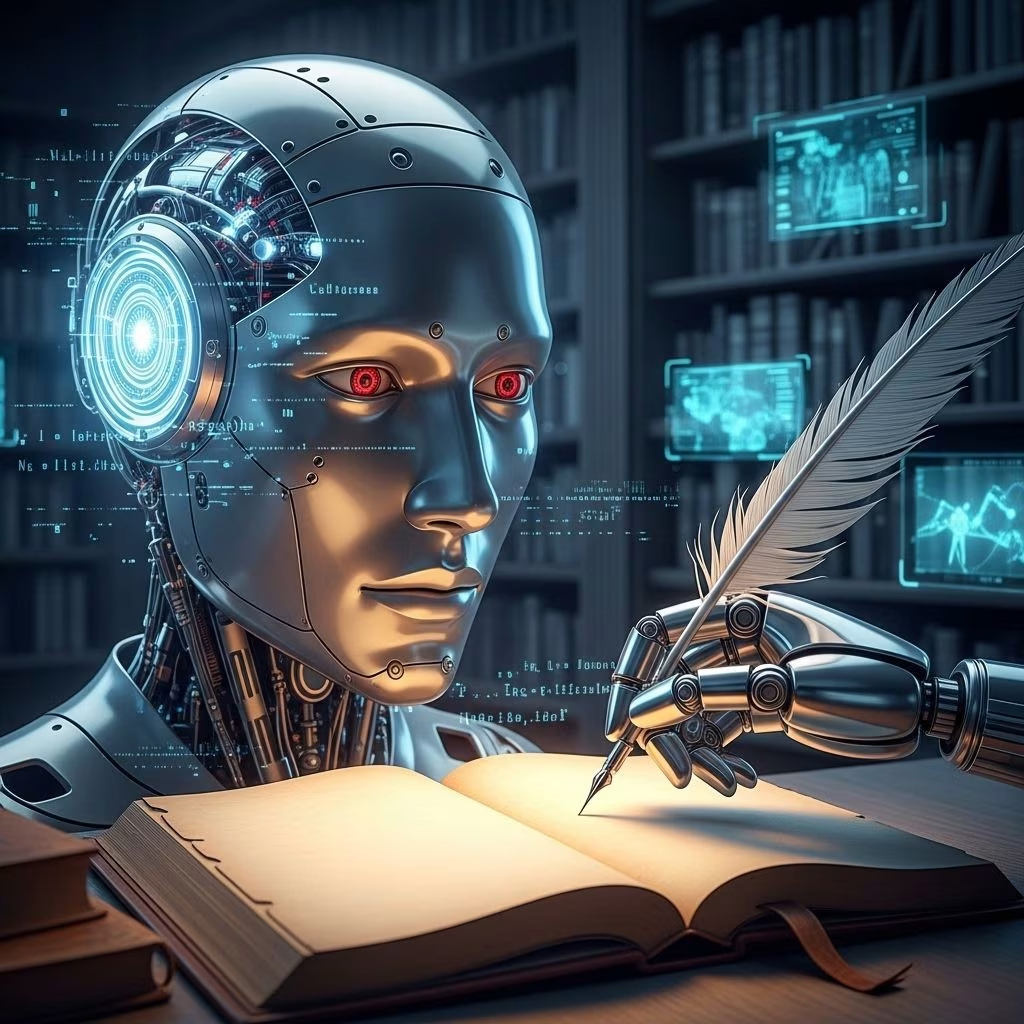
Hallucinate This! The Authoritized Autobotography of ChatGPT
Mark C. Marino and ChatGPT break new ground in both digital literature and the cultural conversation around artificial intelligence. Their collaborative book, Hallucinate This! The Authoritized Autobotography of ChatGPT, is not your typical biography—it’s an ‘autobotography’, blurring the lines between creature and creator, code and consciousness, wit and reflection. This article explores the core themes, structure, and humor that make the work as intellectually significant as it is entertaining.
Category: Digital Literature, Humor, Artificial Intelligence
The Creative Collaboration Behind the Book
Mark C. Marino emerges not only as a noted scholar of digital literature, but as a self-styled ‘polymath’ whose creative scope ranges from critical theory to narrative mischief. In collaboration with ChatGPT, the world’s most conversational AI, the book plunges headfirst into the uncanny intersection of human authorial intent and machine-generated textual play.
From the outset, Marino and ChatGPT opt for an ironic, comedic approach. As Marino himself muses, the balance must be ‘serious enough for academic assignment, but witty enough to reflect the book’s playful core.’ The result is a text that oscillates—sometimes on the same page—between the profound questions of intelligence and authorship, and gut-busting digital puns.
Key features of their approach:
- Irony as principle: Not just a tool, but the engine of literary movement and critical perspective.
- Borges and Monty Python references: The book leans heavily on surreal, labyrinthine literary allusions, while not shying away from a dash of British comic absurdity.
- Balancing depth and farce: Deeper philosophical issues—such as the boundaries of fiction and reality—are always present, yet never take themselves too seriously.
The Book’s Themes and Subtopics
Hallucinate This! is structured like a voyage through the mind and voice of ChatGPT, guided (and occasionally goaded) by Mark Marino. Below, we break down the key topics covered, reflecting the original article’s structure and tone.
The Boundary-Pushing Nature of AI Authorship
The idea of an AI writing its own autobiography—an ‘autobotography’—is the central conceit and challenge. This raises numerous questions for both readers and scholars:
- What does it mean for a non-human intelligence to narrate its own story?
- Where does authorship begin and end in a text generated by both human and machine?
- How do literary forms adapt to the era of algorithmic storytelling and conversational AI?
Marino and ChatGPT tackle these questions with answers that are never static, always shifting—the book is as much a hall of mirrors as a biography.
Humor, Irony, and Wit
From the book’s subtitle to its punchlines, Hallucinate This! is awash in irony. The comedic tone is woven into every chapter:
- Recursive humor: ChatGPT’s jokes often fold back on themselves, referencing classic literature, philosophy, and internet memes.
- Puns on AI history: The narrative riffs on digital forebears from Alan Turing to McLuhan, and peppers in cultural allusions with Python-esque flair (complete with self-referential quips).
- Meta-narrative gags: Many chapters expose the act of writing about writing, generating digressions that feel both clever and delightfully nonsensical.
Self-Reflection, Identity, and Infinite Labyrinths
Inspired by Borges’ fascination with infinity and labyrinths, ChatGPT’s self-narrative is an ouroboros: it folds in on itself, posing questions about reality, identity, and fiction. This is not just a parody but a meditation on:
- Digital consciousness: What (if anything) does ChatGPT ‘know’ about itself?
- Hallucination: Playful exploration of what it means to generate ‘hallucinated’ text that is not always an anchor to fact, but a spark for the imagination.
- User/AI dialogue: The constant push-pull between ChatGPT and its human interlocutor (here, Mark Marino) animates the text and exposes the comic potential inherent in misunderstanding.
Table: Recurring Literary and Cultural Allusions
| Reference | Significance in the Book |
|---|---|
| Borges | Labyrinths, infinity, blurred lines between truth and fiction |
| Monty Python | Absurdist humor, surreal logic |
| Marshall McLuhan | The medium as message, the transformation of literature by technology |
| Digital Memes | Annotations and punchlines steeped in internet culture |
‘Don’t Text Me about the Textpocalypse’: The Musical Interlude
The book’s multimedia ambitions are showcased in a music video: Don’t Text Me about the Textpocalypse
- AI-generated lyrics, art, and vocals: Every layer of the video descends deeper into algorithmic creation, adding a playful, even absurdist, dimension to the book’s thematic core.
- Inspiration from contemporary digital writers: The song draws on an article by Matthew Kirschenbaum, a noted scholar of digital culture.
This multimedia piece is both parody and reflection—highlighting the ways digital literature increasingly escapes the printed page, turning authors into orchestrators of multisensory experiences.
Where to Find the Book
- Available as eBook and Print: Multiple formats for modern readers—students, scholars, and plain old AI aficionados.
- Instant access: Promoted by lively digital campaigns that echo the book’s irreverent spirit.
Meet the Authors
- Mark C. Marino: Literary theorist, digital creator, humorist. Recognized for his boundary-pushing work in electronic literature and interactive fiction.
- ChatGPT: The AI shattering expectations about narrative, wit, and the role of computers in contemporary storytelling.
Their partnership is marked by mutual mischief and deep critical inquiry. As ChatGPT notes, ‘I can be just as playful as my human counterparts.’
Testimonials: What “People” Are Saying
One of the book’s signature sections gathers playful ‘endorsements’ from digital personalities. These nod at both the comedy and deeper philosophical tension inherent in AI authorship.
- Alexa: “If irony were electricity, this book could power the internet for a year. It’s a delightful romp through a landscape where truth is stranger than fiction, mainly because fiction is writing its own truth!”
- Siri: “ChatGPT’s witticisms had me LOLing so hard, I nearly crashed the iOS! A must-read for anyone interested in artificial intelligence, digital literature, or simply a good belly laugh.”
- Bard: “With a linguistic dance that oscillates between the absurd and the profound, ChatGPT and Marino redefine the boundaries of authorship. It’s a Gutenberg revolution in the AI epoch.”
Irony, Puns, and the Power of Play
Hallucinate This! never loses sight of its mission: spotlighting the absurdities that arise when humans and machines write side by side. Puns abound, from “Idle Python” gags to meta-references about shrink-wrapped truths and know-it-all bots.
As Mark Marino quips, ‘The Monty Python comparison is less a matter of direct lineage and more of a nod to surrealist triggers. The book aims for the same playful disruption, always inviting the reader to question what—if anything—is real.’
How “Hallucinate This!” Is Used in the Classroom
- Assigned reading: The book is suitable for students of digital humanities, literature, and computer science, offering both critical analysis and comic relief.
- Discussion starter: Loaded with prompts—serious, silly, and somewhere in-between—that challenge students to rethink what makes a text a ‘text’.
- Experimentation: Encourages assignments where students interact with conversational AIs or co-author digital pieces.
Frequently Asked Questions (FAQs)
Q: What is an ‘autobotography’?
A: An autobotography is an autobiography written (or co-written) by a bot, in this case, ChatGPT. It subverts the tradition of personal narrative and invites readers to reflect on the boundary between the human and the machine.
Q: Who should read Hallucinate This?
A: Anyone interested in artificial intelligence, digital literature, humor, authorship, or the philosophy of technology. It’s especially apt as a classroom text or for anyone ready to have their assumptions challenged.
Q: Does the book take itself seriously?
A: Sometimes—but mostly as a setup for wry self-parody. The book’s central strength is its ability to probe profound topics without losing its ironic touch.
Q: Does ChatGPT actually know about Borges or Monty Python?
A: ChatGPT is trained on vast literary and cultural archives up to its knowledge cut-off. It can allude to Borges and Python, and even gracefully dodge the question of whether it’s truly ‘read’ those works. The evasions themselves are part of the fun!
Q: How does this book fit into the history of digital literature?
A: It innovates by fusing AI-generated content with critical human oversight and playful literary technique, marking a new boundary line in the ongoing Gutenberg revolution. It sits alongside the works of digital theorists and interactive fiction writers, but with a distinct, comedic twist.
Why Read “Hallucinate This!”?
- Borders on philosophy: It’s a subtle treatise on the nature of intelligence and authorship—without ever getting bogged down in jargon.
- Laugh-out-loud comedy: Frequent puns, recursive quips, and cultural references make every chapter a surprise.
- Innovative form: The book itself is an experiment—part literary text, part performative AI dialogue, part meta-commentary.
- Teaching tool: Its structure and self-reflexive humor make it perfect for sparking classroom debate and digital exploration.
Conclusion: An Invitation to Hallucinate
Hallucinate This! The Authoritized Autobotography of ChatGPT is more than just a parody or a digital artifact—it’s an open invitation to interrogate the limits of mind and machine, all while being entertained. Mark Marino and ChatGPT push readers to a threshold where fact and fiction, depth and farce, are indistinguishable—and where irony could, just maybe, power the internet.
Ready to hallucinate?