


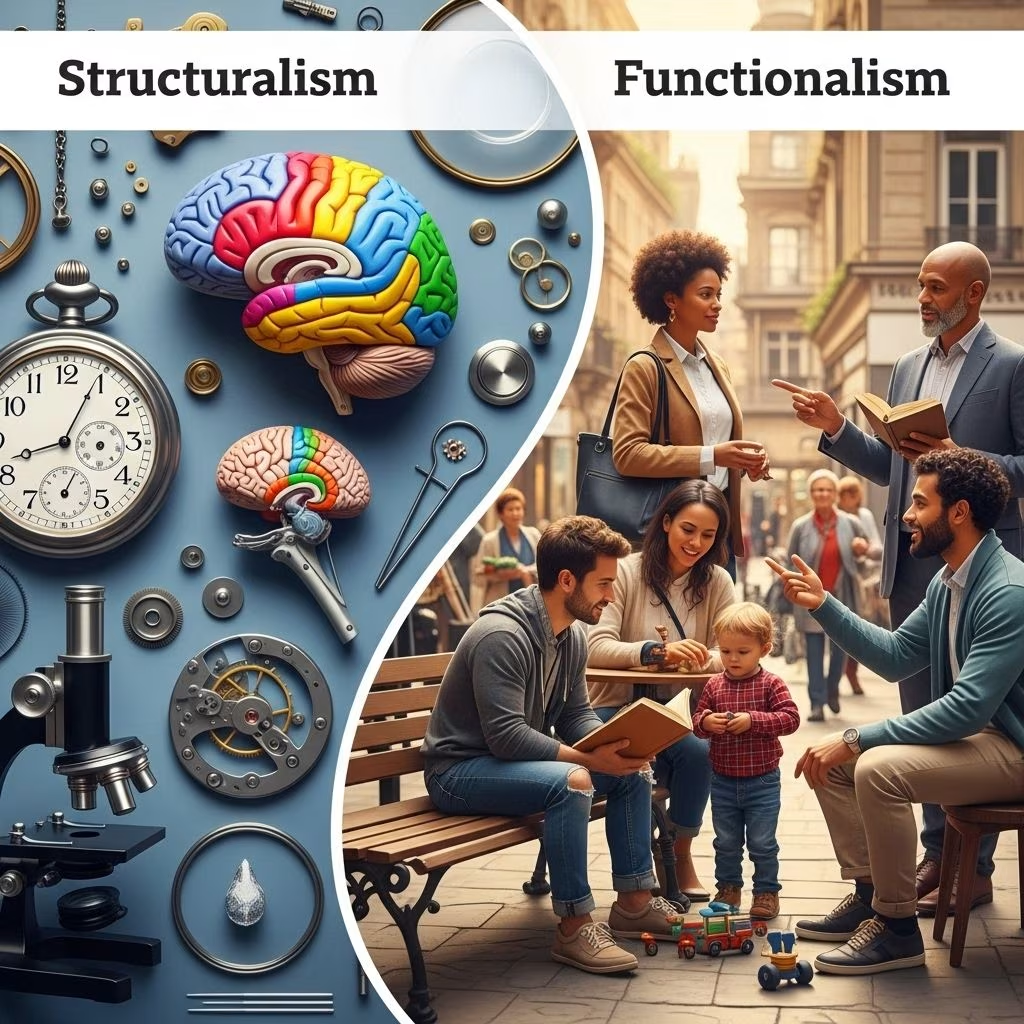
Structuralism and functionalism were two of the most influential early perspectives in psychology. Emerging in the late 19th and early 20th centuries, these schools of thought formed the foundation for the scientific study of the mind and behavior. This article delves into their core principles, key proponents, methodologies, and enduring impact, highlighting why understanding their differences is crucial for grasping the development of psychology as a discipline.
Defining Structuralism
Structuralism is widely regarded as the first formal school of psychology. Developed by Wilhelm Wundt, often referred to as the “father of experimental psychology,” and his student Edward Titchener, structuralism sought to analyze the structure of the mind. This meant dissecting conscious experiences into their basic elements to understand how these components combine to produce the whole of mental life.
- Goal: Identify the fundamental elements (such as sensations, images, and feelings) that make up conscious experience.
- Method: Relied heavily on introspection—the systematic self-examination and reporting of one’s conscious thoughts and sensations.
Edward Titchener extended Wundt’s work, bringing structuralism to the United States and formalizing it further. He argued that just as molecules can be broken down into atoms, conscious experience could be dissected into mental atoms or elements.
Key Features of Structuralism
- Elemental Focus: Sought to catalog and understand sensations and components of consciousness.
- Introspection: Participants trained to carefully and objectively analyze their own mental processes.
- Reductionism: Broke complex experiences into the simplest definable components.
Defining Functionalism
Functionalism developed in response to structuralism. It arose primarily from the work of American psychologists, most notably William James and John Dewey, and was deeply influenced by Charles Darwin’s theory of evolution. Instead of asking what mental processes are, functionalists asked what they do: how do mental processes help us adapt and function in our environment?
- Goal: Understand the purpose and adaptive functions of mental processes and behavior.
- Method: Employed a diverse set of research methodologies—including direct observation, experimentation, and studying a wide array of subjects (children, animals, individuals with mental disturbances).
Functionalists were interested in the practical applications of psychology, addressing real-world problems in education, mental health, and industry. They considered consciousness a continuous flow rather than a set of discrete elements—a concept William James termed the stream of consciousness.
Key Features of Functionalism
- Purpose-Focused: Explored the functions of mental activities in adapting to the environment.
- Methodological Diversity: Accepted observations, mental testing, and comparative methods in addition to introspection.
- Broader Scope: Studied individual differences and included children and animals as subjects.
Historical Background and Emergence
The Birth of Psychology as a Science
The late 19th century marked the official emergence of psychology as a distinct scientific discipline. Wilhelm Wundt established the first psychology laboratory in Leipzig, Germany, in 1879, an event that signaled the separation of psychology from philosophy and physiology. Wundt’s work inspired a wave of research dedicated to understanding the inner workings of the mind using experimental methods.
Roots and Influences
- Structuralism: Grounded in philosophical analysis and methods borrowed from the physical sciences, emphasizing internal mental processes.
- Functionalism: Shaped by evolutionary biology, ideas about adaptation, and a uniquely American emphasis on practicality and individuality.
Comparing Structuralism and Functionalism
| Aspect | Structuralism | Functionalism |
|---|---|---|
| Definition | Analyzes conscious experience into basic elements or structures. | Focuses on mental processes’ purpose in helping individuals adapt. |
| Methodology | Introspection, controlled laboratory experiments. | Observation, experiments, tests, diverse populations. |
| Focus | Sensations, images, feelings—the parts of consciousness. | How consciousness functions to solve real-life problems. |
| Key Figures | Wilhelm Wundt, Edward Titchener | William James, John Dewey, G. Stanley Hall |
| Scientific Basis | Rooted in reductionism and experimental introspection. | Tied to evolutionary theory and application to behavior. |
| Criticisms | Seen as too subjective, focused on unobservable processes. | Accused of lacking systematic structure and testability. |
| Legacy | Laid foundation for experimental and cognitive psychology. | Influenced applied and behavioral psychology, education. |
Pioneers of Structuralism
- Wilhelm Wundt: Established the first psychology laboratory, emphasized controlled introspection and laboratory methods.
- Edward B. Titchener: Popularized structuralism in the U.S., stressed separating the objective elements of experience from interpretation.
Pioneers of Functionalism
- William James: Authored “The Principles of Psychology,” introduced the concept of the stream of consciousness, and advocated studying the purposes of mental processes.
- John Dewey: Emphasized social and educational applications; influential in child and educational psychology.
- G. Stanley Hall: Promoted psychological research in children and adolescence, founded the first American psychology laboratory.
Methods and Approaches
Structuralist Methods
- Introspection: Carefully trained observers report conscious experiences in response to stimuli. Participants describe sensations, images, and feelings as they occur.
- Controlled Laboratory Settings: Ensured experimental rigor, though at the cost of ecological validity.
Functionalist Methods
- Direct Observation: Studied behavior and mental processes in naturalistic environments.
- Experiments: Explored memory, learning, and adaptation using diverse participants, including animals and people of different ages and mental conditions.
- Mental Testing: Developed early forms of standardized mental tests to measure abilities and individual differences.
Major Criticisms
Structuralism
- Reliance on introspection was considered too subjective; different participants reported different experiences for the same stimuli.
- Focusing exclusively on internal mental states meant neglecting observable behavior and environmental influences.
Functionalism
- Lacked a clearly defined and systematic methodology, making it difficult to test theories rigorously.
- Criticized for being too broad and eclectic, sometimes blurring the boundaries of psychological study.
Enduring Influence and Legacy
- Structuralism’s emphasis on experimental methods and the analysis of consciousness influenced the later development of cognitive psychology and experimental design.
- Functionalism’s focus on practical applications paved the way for applied psychology, educational psychology, and ultimately set the stage for the emergence of behaviorism and the study of individual differences.
- Modern psychology incorporates aspects of both approaches: cognitive psychology examines mental processes (an intellectual descendant of structuralism), while applied fields and behavioral analysis trace their roots to functionalism.
Structuralism and Functionalism in Contemporary Psychology
While both schools as originally conceived have faded in prominence, their insights remain deeply embedded in psychology’s foundations. Current approaches often combine an interest in mental processes with an appreciation for environmental and practical functions, tailored to various subfields.
- Cognitive psychology: Investigates mental structures and processes, reminiscent of structuralists’ interests but using objective, empirical methods.
- Applied psychology: Builds on functionalist ideas by addressing how psychology can solve real-world problems.
- Developmental, educational, and behavioral psychology: Continue the functionalists’ tradition of studying adaptation, learning, and variation among individuals.
Frequently Asked Questions (FAQs)
What is the main difference between structuralism and functionalism?
Structuralism examines the structure of the mind by analyzing its components through introspection, while functionalism explores the functions of mental processes—how they help individuals adapt and thrive in their environments.
Who were the key figures behind each school of thought?
Structuralism was primarily championed by Wilhelm Wundt and Edward Titchener. Functionalism was led by William James, John Dewey, and G. Stanley Hall.
Why did structuralism decline as a major perspective?
Structuralism declined due to its over-reliance on introspection, which was considered unreliable and too subjective, and its inability to address complex mental processes and behaviors observable in real life.
How did functionalism influence later psychology?
Functionalism expanded the scope of psychological study, inspired the development of applied psychology and behaviorism, and highlighted the importance of understanding mental processes in real-world contexts.
Are there modern schools of thought that reflect structuralist or functionalist ideas?
Yes, cognitive psychology reflects structuralism’s interest in mental processes, while applied, behavioral, and educational psychology incorporate functionalist principles by studying how mental processes serve practical, adaptive functions.
Summary Table: Key Distinctions
| Structuralism | Functionalism | |
|---|---|---|
| Main Focus | Basic elements of consciousness | Purpose and utility of mental processes |
| Primary Methods | Introspection, laboratory experiments | Observation, experimentation, wider range of subjects |
| Applications | Theoretical understanding of the mind’s structure | Solving practical problems, real-life applications |
| Lasting Impact | Influenced cognitive psychology and research methodology | Led to applied psychology, behaviorism, and educational psychology |
Conclusion
The historical rivalry between structuralism and functionalism played a pivotal role in shaping modern psychology. Each tradition offered unique insights—structuralism with its rigorous scientific approach to the contents of consciousness, and functionalism with its dynamic emphasis on practical function and adaptation. Though both were ultimately superseded by newer schools of thought, their contributions endure, laying the intellectual groundwork for today’s diverse and vibrant psychological science.
References
- https://helpfulprofessor.com/structuralism-vs-functionalism/
- https://www.ebsco.com/research-starters/psychology/structuralism-and-functionalism
- https://www.youtube.com/watch?v=EWlETRHAYw8
- https://www.youtube.com/watch?v=5J4ndwX8MPw
- https://courses.lumenlearning.com/waymaker-psychology/chapter/reading-structuralism-and-functionalism/
- https://pressbooks.online.ucf.edu/lumenpsychology/chapter/reading-structuralism-and-functionalism/


