


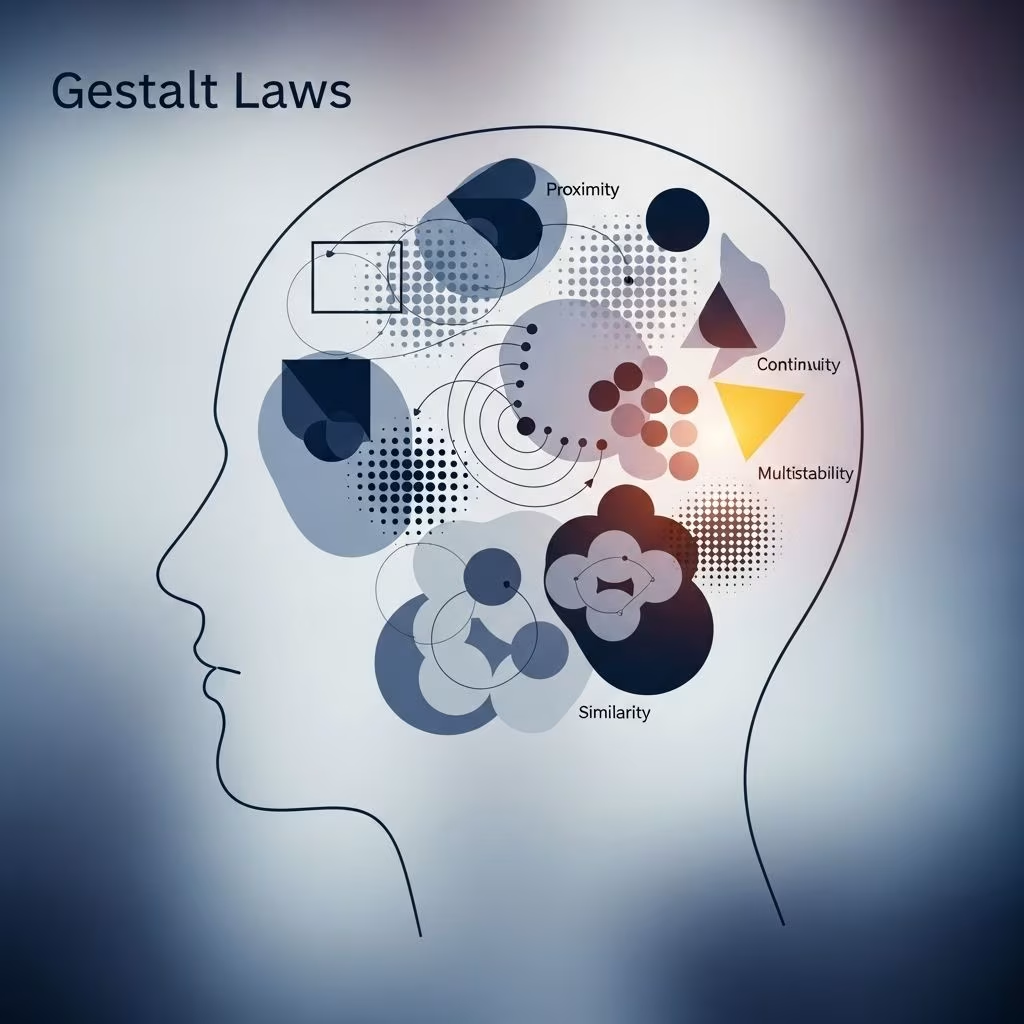
Gestalt Laws of Perceptual Organization
The Gestalt laws of perceptual organization describe the processes by which humans naturally group visual elements into unified wholes, enabling us to make sense of complex, often ambiguous, sensory information. Developed in the early 20th century by German psychologists such as Max Wertheimer, Wolfgang Köhler, and Kurt Koffka, Gestalt theory revolutionized our understanding of perception by asserting that the whole of experience is more than the sum of its parts. Instead of passively recording raw sensory input, the mind actively organizes and interprets what we see, hear, and feel, following predictable principles that govern how we recognize patterns, group objects, and identify meaningful forms in our environment.
Key Concepts in Gestalt Psychology
- Whole vs. Parts: The core idea of Gestalt psychology is that people perceive entire structures, forms, or objects (the whole), not just individual stimulus components (the parts).
- Innate Organization: The Gestalt principles are believed to reflect innate tendencies to seek order, simplicity, and meaning when interpreting sensory input.
- Mental Shortcuts: These laws act as perceptual shortcuts or heuristics, allowing for swift interpretation—but occasionally leading to illusions or misperceptions.
Why Gestalt Laws Matter
Understanding the Gestalt laws of organization is vital in many areas including psychology, education, art, design, and user experience (UX). They help explain not only how we make sense of visual information but also why certain presentations are easier to understand, remember, or use. For example, designers use these principles to create intuitive websites, artists invoke them to craft compelling compositions, and educators apply them to facilitate clear, organized instruction.
Core Gestalt Principles
Over the decades, Gestalt psychologists identified several core principles—also called “laws”—that describe how our brains organize sensory input. The most widely recognized of these laws include:
- Law of Proximity
- Law of Similarity
- Law of Continuity
- Law of Closure
- Figure-Ground Principle
- Law of Prägnanz (Simplicity)
- Other Gestalt Principles
Law of Proximity
The law of proximity asserts that objects or shapes that are close to one another appear to form groups, even if their other attributes (like shape, color, or size) differ. Proximity helps us perceive clusters or sets, dramatically influencing interpretation. For example, in text, letters close together are read as words, while spacing breaks up meaning (liket his versus like this).
- We group items arranged closely in space as being related.
- Designers use proximity to organize menus, forms, or content blocks.
- In everyday life, a group of people standing close together is perceived as a cohesive group.
Law of Similarity
The law of similarity states that elements similar in appearance are perceived as part of the same group. Similarity can be based on color, shape, size, texture, orientation, or any other visual attribute.
- We tend to group together people wearing the same uniform, or dots of the same color within a pattern.
- Graphic designers apply this law using consistent fonts or icons for buttons with similar functions.
- This principle facilitates rapid recognition and categorization, enabling effective information processing.
Law of Continuity (Good Continuation)
The law of continuity posits that we perceive lines and patterns as continuing along a smooth path, rather than abruptly changing direction. This principle favors seamless flows and avoids jarring breaks.
- We follow straight or gently curving lines, filling in gaps to perceive continuous figures.
- Subway maps and diagrams often rely on continuity for visual clarity.
- Artists use line continuity to lead the viewer’s eye through a composition.
Law of Closure
The law of closure is the tendency to perceive incomplete figures as complete. Our brains fill in missing information to create whole objects from partial data.
- An interrupted circle still appears as a circle; we mentally “close” gaps.
- Logos like the WWF panda or IBM make use of closure for memorable designs.
- This principle reflects the mind’s drive for completeness and simplicity.
Figure-Ground Principle
The figure-ground principle describes how we separate important elements (figures) from the background (ground). This distinction is essential for recognizing objects in cluttered or ambiguous scenes.
- We can identify letters against a contrasting page, or spot a friend in a crowd.
- Optical illusions often play with figure-ground ambiguities (e.g., the Rubin vase, which can be seen as a vase or two faces).
- Good interface design ensures crucial content “stands out” from the background.
Law of Prägnanz (Simplicity or Good Figure)
The law of Prägnanz (from German, meaning “pithiness”)—also called the law of simplicity or good figure—states that people will perceive and interpret ambiguous or complex images as the simplest form(s) possible.
- Faced with
References
- https://jackwestin.com/resources/mcat-content/perception/gestalt-principles
- https://courses.lumenlearning.com/waymaker-psychology/chapter/gestalt-principles-of-perception/
- https://www.simplypsychology.org/what-is-gestalt-psychology.html
- https://en.wikipedia.org/wiki/Principles_of_grouping
- https://dovetail.com/ux/gestalt-principles/
- https://www.youtube.com/watch?v=lqque_JJRMo
- https://www.khanacademy.org/test-prep/mcat/processing-the-environment/sensory-perception/v/gestalt-principles
- https://ecampusontario.pressbooks.pub/sensoryaspectsofdesign/chapter/2-4-gestalt-principles-of-perceptual-organization/


