


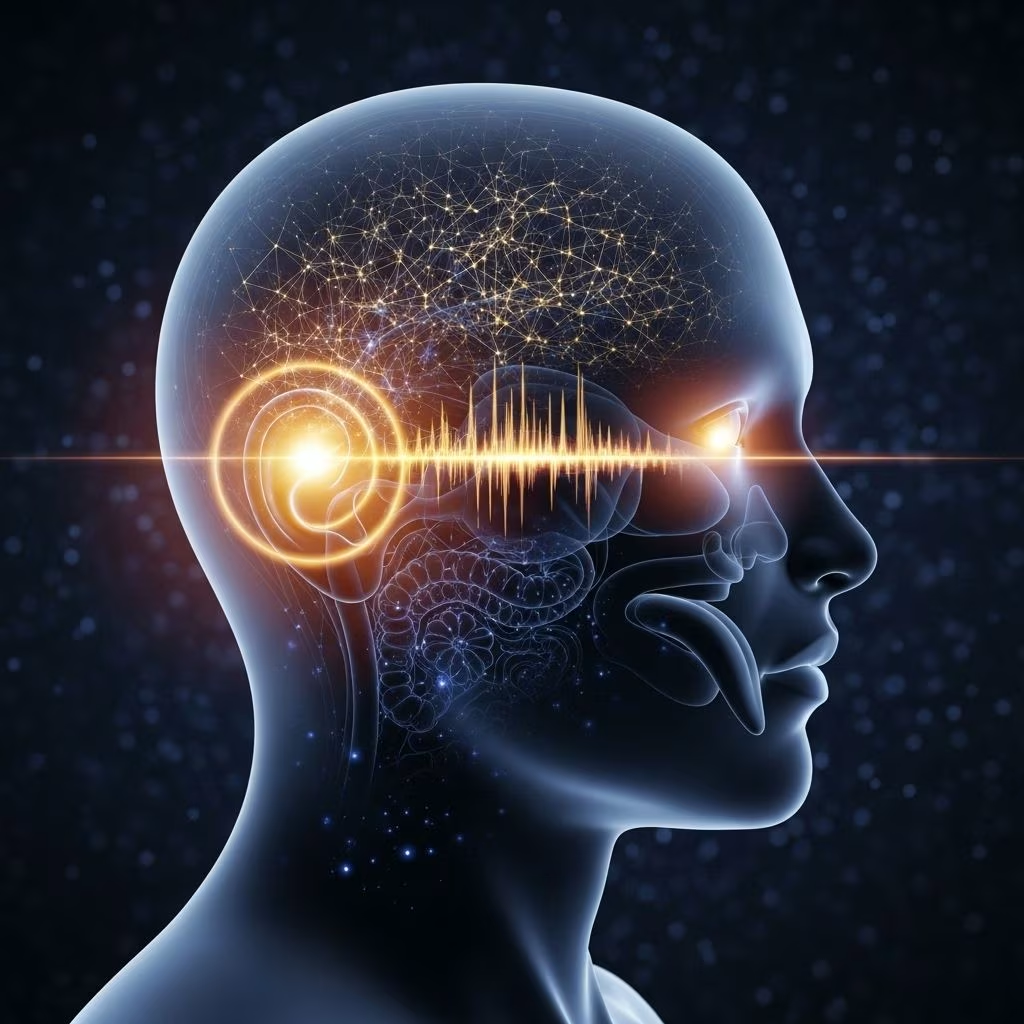
What Is the Absolute Threshold?
The absolute threshold is the minimum intensity of a stimulus that an organism can detect at least 50% of the time. This concept plays a central role in psychology and sensory sciences by helping researchers define the lower bounds of sensation—where a stimulus transitions from being undetectable to just barely noticeable. Measuring the absolute threshold allows scientists to quantify sensory systems’ sensitivity and highlight how individuals perceive the world around them.
Key Characteristics
- Minimum Intensity: It represents the weakest stimulus that is still detectable half the time.
- Not a fixed value: The absolute threshold can fluctuate with various factors like attention, fatigue, age, and environmental conditions.
- Sensation Limit: It sets the point where perception begins, differentiating undetectable from detectable stimuli.
For example, the faintest sound someone hears in a quiet room marks their absolute threshold for hearing, while the weakest light they can see in darkness denotes their absolute threshold for vision.
Historical Foundations: Gustav Fechner and the Weber-Fechner Law
The concept of the absolute threshold traces back to the 19th-century German psychologist Gustav Fechner. Fechner, building on Weber’s earlier work, developed a theory known as the Weber-Fechner Law, which describes how the perception of a stimulus is related to its intensity.
- The Weber-Fechner Law posits that stimulus perception increases proportionally to stimulus intensity, meaning people require an exponential increase in stimulus energy to notice a difference.
- The point at which stimuli become just noticeable is what Fechner termed as the absolute threshold.
- Fechner also developed the concept of the differential threshold or the minimum change in a stimulus required to be perceived as different.
This pioneering research provided the basis for psychophysics—studying the relationship between physical stimuli and mental processes.
Absolute Threshold Across the Five Senses
An individual’s absolute threshold varies across the five primary senses: vision, hearing, touch, smell, and taste. Understanding the thresholds for each sense highlights the extraordinary sensitivity of our sensory systems and the factors that influence them.
| Sense | Absolute Threshold Example | Notable Details |
|---|---|---|
| Vision | Detecting a candle flame 30 miles away on a dark, clear night. | Hecht, Shlaer, and Pirenne’s 1942 experiment illuminated the minimum light intensity required for detection. |
| Hearing | Perceiving tick of a watch 20 feet away in a quiet room; the faintest noise at 20–30 decibels. | Children generally have lower thresholds than adults, detecting higher frequencies. |
| Smell | Noticing a single drop of perfume in a six-room apartment. | The smallest concentration of odor molecules detectable. |
| Touch | Feeling a bee’s wing drop onto your cheek from a centimeter away. | Minimum pressure needed to detect physical contact. |
| Taste | Tasting one teaspoon of sugar dissolved in two gallons of water. | Lowest concentration of a substance needed for taste sensation. |
These classic examples underscore the extraordinary sensitivity of human sensory systems and provide standardized references for psychological studies.
Factors That Affect Absolute Threshold
The absolute threshold is not universally consistent; it varies from person to person and can change over time. Several factors interact to influence where this threshold lies for an individual.
- Age: Sensory thresholds often increase with age due to gradual declines in sensory abilities, especially in hearing and vision.
- Health: Illness, neurological conditions, or sensory impairments can raise the threshold, decreasing sensitivity.
- Fatigue: Tiredness and lack of attention can affect one’s ability to perceive faint stimuli.
- Expectations & Motivation: If someone expects or is motivated to detect a stimulus, their threshold may lower.
- Environmental Conditions: Background noise, lighting, and distractions can mask stimuli, raising the threshold.
- Acclimation/Adaptation: Prolonged exposure to a stimulus, such as bright light or loud sound, can lead to sensory adaptation, temporarily raising the threshold.
For instance, someone working in a noisy factory may develop a higher threshold for soft sounds, requiring louder noises to perceive them.
Absolute Threshold vs. Difference Threshold
To fully understand the absolute threshold, it helps to compare it to the related concept of the difference threshold (also called the just noticeable difference, or JND).
| Concept | Definition | Example |
|---|---|---|
| Absolute Threshold | Minimum intensity of stimulus detectable 50% of the time | Hearing a watch tick in a quiet room, detecting a faint odor |
| Difference Threshold (JND) | Minimum change in intensity required to notice a difference | Noticing the difference when the volume of music increases very slightly |
While the absolute threshold indicates the lowest level of detectable stimulus, the difference threshold identifies the smallest difference between two stimuli that can be distinguished. Measuring both enables scientists to comprehensively understand sensory limits.
How Is the Absolute Threshold Measured?
Scientists measure absolute thresholds through careful experimental procedures, ensuring statistical reliability and reproducibility:
- Repeated Trials: Subjects are exposed to a stimulus at varying intensities over multiple trials, noting whether they perceive the stimulus.
- Probability Criterion: The threshold is defined as the intensity detected at least 50% of the time, accounting for variability in perception.
- Control of Variables: Researchers minimize external distractions and set consistent environmental conditions (lighting, noise, etc.).
- Calibration: Equipment is regularly calibrated to ensure accuracy in stimulus presentation.
These protocols allow for the quantification of sensory sensitivity and comparison between individuals or groups. For example, hearing tests often use pure tones at different volumes to identify the faintest audible sound for each participant.
Significance in Psychology & Real-World Applications
Understanding the absolute threshold is crucial across psychology and numerous practical fields:
- Sensory Testing & Diagnosis: Used for detecting sensory impairments and designing supportive technologies (e.g., hearing aids).
- Product Design: Informing the intensity of signals, alarms, and alerts to ensure they are perceivable to users.
- Advertising & Marketing: Crafting advertisements that leverage sensory thresholds for maximal visibility or audibility.
- Sensory Research: Investigating individual differences in perception, including effects of drugs, environment, and medical conditions.
- Treatments for Sensory Disorders: The threshold concept guides interventions for conditions like presbycusis (age-related hearing loss) or anosmia (loss of smell).
Ultimately, accurate knowledge of sensory thresholds helps tailor environments, communications, devices, and therapies to human abilities.
Frequently Asked Questions (FAQs)
Q: Why is the absolute threshold not defined as detecting a stimulus 100% of the time?
A: Sensory perception is inherently variable and influenced by internal and external distractions. Defining the absolute threshold at 50% detection rates accounts for this variability and provides a more reliable statistical measure.
Q: Can the absolute threshold change over time?
A: Yes. Factors like aging, illness, repeated exposure, and lifestyle can increase or decrease sensory sensitivity, resulting in a higher or lower threshold.
Q: How do researchers measure absolute thresholds?
A: Through repeated presentations of a stimulus at varying intensities, noting the minimum detected half the time. Strict controls reduce environmental and individual variability in results.
Q: What is the difference between absolute and difference thresholds?
A: The absolute threshold marks the minimum detectable stimulus, while the difference threshold (JND) marks the smallest change needed to perceive a difference between two stimuli.
Q: Why are absolute threshold values important?
A: They help us understand the limits of human sensation, guide design for devices and environments, and inform diagnosis and treatment of sensory disorders.
Summary Table: Absolute Threshold At a Glance
| Sense | Threshold Example | Factors Influencing |
|---|---|---|
| Vision | Detecting a candle flame 30 miles away | Lighting, age, eye health |
| Hearing | Tick of a watch at 20 feet | Noise, age, auditory health |
| Smell | Single drop of perfume in a large area | Environmental conditions, olfactory health |
| Touch | Bee’s wing from 1cm | Fatigue, skin sensitivity |
| Taste | Sugar in two gallons of water | Health, adaptation |
Conclusion
The absolute threshold is a foundational concept in psychology and sensory sciences, delineating the starting point of sensation. Understanding what we can faintly see, hear, touch, taste, or smell empowers researchers and practitioners to assess, compare, and support human differences in perception. Knowledge of the absolute threshold continues to inform scientific studies, technological design, medicine, and daily experiences, underscoring the nuances of how we interact with our sensory world.
References
- https://www.youtube.com/watch?v=avHq_u6xebI
- https://helpfulprofessor.com/absolute-threshold/
- https://study.com/academy/lesson/absolute-threshold-examples-definition-quiz.html
- https://www.albert.io/blog/absolute-vs-difference-threshold-ap-psychology-crash-course-review/
- https://www.khanacademy.org/test-prep/mcat/processing-the-environment/sensory-perception/v/absolute-threshold-of-sensation
- https://fiveable.me/key-terms/introduction-brain-behavior/absolute-threshold


