


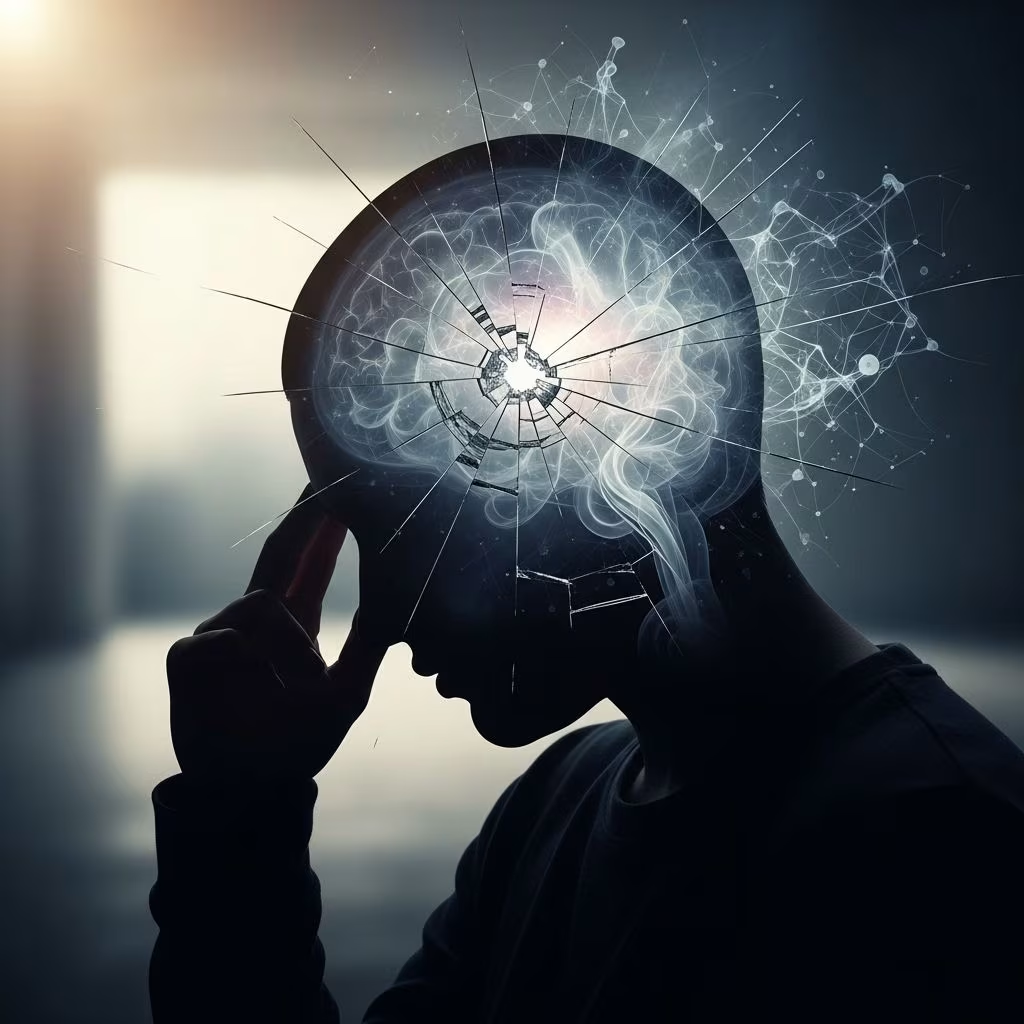
Delusions—fixed, false beliefs that persist in spite of clear evidence to the contrary—are among the most striking and misunderstood symptoms in the realm of mental health. Crucial for diagnosing certain psychiatric conditions, delusions challenge both affected individuals and clinicians to discern reality from powerful conviction. This guide explores the nature of delusions, their types, symptoms, causes, diagnostic criteria, and their significance within mental health disorders.
What Is a Delusion?
A delusion is a rigidly held, false belief that stands in clear conflict with objective reality. Even when presented with undeniable, contrary evidence, a person experiencing a delusion cannot be persuaded to see the situation differently. This conviction is typically not shared by others within the person’s culture, community, or subculture, distinguishing delusions from collectively held beliefs or faiths.
- Delusions are not simply mistaken ideas—they persist through logical argument and overwhelming contradicting proof.
- They often result from misinterpretation of events, sometimes reinforced by paranoia or fear.
- Delusions may present in various psychiatric and medical disorders, most notably within psychotic and certain mood disorders.
Core Characteristics of Delusions
Essential features of delusions include:
- Certainty: Delusions are held with absolute conviction.
- Incorrigibility: The belief is unchangeable by logic or contradictory evidence.
- Impossibility or Falsehood: The belief is clearly implausible, impossible, or demonstrably untrue to others.
- Cultural Distinction: The belief is not one ordinarily accepted by one’s cultural or subcultural group.
Unlike ordinary mistaken beliefs, delusions do not yield to evidence or reasoned debate. The conviction and emotional investment may be so intense that the person’s daily behavior is influenced or shaped by these beliefs.
Signs and Symptoms of Delusions
The main sign of a delusion is an unshakable belief in something demonstrably untrue, sometimes producing life-changing behavior. Additional features may include:
- Persistence: The person clings to the belief over time, despite mounting evidence against it.
- Preoccupation: The wrong belief may dominate thinking, conversations, or life decisions.
- Paranoia or Suspicion: Many delusions, especially persecutory types, involve distrust or fear of others.
- Emotional distress: Anxiety, anger, or agitation may occur if the delusion is challenged.
Importantly, except for their delusions, individuals may appear to function and reason normally in other areas of life. Hallucinations—perceptions without external stimuli—are not always present, but if they are, they typically relate to the delusional theme.
Types of Delusions
Delusions differ in content and theme. Mental health professionals recognize several distinct types, including:
- Persecutory Delusions: Belief that one is being plotted against, spied on, harassed, or harmed. For example, believing the neighbors are surveilling you, or the government is conspiring against you.
- Grandiose Delusions: Convictions of inflated worth, power, knowledge, identity, or special relation to a prominent person or deity. The person may believe they have exceptional talents or are destined for greatness.
- Erotomanic Delusions: Firm belief that someone, often of higher status or a stranger, is in love with the individual. Stalking behaviors sometimes result.
- Jealous Delusions: Unfounded accusations that a partner is unfaithful, based on flawed reasoning or imagined “evidence.”
- Somatic Delusions: False beliefs involving bodily functions or physical sensations, such as infestation by parasites or having a severe illness without medical basis.
- Bizarre Delusions: Completely implausible beliefs, such as aliens replacing all one’s organs or mind control by radio waves.
- Mixed Delusions: No single delusional theme predominates—multiple themes are present simultaneously.
- Referential Delusions: The false idea that events, objects, or people in the immediate environment are specifically referring to or communicating with the individual.
- Thought Broadcasting/Insertion: The belief that others can hear one’s thoughts, or that thoughts are being inserted into the mind by outside forces.
Table: Types of Delusions and Examples
| Type | Definition | Example |
|---|---|---|
| Persecutory | Belief of being targeted or mistreated | “My boss is poisoning my food.” |
| Grandiose | Belief in one’s exceptional abilities or identity | “I am the chosen savior of humanity.” |
| Erotomanic | False conviction someone loves the person | “The famous actor sends me secret love signals on TV.” |
| Jealous | Unfounded belief of partner’s infidelity | “My spouse is cheating based on how they answered the phone.” |
| Somatic | Belief relating to body or health | “I have worms crawling under my skin.” |
| Bizarre | Completely implausible, impossible belief | “Aliens replaced my brain at night.” |
Causes and Risk Factors
The exact cause of delusions is not fully understood, but various biological, psychological, and environmental factors play roles. Often, multiple factors interact to trigger or sustain delusional thinking.
- Genetic predisposition: Having close family members with psychotic disorders increases risk.
- Imbalance of brain chemicals: Disruptions in neurotransmitters (e.g., dopamine) may affect perception and interpretation of reality.
- Stress or trauma: Significant life stress or trauma can precipitate or worsen delusions in vulnerable individuals.
- Medical conditions: Delusions may occur in neurological illnesses (e.g., Parkinson’s, dementia), intoxication, or withdrawal from substances.
- Isolation and sensory deprivation: Lack of social contact or stimulation can promote false beliefs.
Delusions are not always rooted in psychotic disorders—they can result from medical conditions, substance use, or other factors impacting brain function.
How Are Delusions Diagnosed?
The diagnosis of delusions involves a thorough clinical assessment by mental health professionals, considering symptom history, impact, and cultural context. Key diagnostic Steps include:
- Clinical interview: Assessment of beliefs, reasoning, thought patterns, and the impact on daily functioning.
- Medical evaluation: Ruling out neurological, medical, or substance-induced causes.
- Psychiatric history: Identifying any underlying psychiatric conditions (e.g., schizophrenia, bipolar disorder, depression).
- Cultural assessment: Distinguishing between delusions and culturally accepted beliefs or practices.
According to the Diagnostic and Statistical Manual of Mental Disorders (DSM-5), a delusion is defined as a false belief, based on incorrect inference about external reality, that is firmly maintained despite evidence to the contrary, and is not ordinarily accepted by others of the same culture or subculture.
Delusional Disorder
While delusions can occur as a symptom within various mental health conditions, delusional disorder is a specific diagnosis where delusions are the predominant feature for at least one month. In delusional disorder:
- The person functions relatively normally apart from direct delusional impact.
- Delusions do not typically involve prominent hallucinations or mood disturbances.
- Non-bizarre delusions are most common—those that, while untrue, could conceivably occur in real life.
Impairment, if present, usually stems directly from the consequences of acting on the delusional belief rather than from a broader psychotic disintegration.
Delusions vs. Hallucinations
Although often mentioned together, delusions and hallucinations are distinct psychiatric phenomena. Their differences are summarized below:
| Delusion | Hallucination |
|---|---|
| A false, fixed belief maintained despite counter-evidence. | A false perception in any sense (e.g., seeing, hearing), experienced without real external stimulus. |
| Thought content disturbance. | Sensory perception disturbance. |
| “The FBI is monitoring all my phone calls.” | “I hear voices telling me to hide.” |
Delusions in Psychiatric Disorders
Delusions are central to several mental health conditions:
- Schizophrenia: Delusions are a primary criterion, often accompanied by hallucinations and disorganized thinking.
- Delusional Disorder: Persistent delusions without other major psychotic symptoms.
- Bipolar Disorder: May occur during manic or depressive episodes, especially in severe cases.
- Major Depressive Disorder with Psychotic Features: Delusions may align with mood-congruent themes, such as guilt or persecution.
- Dementia & Neurological Disorders: Delusions can arise as cognitive functions decline.
Treatment and Management
Effective treatment of delusions depends on the underlying cause. Common interventions include:
- Medications: Antipsychotic drugs are often prescribed for delusional disorder and psychotic symptoms.
- Psychotherapy: Cognitive-behavioral therapy (CBT) may help patients recognize misinterpretations and reduce conviction in the delusion.
- Addressing underlying medical issues: Identifying and treating neurological or metabolic causes is critical.
- Supportive measures: Building social support systems and reducing isolation.
Treatment can be challenging, as individuals with delusions often lack insight or may refuse help. Gentle, non-confrontational engagement is typically most effective.
Frequently Asked Questions (FAQs)
Q: Can delusions go away on their own?
A: In some cases, delusions may diminish or resolve, particularly if related to temporary stress, medical conditions, or substance use. However, persistent delusions usually require professional intervention.
Q: What’s the difference between a delusion and a misconception?
A: Misconceptions are mistaken beliefs typically based on misunderstanding or lack of information and can be corrected with evidence. Delusions persist rigidly even when overwhelming counter-evidence is presented.
Q: Is everyone with a delusion mentally ill?
A: Not all delusions are indicative of a primary psychiatric disorder; they can emerge from medical or neurological conditions, extreme stress, or substance use. However, persistent, culture-incongruent delusions generally require mental health evaluation.
Q: Are delusions always bizarre?
A: No. Many delusions involve non-bizarre (possibly realistic) yet unfounded beliefs, such as unfaithfulness or being monitored, though some can be highly outlandish or impossible.
Q: Can cultural or religious beliefs be considered delusions?
A: Culturally sanctioned beliefs, including deeply held religious or spiritual convictions, are not considered delusions—even if they are not verifiable or seem implausible to outsiders.
Key Takeaways
- Delusion describes fixed, false beliefs impervious to logic or evidence, and distinct from cultural norms.
- They arise in various settings, most notably psychotic disorders, but also in medical, neurological, or substance-induced conditions.
- Diagnosis and treatment require careful distinction from culturally endorsed beliefs, medical causes, and analysis of overall functioning.
Early recognition and evidence-based management significantly improve outcomes for those affected by delusions.
References
- https://www.health.harvard.edu/a_to_z/delusional-disorder-a-to-z
- https://www.britannica.com/science/delusion
- https://www.scribd.com/document/514164885/definition-of-delusion-4580458
- https://pmc.ncbi.nlm.nih.gov/articles/PMC3016695/
- https://www.ncbi.nlm.nih.gov/books/NBK539855/
- https://my.clevelandclinic.org/health/diseases/9599-delusional-disorder
- https://en.wikipedia.org/wiki/Delusion


