


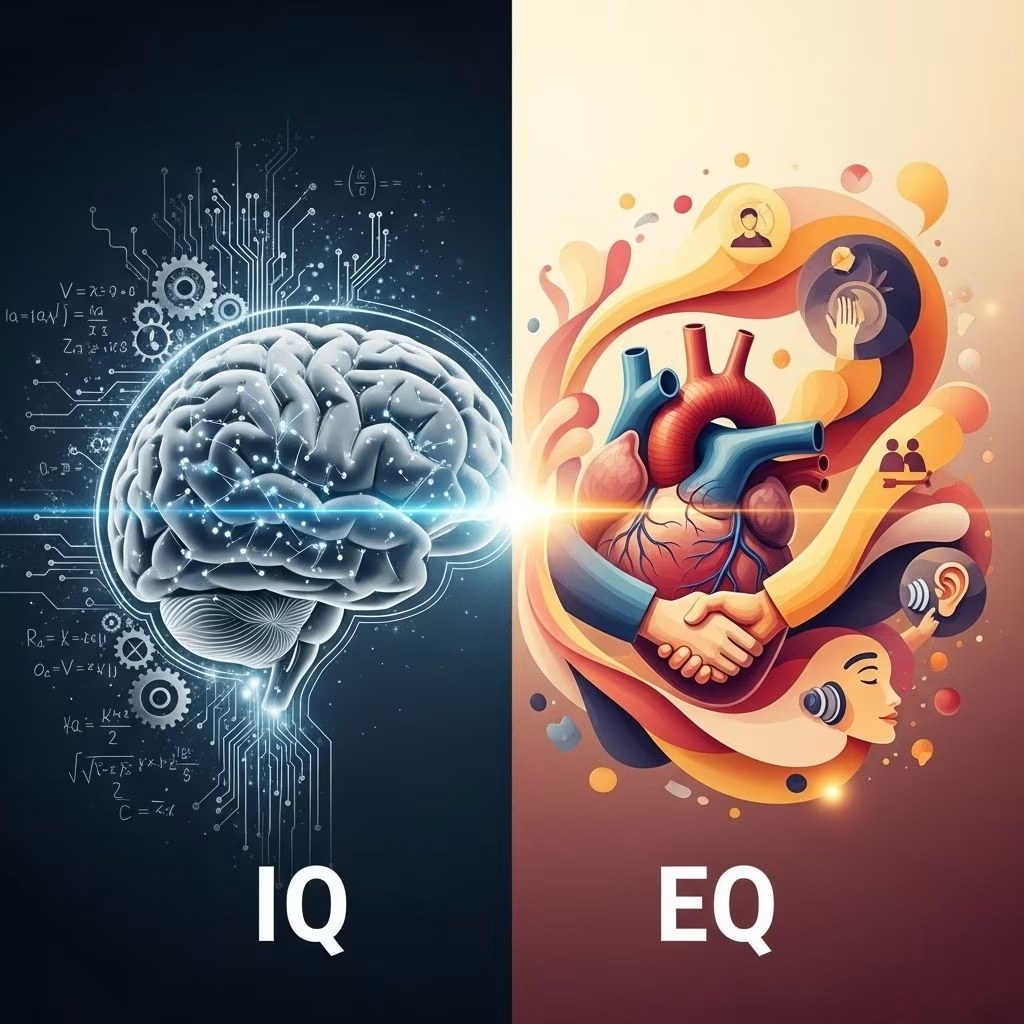
Success is a multifaceted concept. For over a century, intelligence quotient (IQ) has been viewed as a measure of intellectual prowess and the primary benchmark for achievement. Yet, as the complexities of modern life and work unfold, another measure has grown in significance: emotional intelligence (EQ). Which plays a more pivotal role in our personal, academic, and professional accomplishments?
Understanding IQ and EQ: Definitions and Differences
Before exploring which is more influential, it’s essential to define and distinguish IQ and EQ:
| Aspect | IQ (Intelligence Quotient) | EQ (Emotional Intelligence) |
|---|---|---|
| Definition | Measures cognitive ability, logical reasoning, problem-solving, and analytical thinking. | Measures emotional awareness, self-regulation, empathy, and interpersonal skills. |
| Main Focus | Intellectual capabilities | Emotional and social skills |
| Key Abilities | Working memory, analytical thinking, pattern recognition | Self-awareness, self-management, empathy, social skills |
| Assessment Method | Standardized cognitive tests | Self-reports, social observation, behavioral measures |
| Strengths | Problem-solving, academic achievement, comprehension | Relationship building, leadership, adaptability |
| Weaknesses | Lacks sensitivity to emotions, may struggle with team dynamics | May lack technical depth, difficult to quantify precisely |
Historical Emphasis: The Rise and Limits of IQ
The concept of IQ emerged in the early 20th century, designed to quantify cognitive skills such as memory, logic, and mathematical ability. For generations, high IQ scores were equated with academic success, giftedness, and professional potential. Schools and employers favored high-IQ performance in entrance and aptitude exams, shaping educational and hiring practices.
IQ, undeniably, is crucial; it supports:
- Critical thinking
- Analytical reasoning and problem-solving
- Adapting to complex or novel environments
- Mastering technical information in science, engineering, and technology
But as research progressed, evidence emerged that IQ alone could not predict happiness, leadership, or long-term career success. The ability to manage oneself and relate well to others began to reveal its equal—if not greater—importance.
Introducing EQ: Emotional Intelligence Explained
Emotional intelligence (EQ) is a relatively recent but highly influential concept. EQ includes the capacity to:
- Recognize one’s own emotions (self-awareness)
- Manage and regulate these emotions (self-management)
- Detect and empathize with the emotions of others (social awareness)
- Navigate complex social situations and build healthy relationships (relationship management)
Unlike IQ, which is largely stable and influenced by genetics, EQ can be cultivated through reflection, experience, and intentional learning. EQ enables people to communicate more effectively, resolve conflicts peacefully, handle stress, and inspire those around them.
IQ and EQ in the Workplace: Complementary, Not Competitive
The debate between IQ and EQ is particularly relevant in the workplace, where both sets of skills are tested daily. Let’s compare their impacts:
| Workplace Factor | IQ | EQ |
|---|---|---|
| Technical Competence | Enables analytical problem-solving and understanding complex data | Helps adapt knowledge to team and organizational needs |
| Leadership | Supports strategic thinking, long-term vision | Builds trust, motivates teams, ensures effective communication |
| Collaboration | Facilitates clear logical argumentation | Promotes empathy, resolves disputes, creates positive team dynamics |
| Adaptability | Quickly grasps new technical concepts | Adapts to change, manages stress, sustains morale |
| Conflict Resolution | Uses logic to evaluate problems | Empathizes, de-escalates, negotiates consensus |
While IQ is foundational for many technical and analytical professions, growing research and real-world experience show that EQ often distinguishes high performers, particularly in leadership, team-based roles, and customer-facing settings.
Real-World Applications: Where IQ and EQ Make a Difference
- Technical Fields (Science, Mathematics, Engineering):
- IQ dominates in tasks requiring fast information processing, deep analysis, and logical rigor.
- Yet, project success often depends on communication, adaptability, and collaboration, where EQ is key.
- Management, Teaching, Healthcare:
- High EQ enables leaders and practitioners to connect, motivate, and inspire others.
- Empathy and relationship management facilitate effective teaching, patient care, and teamwork.
- Sales and Customer Service:
- EQ enhances persuasion, listening, and customer loyalty.
- IQ supports product knowledge and technical troubleshooting.
In every field, blending both forms of intelligence leads to optimal results.
Why EQ Often Matters More
Numerous studies and workplace observations have shown that high EQ offers decisive benefits, especially when managing people or facing unpredictable situations. EQ allows individuals to:
- Defuse misunderstandings and handle interpersonal conflicts constructively
- Build trust and a shared sense of purpose among teams
- Respond with resilience to setbacks and organizational changes
- Foster open, inclusive cultures that retain talent
Consider the case of a brilliant manager unable to relate well to employees: teams may become disengaged, morale drops, and productivity falters—even when the manager’s strategic plans are technically sound. In contrast, leaders with high emotional intelligence inspire loyalty, drive performance, and create a culture of accountability and growth.
The Science of Intelligence: Can IQ or EQ Be Changed?
Traditionally, IQ was viewed as a relatively fixed trait, heavily influenced by genetics and early life development. Most people experience modest increases in IQ through education and stimulation; however, dramatic changes are rare in adulthood.
EQ, on the other hand, is highly adaptable. With deliberate effort—such as reflective practice, feedback, and social experiences—people of all ages can significantly enhance their emotional awareness, empathy, and regulation skills.
Both IQ and EQ are shaped by:
- Genetics
- Early upbringing
- Education and mentorship
- Life experience and continual learning
Yet, while you cannot radically raise your IQ in adulthood, you can transform your EQ with mindful practice.
Balancing Cognitive and Emotional Intelligence for Overall Success
Achieving balance between IQ and EQ is the optimal approach. Those who are both intellectually adept and emotionally perceptive navigate life’s complexities with greater ease and satisfaction. Here’s why both matter:
- IQ ensures you can analyze information, think critically, and solve technical challenges.
- EQ ensures you manage reactions, resolve interpersonal problems, and architect positive relationships.
Professionals who blend both:
- Innovate and adapt to change
- Lead teams through ambiguity
- Cultivate both expertise and social harmony
- Enjoy greater long-term personal satisfaction and career success
Developing Your EQ: Practical Strategies
Though many focus on boosting their IQ through education and technical training, enhancing EQ involves intentional self-development, including:
- Practicing self-reflection to recognize emotional triggers and patterns
- Developing active listening and empathy in conversations
- Seeking feedback from colleagues and friends to identify blind spots
- Cultivating stress management and mindfulness skills
- Engaging in collaborative problem-solving before asserting personal viewpoints
Regularly investing in emotional skills pays off across every area of life.
IQ and EQ: Myths and Misconceptions
- Myth: High IQ guarantees success.
Fact: Many with high IQ still struggle in teams or relationships. Success depends on a blend of cognitive and emotional skills. - Myth: EQ is innate and can’t be learned.
Fact: EQ can be significantly improved with practice and feedback. - Myth: One must choose between IQ and EQ.
Fact: Both can—and should—be developed for comprehensive success.
Summary Table: Comparing IQ and EQ
| Factor | IQ | EQ |
|---|---|---|
| What It Measures | Logic, reasoning, memory, technical knowledge | Emotional awareness, empathy, relationship skills |
| Main Domains | Academic, technical, problem-solving | Leadership, communication, teamwork |
| Real-World Impact | Grades, test performance, technical jobs | Conflict resolution, leadership, satisfaction |
| Flexibility | Slightly modifiable | Highly trainable |
| Developed By | Genetics, early learning | Experience, reflection, training |
FAQs About IQ and EQ
Which is more predictive of success: IQ or EQ?
Both are predictors of different types of success. IQ is important for academic and technical tasks, while EQ is more predictive of leadership, job satisfaction, and relationship quality.
Can EQ really be developed in adulthood?
Yes. Research shows with deliberate effort, people can boost self-awareness, empathy, and social skills at any age.
Are there jobs where IQ matters more than EQ?
Yes. Highly technical roles in science, technology, and mathematics may prioritize IQ. However, even in these fields, EQ improves teamwork and leadership outcomes.
Is there a trade-off between IQ and EQ?
No. IQ and EQ are independent—excelling in one does not mean you lack in the other. The most successful people, organizations, and leaders cultivate both.
How can I measure my EQ?
There are self-report questionnaires and professional assessments that measure aspects like self-awareness, emotional regulation, and empathy. Direct feedback and observation in social contexts are also valuable.
Key Takeaways
- IQ and EQ represent different but equally vital forms of intelligence.
- IQ underpins technical success; EQ fosters strong relationships and effective leadership.
- Neither is superior; the most accomplished individuals balance both cognitive and emotional abilities.
- EQ can be developed throughout life, dramatically enhancing one’s impact at work, in relationships, and beyond.
References
- https://lumenalta.com/insights/eq-vs-iq-which-matters-more-in-the-workplace
- https://www.betterup.com/blog/eq-vs-iq
- https://orilearning.com/cognitive-intelligence-vs-emotional-intelligence/
- https://www.vgm.com/communities/us-rehab/the-iq-vs-eq-debate-why-emotional-intelligence-trumps-intellectual-quotient-in-effective-leadership/
- https://www.simplypsychology.org/iq-vs-eq.html
- https://www.youtube.com/watch?v=fGbF95aGB7w


