Biochar: A Promising Tool for Global Carbon Drawdown
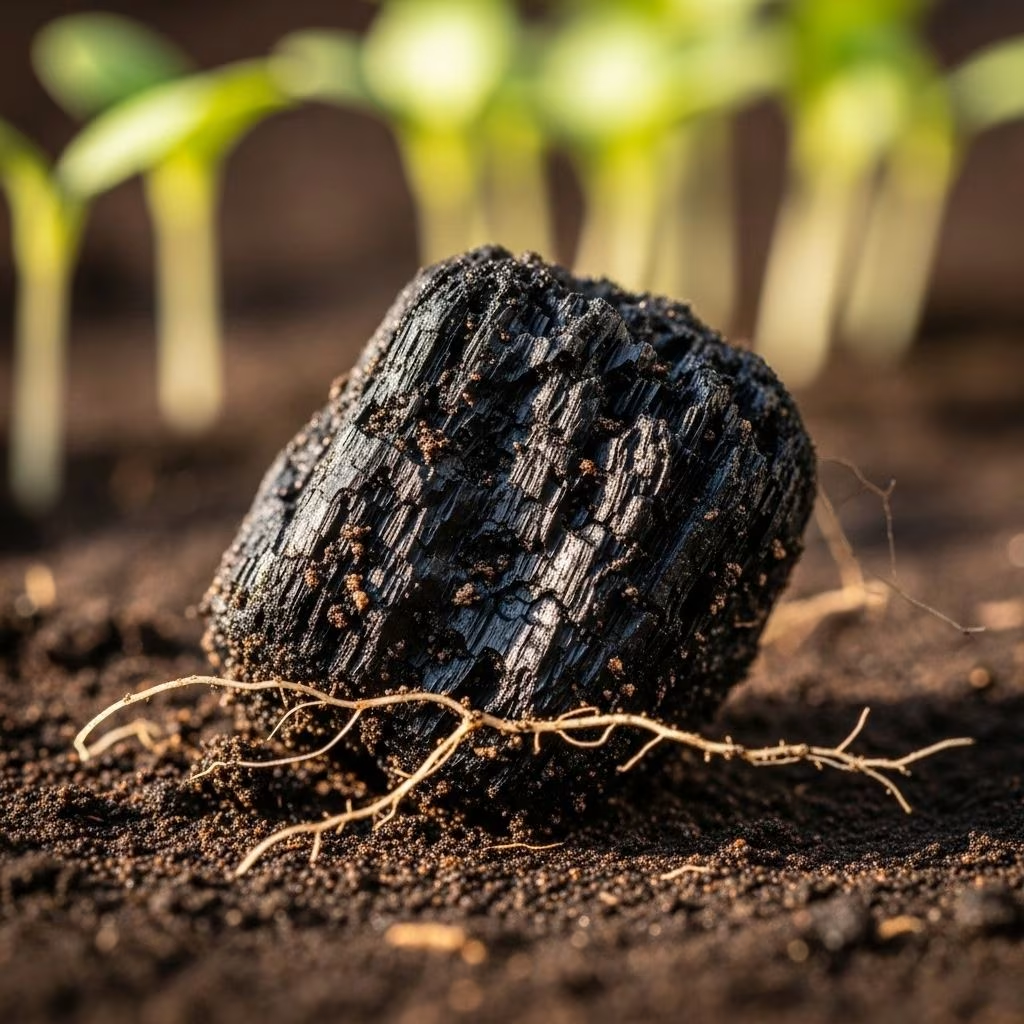
Biochar, a stable carbon-rich material produced from the thermal decomposition of organic biomass under limited oxygen (pyrolysis or gasification), has attracted significant scientific attention as a potential negative-emissions technology. Advocates suggest biochar could play a crucial role in stabilizing Earth’s climate by sequestering atmospheric carbon dioxide (CO2) in soils, improving soil fertility, mitigating wildfire risks, and supporting rural economies. Yet, despite its promise, the real-world efficacy and scalability of biochar require careful evaluation, as outlined in recent comprehensive studies and expert consensus.
Understanding Biochar and Its Climate Potential
To understand biochar’s role in global drawdown efforts, it is essential to examine both its technical carbon sequestration potential and the diverse factors influencing its effectiveness. Scientific models and literature have estimated that, with the sustainable conversion of 2.3 gigatonnes (Gt) of biomass carbon annually, biochar could enable the avoidance of approximately 6.6 Gt of CO2-equivalent emissions per year at full scale, with about half of this attributed to the carbon stored long-term in soils. Such annual drawdown could ultimately offset about a third of the 1,000 Gt of CO2 needed to be removed from Earth’s atmosphere to stabilize climate, according to the most ambitious scenarios.
- Maximum sustainable carbon drawdown: Approximately 3.3 Gt CO2 per year through biochar soil storage
- Long-term goal: Contribute about one-third of the necessary global CO2 removals over a century
- Financial cost: Tens of trillions of dollars over a hundred years, depending on technological scalability and fossil carbon emission reduction rates
The Scientific Surge in Biochar Research
The past twenty years have seen an exponential rise in peer-reviewed biochar studies. This growing literature has advanced understanding of biochar’s multifaceted impacts—including soil productivity, greenhouse gas mitigation, and ecosystem benefits. However, rapid development, highly variable feedstocks and production processes, and the wide range of environmental conditions have left considerable scientific gaps. Short-duration research funding cycles and a lack of coordinated, regionally focused long-term studies further compound these challenges, underscoring the need for robust, standardized research programs.
Major Factors Affecting Biochar Performance
- Biomass supply and sustainability: Availability and procurement of biomass for biochar production
- Feedstock diversity: Types of biomass used (wood, straw, manure)
- Production methods: Techniques such as slow pyrolysis, fast pyrolysis, and gasification
- Biochar properties: Resulting ash content, lignin, cellulose, and activation treatments
- Soil and cropping systems: Soil chemistry, plant communities, management practices
Biochar’s Impact on Ecosystems, Productivity, and Rural Economies
Researchers investigating biochar’s effects have identified several potential benefits for soils and ecosystems:
- Improved soil fertility: Biochar can enhance soil pH, water retention, and nutrient management, which may also support crop yields
- Resilience to environmental stresses: Addition of biochar may help soils adapt to drought, heavy rains, and pest outbreaks
- Wildfire mitigation: Integrating biochar production with land management can reduce fuel loads and wildfire risks, providing additional rural economic opportunities
- Support for rural communities: Encouraging biochar projects brings value-added markets to agricultural and forest byproducts
The Limits of Current Knowledge: Research Gaps
Despite these promising aspects, actual field performance of biochar varies widely due to differences in local environments, biochar types, and management strategies. The lack of long-term, cross-regional, standardized field trials impedes accurate prediction of biochar’s impacts, particularly in terms of soil carbon longevity, plant composition, native soil organic carbon stocks, and non-CO2 greenhouse gas emissions.
Key Knowledge Gaps:
- Longevity of biochar carbon in soil across varying climates and soil types
- Comprehensive life-cycle impacts including energy demands, emissions, and economic viability
- Region-specific effects on vegetation, soil chemistry, greenhouse gas fluxes, and crop quality
Proposed Roadmap: Coordinated, Integrated Biochar Research
To address these uncertainties, scientific experts recommend a global, long-term, multisite research initiative for biochar production and application:
- Field experiments: Around 20 coordinated field sites using standardized biochars and study protocols
- Phased research stages: Initiating studies in three stages, each informed by the data of the previous
- Comprehensive modeling: Data consolidated into pyrolysis chemistry, soil-biochar mechanistic, plant-response, life-cycle, and techno-economic models
Mechanistic vs. Systems-Oriented Research
The foundational approach splits research into two interconnected categories for robust measurement and assessment:
| Research Category | Main Focus | Methods |
|---|---|---|
| Mechanistic Research | Fundamental processes of biochar formation and soil performance | Controlled trials, standard biochar set, chemical & physical property assessment, cross-site data |
| Systems-Oriented Research | Pilot-scale production, site-specific applications, life-cycle and techno-economic analysis | Pilot facilities, local feedstocks, ecological measurement, systems performance modeling |
Standardization for Comparative Studies
Standardized sets of biochars, produced from diverse major feedstocks (wood, straw, manure) and using multiple production technologies, are essential for clear comparative research. Expanding this set by incorporating various reaction temperatures or post-production activation processes will strengthen insights into best-use scenarios.
- Minimum of nine standard biochars deployed across all sites
- Potential for further expansion with additional processing methods
Performance Assessment and Cross-Site Correlations
Mechanistic field studies will focus on revealing broad correlations among climate, soil type, water regimes, application technologies, management practices, and biochar chemical properties, alongside their effects on greenhouse gas exchange, plant growth, and soil quality.
Modeling and Data Integration
Consolidating experimental data into robust predictive models is a cornerstone for understanding pyrolysis chemistry, optimizing reactor design, and projecting plant and soil responses under diverse environmental scenarios. This integration ultimately clarifies the landscape-scale viability and economic feasibility of biochar interventions.
Challenges to Realizing Biochar’s Climate Promise
Despite biochar’s theoretical capacity as a major carbon sink, several obstacles remain:
- Scale and feasibility: Achieving the necessary volume of biomass sustainably and deploying biochar globally is a massive logistical and financial endeavor
- Economic viability: Tens of trillions of dollars are estimated as costs over the century, contingent on technology, market dynamics, and greenhouse gas emission reductions
- Knowledge gaps: Regional soil, climate variability, and long-term biochar stability require further standardized study
Potential Co-Benefits for Land Management and Rural Economies
Successful biochar implementation offers broader advantages beyond carbon sequestration:
- Enhanced soil health and crop productivity
- Resilience against drought and extreme weather events
- Reduction in wildfire risks through strategic forestry management
- Ecosystem restoration and support for economic viability in rural communities
Frequently Asked Questions (FAQs)
What is biochar, and how is it produced?
Biochar is a carbon-rich material made by heating organic biomass (such as wood, straw, or manure) in the absence or near-absence of oxygen (through pyrolysis or gasification processes). The result is a stable compound that can be incorporated into soils for long-term carbon sequestration.
How much carbon can biochar realistically remove from the atmosphere?
Estimates suggest that biochar could sustainably remove about 3.3 Gt CO2 annually at full global scale, ultimately accounting for about one-third of the required 1,000 Gt CO2 to achieve climate stabilization over a century.
What are the main benefits and co-benefits of biochar application?
Biochar enhances soil fertility and water retention, improves crop tolerance to drought, mitigates pest pressures, reduces wildfire risks when tied to forestry management, and can stimulate rural economic opportunities.
What are the biggest challenges facing biochar deployment?
Challenges include the sustainable sourcing and large-scale processing of biomass, regional variability in biochar effectiveness, high costs over the century, lack of long-term, standardized field studies, and uncertainty regarding carbon longevity in soils.
Is biochar a silver bullet for climate change?
No single technology will “solve” climate change. While biochar may play an important role in a portfolio of negative-emissions solutions, its wide-scale efficacy depends on coordinated research, regional suitability, technological viability, and economic feasibility.
Conclusion: Pathways Forward for Biochar Adoption
Biochar holds significant promise for contributing to global carbon drawdown and resilience against climate and ecosystem challenges. Yet, harnessing its full potential will require a long-term, globally coordinated research program, standardization of production and testing methods, and deeper understanding of region-specific impacts. With strategic investments and collaborative action, biochar could become a cornerstone of sustainable land management and climate mitigation strategies.
References
- https://www.tandfonline.com/doi/full/10.2489/jswc.2021.1115A
- https://www.usu.edu/ubrg/files/biochar/integrated-biochar-research.pdf
- https://biochar-international.org/wp-content/uploads/2023/01/Coffee_FINAL_Oct-2018.pdf
- https://www.youtube.com/watch?v=03FThGoQBEU
- https://www.nature.com/articles/s43247-024-01771-3