


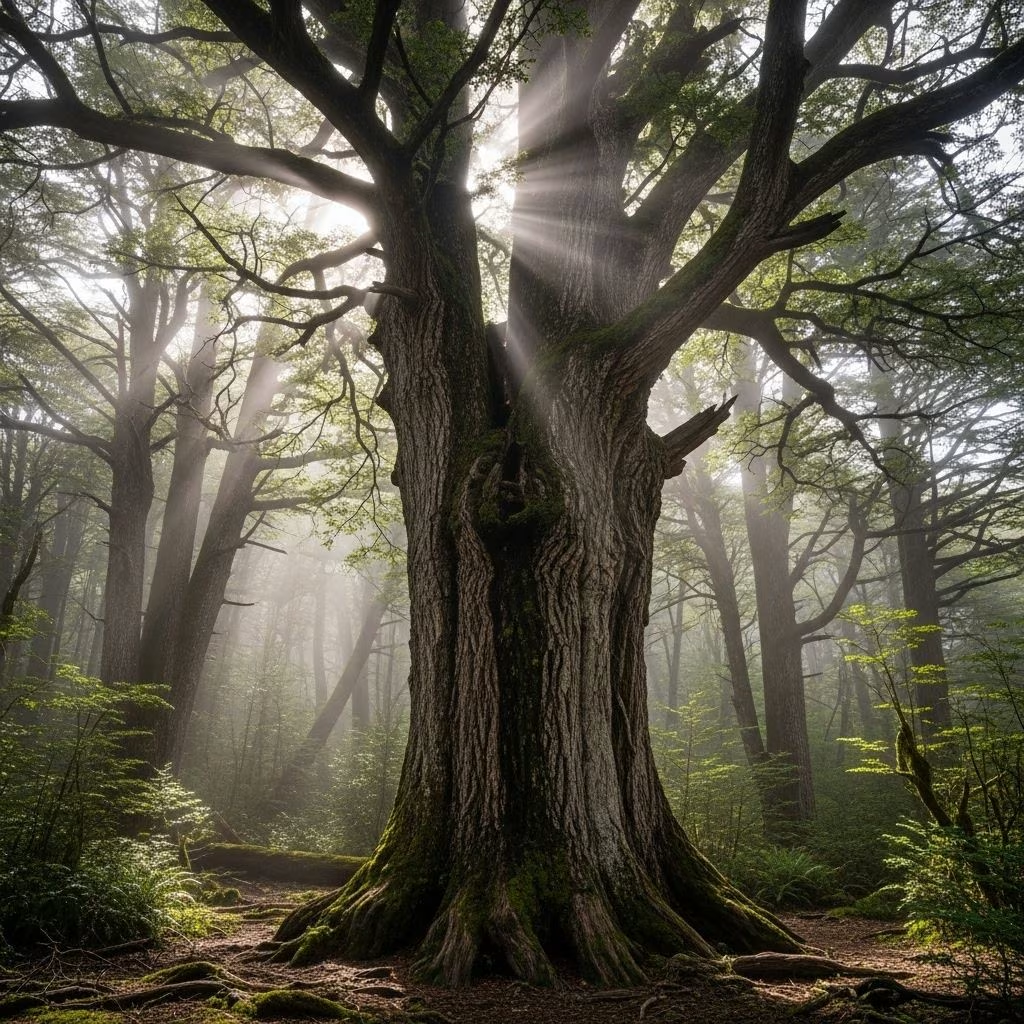
Chile’s Ancient Giant: The Search for the World’s Oldest Tree
The forests of Chile’s Alerce Costero National Park are home to a botanical marvel that could rewrite the record books: the Alerce Milenario, or “Great Grandfather” tree (Fitzroya cupressoides), may be the oldest living tree on Earth, with researchers estimating it could be over 5,000 years old. If confirmed, this venerable giant would surpass California’s famed Methuselah, a bristlecone pine, as the planet’s most ancient—and still living—witness to millennia of climatic changes.
The Discovery and Significance of the Alerce Milenario
Discovered by park warden Anibal Henriquez in 1972 and kept confidential to protect it from exploitation, the Alerce Milenario has only recently emerged as a global sensation. Unlike Methuselah, whose exact location remains a secret, Chile’s ancient sentinel has become a pilgrimage site for tourists and scientists alike, eager to stand in the shadow of life that has endured for five millennia.
The tree’s official visitor numbers are now around 10,000 a year, with many hoping to glimpse a living relic of Earth’s distant past. However, this attention also poses a serious threat to the tree’s survival, as foot traffic damages the fragile root system—the source of most of the tree’s remaining living tissue.
The Science Behind the Age Estimate
The astonishing claim that the Alerce Milenario might be over 5,000 years old comes from the research of Jonathan Barichivich, a Chilean environmental scientist. Barichivich used an increment borer—a tool that extracts a thin cylinder of wood without harming the tree—to retrieve a sample in 2020.
- Methodology: The sample contained 2,400 visible growth rings, but full counting was not possible due to the tree’s partially dead and hollow trunk. Barichivich combined this partial ring count with statistical methods to estimate the tree’s total age, concluding there’s an 80% probability it is 5,484 years old.
- Skepticism and Debate: The scientific community remains divided. Some, like Harald Bugmann of ETH Zürich, praise Barichivich’s innovative approach, while others, including Nathan Stephenson and Ed Cook, stress the need for full ring counts and peer-reviewed publication.
A Living Record of Earth’s History
The Alerce Milenario is not just a contender for a world record—it is a living archive. Each growth ring encodes information about historical rainfall, temperature, and atmospheric conditions, offering scientists a rare window into millennia of environmental change.
| Feature | Alerce Milenario | Methuselah (Bristlecone Pine) |
|---|---|---|
| Location | Alerce Costero National Park, Chile | White Mountains, California, USA |
| Species | Fitzroya cupressoides (Patagonian cypress) | Pinus longaeva (Great Basin bristlecone pine) |
| Estimated Age | Over 5,000 years | 4,850 years |
| Height | 28 meters | Approx. 12–15 meters |
| Diameter | 4 meters | Approx. 2 meters |
| Public Access | Yes, regulated | Location kept secret |
Ecology and Conservation
The Patagonian cypress (Fitzroya cupressoides), to which the Alerce Milenario belongs, is the largest tree species in South America and is endemic to the continent’s southern reaches. The species is threatened by logging and climate change, but the Alerce Costero National Park protects this ancient specimen and its forest habitat.
However, the tree’s health is precarious. “Only 28 percent of the tree is actually alive, most of which is in the roots,” Barichivich notes. As visitors tread near the trunk, they risk damaging its last living parts, prompting park authorities to increase monitoring and regulate access.
Why the Search for the Oldest Tree Matters
Ancient trees like the Alerce Milenario are more than botanical curiosities—they are invaluable repositories of ecological and climatic data, offering insights into how life adapts to environmental upheaval over extraordinary time spans. These “chronological sentinels” help researchers reconstruct past climates, predict future changes, and assess the impacts of human activity on forest ecosystems.
Moreover, their existence challenges us to reconsider our relationship with nature: to recognize both the fragility and resilience of life, and to act as stewards of these living monuments.
Frequently Asked Questions
Q: What is the Alerce Milenario?
A: The Alerce Milenario (“Millennial Larch”), also known as Gran Abuelo (“Great Grandfather”), is a massive Fitzroya cupressoides tree in Chile’s Alerce Costero National Park. It is the largest tree in Chile and may be the oldest living tree in the world, with estimates exceeding 5,000 years.
Q: How was the tree’s age estimated?
A: Scientists used an increment borer to extract a wood sample and counted 2,400 growth rings. Using statistical modeling based on growth rates and comparisons with other trees, they estimate the tree is over 5,000 years old, though this method is debated among dendrochronologists.
Q: Why is its location not kept secret like Methuselah?
A: The tree’s location in a national park means it is a significant natural monument and tourist attraction. Access is regulated to protect the tree, but complete secrecy is not possible due to its size and fame.
Q: How is the tree being protected?
A: Increased park ranger presence and visitor regulation aim to minimize damage from tourism. The park emphasizes that most of the tree’s living tissues are in the roots, which are especially vulnerable to soil compaction and trampling.
Looking Ahead: Conservation, Science, and Hope
The story of the Alerce Milenario is a reminder of the extraordinary resilience of nature—and the urgent need to protect it. While scientists debate the precise age of this ancient giant, its symbolic and ecological significance is undeniable. As Jonathan Barichivich prepares to publish his full findings, the world watches, waiting to see if Chile’s “Great Grandfather” will officially become the planet’s oldest living tree.
For now, the Alerce Milenario stands as a living bridge between the ancient past and an uncertain future—a silent witness, a scientific treasure, and a call to conservation for generations to come.


